
Oregon Study: Solar Shade Reduces Grass Volume but Maintains Lamb Growth via Higher Nutrient Density
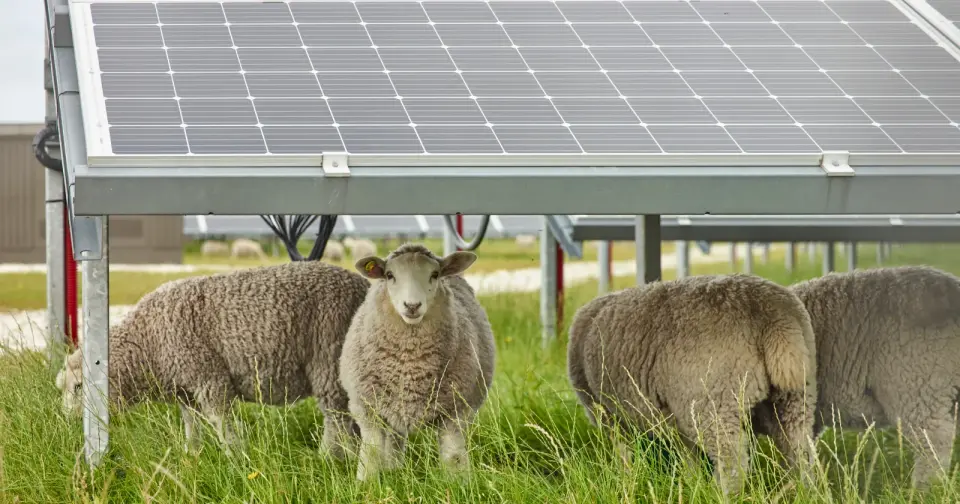
A two-year experiment at Oregon State University found that lambs grazing under solar panels gained the same weight as those in open fields, despite having 38% less grass. The shaded pasture produced lower biomass but higher protein and digestibility, allowing animals to extract equivalent nutrition from less material. This suggests solar farms can support livestock without compromising agricultural yield.
Key points
- Lambs under solar panels gained 120g/day in 2019 and 89g/day in 2020, statistically identical to open-field counterparts.
- Shaded pastures produced 38% less forage biomass but had higher nutritive quality, including more protein and digestibility.
- Grazing returns were nearly identical: $1,046/ha in open fields vs. $1,029/ha under panels, a difference of less than 2%.
- Shade reduced heat stress, with open-field lambs drinking nearly 0.75 liters more water per day in hot weeks.
- The study, published in Frontiers in Sustainable Food Systems, is the first to measure livestock production under a working solar array.
Background
This finding aligns with broader agrivoltaics research, including recent developments in breeding heat-resistant livestock for solar sites and efforts to optimize land use for dual energy and food production. While previous studies focused on crop yields or specific animal breeds, this experiment provides direct evidence that ruminants can thrive under solar infrastructure without significant loss in productivity.
Why it matters
The results challenge the assumption that solar installation on farmland inevitably reduces agricultural value. By demonstrating that livestock production remains stable despite lower biomass, the study supports the economic viability of agrivoltaics, where land generates both energy and food revenue. This could alleviate land-use conflicts between energy developers and farmers, particularly in regions like the Pacific Northwest where summer heat and moisture retention under panels can offset seasonal deficits.
What to watch
Researchers and landowners may expand agrivoltaic projects, integrating livestock grazing into solar farm designs to maximize land utility. Further studies may explore how seasonal variations in shade affect pasture quality and animal behavior, as well as the long-term sustainability of combining energy generation with animal husbandry.
Want the full story? Read the original reporting
Read on Space Daily