
Twin Study Finds Shared Genetics, Not Just Screens, Drive Youth Mental Health Links
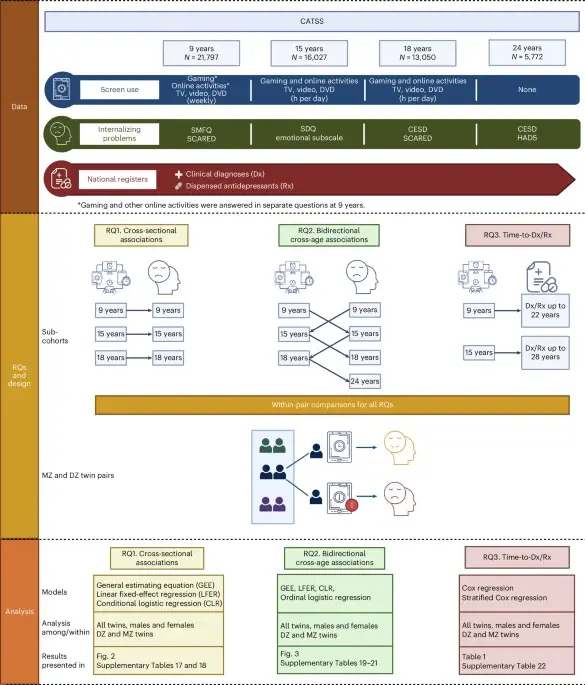
A massive longitudinal study of 21,797 Swedish twins finds that while heavy recreational screen use correlates with depression and anxiety, these links largely disappear when comparing twins raised in the same household. This suggests shared genetic and familial factors, rather than screen time itself, explain much of the association. However, heavy interactive use at age 15 still showed a residual link to later clinical diagnoses, indicating a complex relationship between digital behavior and mental health.
Key points
- The study used the Child and Adolescent Twin Study in Sweden (CATSS), tracking twins from ages 9 to 24.
- In the full cohort, heavy interactive screen use (>6 hours/day) was associated with higher internalizing symptoms, especially in girls.
- When comparing discordant twin pairs (one heavy user, one light user), the associations were substantially attenuated or became statistically insignificant.
- Passive screen use (TV watching) showed little to no link with mental health outcomes, while interactive use (gaming, browsing) showed stronger initial links.
- Heavy interactive use at age 15 was linked to a higher risk of clinical depression or anxiety diagnosis by late 20s, but this risk dropped significantly in twin comparisons.
- The study found a bidirectional link: earlier symptoms predicted later heavy screen use, suggesting a two-way relationship.
Background
Previous research, including a September 2026 study on older adults, has linked heavy screen consumption to cognitive decline and psychological harm. Public health agencies worldwide have issued guidelines limiting youth screen time based on observational data, but these guidelines have faced debate over their causal basis. This new study provides a more rigorous, quasi-experimental approach to testing causality by controlling for shared familial and genetic factors, addressing a key gap in prior observational research.
How outlets are covering it
Nature presents the findings as a significant attenuation of the screen-mental health link when controlling for shared factors, suggesting that the association is largely confounded by genetics and family environment. However, Nature notes that heavy interactive use still showed a residual link to clinical diagnoses, highlighting the need for further mechanistic research. StudyFinds emphasizes the practical implication that blaming screens alone for the teen mental health crisis is an oversimplification, pointing to a 'messier reality' involving genes and pre-existing struggles. Both sources agree that the twin design provides a more reliable picture than standard surveys, but they differ in emphasis: Nature focuses on the statistical attenuation and the remaining clinical risk, while StudyFinds focuses on the broader narrative that screens are not the sole cause of youth mental health issues.
Why it matters
This study challenges the prevailing narrative that screen time is a primary driver of youth mental health crises. By demonstrating that shared familial and genetic factors explain much of the observed association, it suggests that public health interventions focused solely on limiting screen time may be insufficient. Instead, policies and parental strategies should consider the broader context of family environment, genetic predisposition, and pre-existing mental health issues. The finding that heavy interactive use still carries a residual clinical risk indicates that while screens are not the sole cause, they may still play a role in exacerbating vulnerabilities, necessitating a more nuanced approach to digital health guidelines.
What to watch
Future research should focus on understanding the specific mechanisms linking digital behaviors to mental health, particularly for heavy interactive use. Researchers will need to explore how individual vulnerabilities, sex, and developmental stages interact with screen use. Additionally, there is a need for evidence-based guidance that accounts for the complex interplay of genetic, familial, and environmental factors, rather than relying solely on screen time limits. The study also highlights the need for better measurement of screen use, as current broad categories may not capture the nuances of digital behavior.
- Recreational screen use and internalizing problems from preadolescence to young adulthood in a longitudinal twin cohort with co-twin comparison Nature
- Genes And Family, Not Just Phones, May Drive The Teen Screen-Depression Link StudyFinds
- Twin study suggests screen time's link to mental health may be overstated Medical Xpress
Want the full story? Read the original reporting
Read on Nature