
AI maps obesity-driven, body-wide cellular changes in mice with a three-part neural-immune-tissue framework
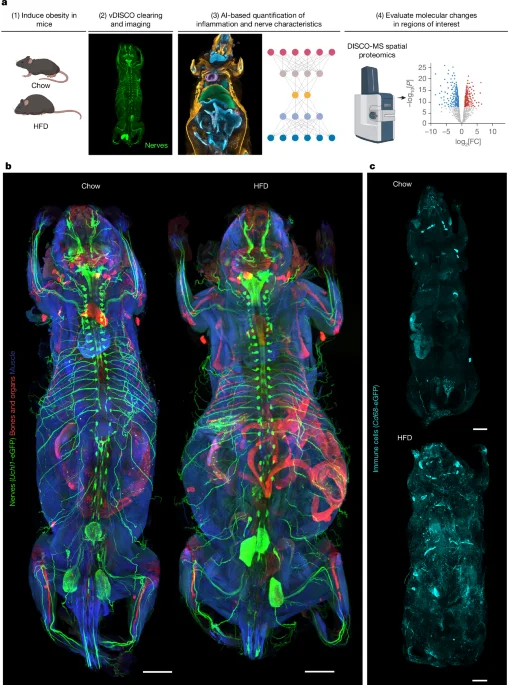
A new AI suite called MouseMapper uses foundation-model–based 3D imaging to automatically segment nerves, immune cells, and 31 organs across an entire mouse body, enabling multi-system analyses of obesity. Built on VesselFM, it comprises a Nerve-Module, Immune-Module, and Tissue-Module that generalize across imaging resolutions and labeling strategies. In diet-induced obesity, the framework reveals reduced whole-body nerve density, increased nerve presence in adipose tissue, and notable infraorbital nerve remodeling in the trigeminal nerve linked to sensory deficits. Spatial proteomics of the trigeminal ganglion shows actin cytoskeleton and inflammation pathway changes, conserved in obese humans. Additionally, MouseMapper generates whole-body inflammation maps by profiling Cd68+ immune-cell clusters across tissues, illustrating systemic, organ-wide perturbations and offering a scalable bridge from cell-level changes to whole-body disease phenotypes.
- A deep-learning framework reveals whole-body perturbations at cell level Nature
- New AI framework maps systemic obesity damage at cellular resolution News-Medical
- Deep Learning Uncovers Cell-Level Whole-Body Changes Bioengineer.org
- AI-Powered Atlas Uncovers Extensive Whole-Body Damage Linked to Obesity Bioengineer.org
- AI atlas reveals hidden whole-body-damage caused by obesity EurekAlert!
Reading Insights
1
44
83 min
vs 84 min read
99%
16,665 → 122 words
Want the full story? Read the original article
Read on Nature