
Early-morning 4.4-magnitude quake near Commerce shakes Southern California with no reported damage
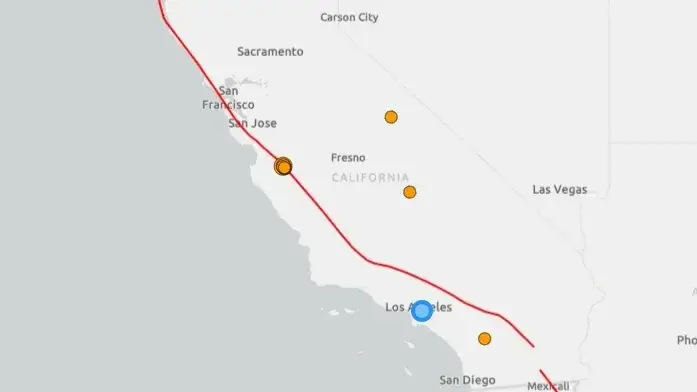
A magnitude 4.4 earthquake struck near Commerce, California, at 3:25 a.m. PT on November 20, 2026. The U.S. Geological Survey (USGS) initially rated the tremor at 4.2 before upgrading it. The quake was felt across the Los Angeles basin, including Pasadena, Riverside, and Koreatown. The Los Angeles Fire Department (LAFD) activated its earthquake response protocol, surveying critical infrastructure across its 470-square-mile jurisdiction. No injuries or significant structural damage were reported. Mayor Karen Bass confirmed no operational impacts at Los Angeles International Airport (LAX).
Key points
- The earthquake occurred at 3:25 a.m. PT with an epicenter approximately 1 mile northwest of Commerce, at a depth of 10.6 miles (USA Today) or 16 kilometers (KTLA).
- USGS initially reported a magnitude of 4.2, later upgrading it to 4.4 (ABC7, Los Angeles Times).
- Over 7,500 people reported feeling the shaking within the first hour (USA Today).
- LAFD entered 'earthquake mode,' deploying personnel from all 106 neighborhood fire stations to survey infrastructure by land, air, and sea (KTLA, Los Angeles Times).
- The assessment concluded by approximately 5:30 a.m. with no reported damage or injuries (KTLA).
- Mayor Karen Bass stated there were no operational impacts, including at LAX (KTLA, ABC7).
Background
This event follows a recent atmospheric river that brought heavy rain and flood risks to Southern California in late November 2026. California’s seismic activity is driven by the movement of the Pacific and North American tectonic plates, with the San Andreas Fault being the most prominent boundary. While earthquakes cannot be predicted, California has an early warning system that provides seconds of notice before strong shaking arrives. The quake occurred near the San Andreas Fault system, which has not experienced a major rupture in some sections since the 17th century, though experts caution that this does not mean a quake is 'overdue.'
How outlets are covering it
Outlets initially reported varying magnitudes, with USGS first listing 4.2 before upgrading to 4.4. KTLA and ABC7 emphasized the initial 4.2 rating before the upgrade, while USA Today and the Los Angeles Times focused on the final 4.4 magnitude. All sources agreed on the lack of damage and injuries. USA Today provided broader context on California’s tectonic activity and the San Andreas Fault, while KTLA and ABC7 focused on immediate local impacts and official responses. The Los Angeles Times highlighted resident reactions and the wide geographic reach of the shaking.
Why it matters
The quake highlights the ongoing seismic risk in Southern California, where hundreds of active faults exist. Although this event caused no damage, it underscores the importance of preparedness and the functionality of emergency response protocols. The lack of damage is reassuring, but experts note that a major San Andreas earthquake could have severe consequences for infrastructure, including water systems, and affect millions of people.
What to watch
Residents are advised to remain prepared for possible aftershocks. The USGS encourages people who felt the quake to submit reports via its 'Did You Feel It?' system to help assess intensity. No further major earthquakes are predicted, but monitoring continues. The LAFD has concluded its survey, and normal operations have resumed.
- Earthquake rattles Los Angeles area before dawn USA Today
- Magnitude 4.2 earthquake rocks Los Angeles County KTLA
- Magnitude 4.2 earthquake strikes Commerce area, awakens residents across Southern California ABC7 Los Angeles
- L.A. rattled by magnitude 4.2 earthquake felt over a wide area Los Angeles Times
- Magnitude 4.4 earthquake hits near downtown Los Angeles ABC News - Breaking News, Latest News and Videos
Want the full story? Read the original reporting
Read on USA Today