
Judge releases California man who drove guillotine to D.C. Supreme Court
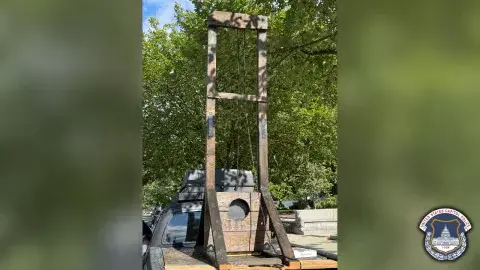
A federal judge released Philan-Tam-Duy Le, a 35-year-old from California, after he was arrested for transporting a guillotine in a pickup truck near the U.S. Supreme Court. Le pleaded not guilty to a misdemeanor charge of attempted possession of a prohibited weapon. While federal prosecutors argued for his continued detention, the judge cited his lack of criminal history and cooperation. Le’s father claims the device was a symbolic protest against political figures, though Le told police it was the 'real deal.'
Key points
- Le was arrested by U.S. Capitol Police on Tuesday after officers found a guillotine in the bed of his illegally parked truck near the Supreme Court.
- He faces a misdemeanor charge for attempted possession of a prohibited weapon and pleaded not guilty at his arraignment.
- The judge released Le with pretrial conditions, rejecting the prosecution’s request to keep him in jail.
- Le’s father stated the guillotine was built over three months as a political demonstration, not a threat of violence.
- Le had announced his trip to Washington, D.C., on social media, expressing frustration with unelected officials and international conflicts.
Background
This incident follows a pattern of unusual protests and public safety concerns in Washington, D.C., where individuals have used symbolic actions to draw attention to political grievances. The archive notes similar high-profile arrests involving unusual items or actions near federal buildings, highlighting ongoing tensions between public expression and security protocols.
How outlets are covering it
The Washington Post and NBC4 Washington emphasize the legal proceedings and the judge’s decision to release Le, noting his lack of criminal history. NBC 7 San Diego focuses on the family’s perspective, describing the guillotine as a symbolic protest and highlighting Le’s political views. The New York Times provides a factual account of the arrest and the police response. Outlets differ in emphasis: some focus on the legal outcome, while others highlight the protest motive and family statements.
Why it matters
The case raises questions about the boundaries of symbolic protest and public safety in Washington, D.C. It also highlights the legal process for individuals arrested for unusual actions near federal buildings, and the role of judges in balancing public safety with individual rights.
What to watch
Le’s next court hearing is scheduled for September. Prosecutors may appeal the release or seek additional charges if new evidence emerges. The guillotine and Le’s truck remain impounded pending further investigation.
- Judge releases man accused of driving guillotine to Supreme Court The Washington Post
- Man Accused of Bringing Guillotine to D.C. Is Arrested The New York Times
- Carlsbad man charged after bringing guillotine to Library of Congress NBC 7 San Diego
- California man arrested with guillotine near U.S. Capitol NBC4 Washington
- US Capitol Police arrest driver with a guillotine in truck bed by the US Capitol building WUSA9
Want the full story? Read the original reporting
Read on The Washington Post