
US and Venezuela sign military pact as Hegseth frames Maduro’s capture as 'liberation'
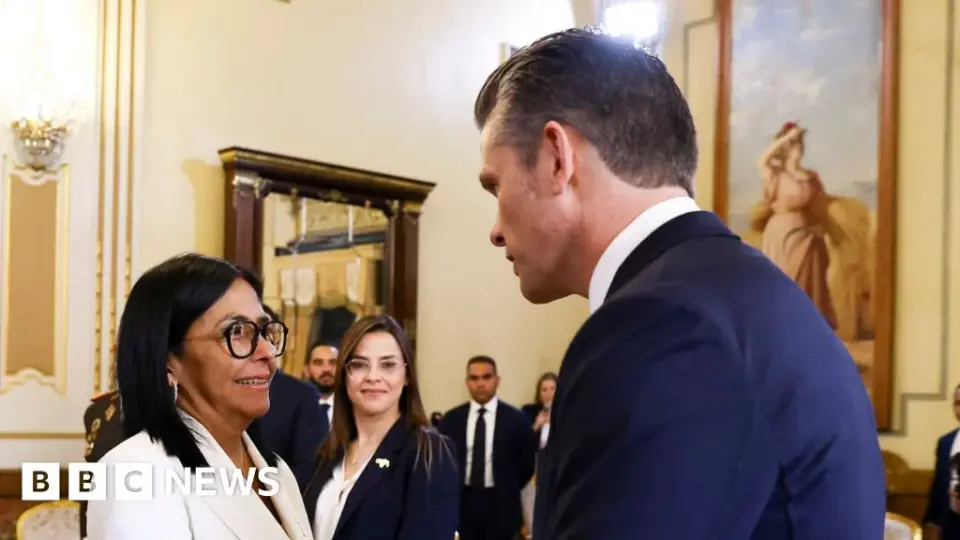
The US and Venezuela signed a military cooperation agreement on November 18, re-establishing ties severed in 2005. Defense Secretary Pete Hegseth described the interim government as a 'compliant security partner,' while critics view the move as a consolidation of US control over Venezuelan oil and sovereignty.
Key points
- US Secretary of Defense Pete Hegseth and Venezuelan Defense Minister Gustavo González López signed a military cooperation agreement on November 18, less than a year after US forces captured President Nicolás Maduro in January 2026.
- Interim President Delcy Rodríguez, Maduro’s former vice-president, stated the deal aims to confront 'common threats' and improve operational equipment, though specific details of the agreement remain undisclosed.
- Hegseth characterized the shift from an 'aggressive regional threat' to a 'compliant security partner' as historic, referencing the January 3 raid that seized Maduro, who is currently in US custody facing drug trafficking and torture charges.
- The agreement includes joint training and intelligence sharing, with Hegseth warning that the US will 'hunt down' and 'kill' narco-terrorists operating in Venezuela, a stance criticized by Venezuelan journalists as an assertion of US operational sovereignty.
- Hegseth subsequently traveled to Colombia to discuss security ties, where President Abelardo de la Espriella denied reports of rejecting joint US-Colombian military operations, citing constitutional constraints on foreign forces.
Background
Military ties between the US and Venezuela were terminated in 2005 by Hugo Chávez, who accused US personnel of conspiring against his government. Relations deteriorated further under Nicolás Maduro, culminating in a US military raid on January 3, 2026, that captured Maduro and his wife, Cilia Flores. Since the capture, interim President Delcy Rodríguez has aligned with Washington, releasing political prisoners and facilitating US oil investments, including a recent deal with ExxonMobil. The current agreement follows a broader US strategy to bolster security cooperation in Latin America against designated terrorist organizations, despite recent setbacks in Brazil.
How outlets are covering it
US officials, including Hegseth, frame the agreement as a successful transition from conflict to partnership, emphasizing security cooperation and the stabilization of the region. Hegseth explicitly labeled the January raid a 'day of liberation' and described Venezuela as a 'compliant security partner.' In contrast, Venezuelan critics and journalists, such as Luz Mely Reyes, characterize the visit as a 'humiliating act of genuflection' that undermines national sovereignty, arguing that the US now directly administers Venezuelan policy. CNN notes that while the US seeks to deepen cooperation, Colombia has expressed constitutional limits on joint military operations, highlighting divergent regional responses to US security initiatives. The Guardian emphasizes the 'improbable rapprochement' between Washington and the Chavista regime, noting that Rodríguez’s government has met nearly all US demands despite her previous anti-imperialist stance.
Why it matters
The agreement signals a fundamental shift in US-Latin American security dynamics, potentially setting a precedent for US military influence in the region. It raises questions about the sovereignty of nations that align with US interests following coercive interventions, and it underscores the tension between security cooperation and democratic governance in the Western Hemisphere.
What to watch
The US and Venezuela are expected to implement joint training and intelligence sharing, with Hegseth continuing his Latin American tour to Ecuador and Honduras. The outcome of the Maduro trial, scheduled for June 2027, and the potential for further US military presence in Venezuela remain key developments. Colombia’s response to US pressure for joint operations will also be monitored, as it tests the limits of regional sovereignty in the face of US security demands.
- Venezuela signs military deal with US less than a year after Maduro's removal BBC
- Venezuela a ‘compliant security partner,’ Hegseth says as he announces military deal with Caracas CNN
- Hegseth, in Caracas, announces US-Venezuela military partnership agreement Reuters
- Hegseth Cements New Military Deal in Visit to Venezuela WSJ
- Hegseth uses Venezuela visit to boast of Maduro’s capture by US military The Guardian
Want the full story? Read the original reporting
Read on BBC