
US Grants Visas to Iranian Leaders for UN Summit Amid Ongoing War
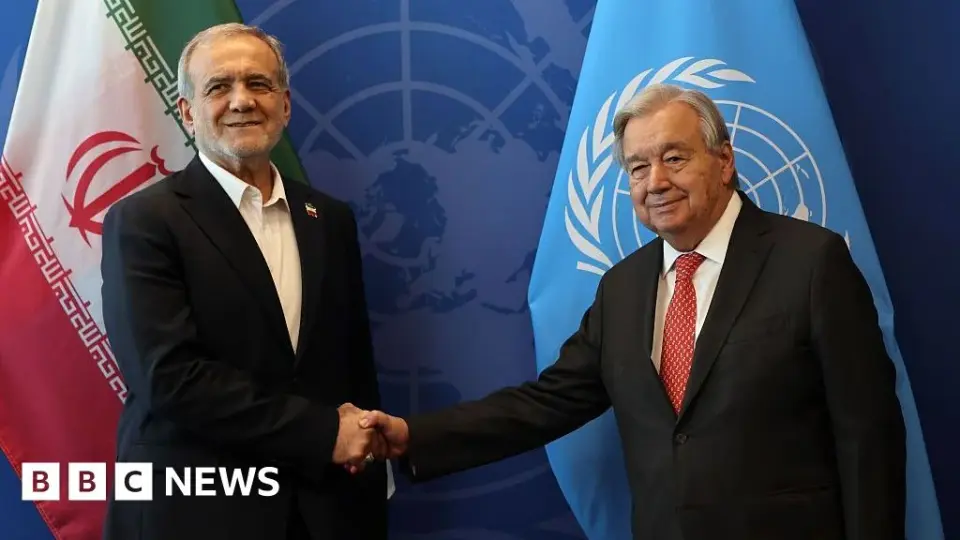
The US State Department has approved visas for a core Iranian delegation, including President Masoud Pezeshkian and Foreign Minister Abbas Araghchi, to attend the UN General Assembly in New York next week. This decision comes as the US-Iran war enters its seventh month, with the conflict having expanded into neighboring countries and driven up global energy prices. While the US cites host country obligations, it has imposed strict travel restrictions and bans on the purchase of luxury goods, citing Iranian domestic suffering. The move contrasts with the continued denial of visas to Palestinian Authority President Mahmoud Abbas, highlighting selective diplomatic engagement during active hostilities.
Key points
- The US has granted visas to Iranian President Masoud Pezeshkian and Foreign Minister Abbas Araghchi for the UN General Assembly High Level Week, which begins next week.
- The delegation is smaller than last year's and will face travel restrictions, including bans on purchasing luxury goods, wholesale club memberships, and certain American products.
- State Department spokesperson Tommy Pigott stated the restrictions aim to prevent Iranian elites from exploiting the visit for shopping while the Iranian people face water shortages, repression, and inflation.
- The visa approval occurs seven months after the US and Israel launched joint attacks on Iran in February, a conflict that has expanded into neighboring countries and impacted global energy markets.
- The US has simultaneously denied visas to Palestinian Authority President Mahmoud Abbas for the second consecutive year, citing the organization's efforts to internationalize the Israeli-Palestinian conflict.
Background
This development follows earlier tensions at the G20 finance ministers meeting in August, where the US and Iran exchanged attacks after a brief lull, including US strikes on Lark Island and Iranian retaliation against bases in Jordan and the UAE. The current visa decision reflects a cautious diplomatic posture during a period of heightened hostility, as the US balances host country obligations with ongoing military operations in the Strait of Hormuz, a waterway through which 20% of the world's oil flowed before the war.
How outlets are covering it
BBC and NBC News both confirm the visa approval and the imposition of travel and purchasing restrictions, but NBC News provides additional context on the ongoing military tensions, noting that the US struck five Iranian tankers linked to the Islamic Revolutionary Guard Corps last week in response to attacks on an American warship. NBC also highlights President Trump's recent comments about potentially resuming full-scale attacks against Iran, adding a layer of military uncertainty to the diplomatic engagement. Both outlets agree on the core facts but differ in emphasis: BBC focuses on the humanitarian justification for the restrictions, while NBC emphasizes the broader military and geopolitical context, including the Strait of Hormuz conflict and Trump's decision-making process.
Why it matters
The visa approval signals a limited diplomatic channel between the US and Iran despite active warfare, potentially influencing global energy markets and regional stability. The selective nature of the visa policy—allowing Iranian leaders while barring Palestinian Authority officials—highlights the US's strategic priorities and may affect international perceptions of US neutrality in the Middle East. The restrictions on luxury goods also reflect a broader US policy of linking economic sanctions to humanitarian concerns, which could set a precedent for future diplomatic engagements with sanctioned nations.
What to watch
The UN General Assembly General Debate is scheduled to begin on Tuesday, with President Trump, UK Prime Minister Andy Burnham, and French President Emmanuel Macron expected to speak. Iranian President Pezeshkian is scheduled to address the assembly on Wednesday. The US is expected to monitor the Iranian delegation's compliance with travel and purchasing restrictions, and any violations could lead to further diplomatic tensions. Additionally, the ongoing military situation in the Strait of Hormuz and Trump's potential decision to resume full-scale attacks against Iran will likely influence the broader diplomatic landscape.
- US to allow Iran delegation to attend UN meetings in New York as war passes half-year mark BBC
- US approves visas for top Iranian leaders to attend UN high-level meeting even with sides at war AP News
- Trump administration grants visas to top Iranian leaders to attend U.N. General Assembly NBC News
- Live updates • Tanker hit by projectile in Strait of Hormuz, U.K. maritime agency says Haaretz
- US Says Iranian Officials May Travel to New York for UN Meetings Bloomberg.com
Want the full story? Read the original reporting
Read on BBC