
Tech CEOs Adopt Trump’s 'Super Intelligence' Rebrand to Secure Federal Favor
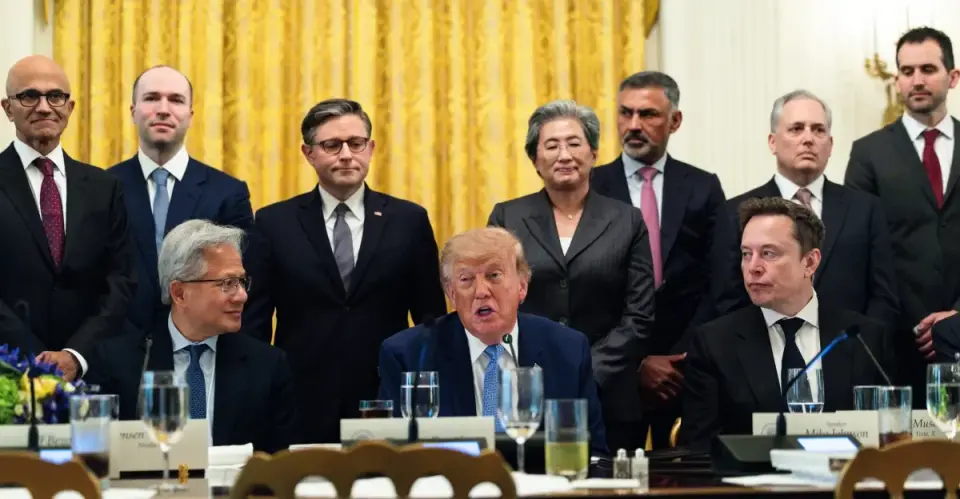
President Trump’s executive order mandating the term 'super intelligence' over 'artificial intelligence' is driving major tech leaders to capitulate. Microsoft CEO Satya Nadella, Nvidia’s Jensen Huang, and others have adopted the new terminology in public statements and corporate branding. This shift follows a broader pattern of Silicon Valley ingratiation with the administration to secure favorable regulatory treatment and federal contracts.
Key points
- Microsoft CEO Satya Nadella recently used 'super intelligence' in a post advocating for safety mechanisms, marking the latest major adoption of the term.
- Elon Musk announced plans to rename SpaceXAI to SpaceXSI, while Salesforce rebranded its AIForce division to SIForce.
- Nvidia committed $1 billion to 'super intelligence research' as part of a broader scientific advancement pledge.
- Trump declared that using the term 'artificial intelligence' marks one as 'THE ENEMY' of the White House.
- The rebranding effort follows an executive order requiring federal agencies to use the new terminology.
Background
This development follows a series of recent actions by the Trump administration to reshape AI policy, including the launch of an 'AI Force' and the appointment of an AI czar. In late September, Trump hosted a summit where he awarded national medals to tech executives, including Musk and Huang, while simultaneously suspending Microsoft from the H-1B visa program. The administration has also pushed for light-touch regulation, a stance championed by adviser David Sacks, contrasting with growing calls for stricter oversight from safety advocates.
How outlets are covering it
The Verge frames the shift as a capitulation by Silicon Valley leaders to Trump’s demands, noting that figures like Musk, Benioff, Huang, and Nadella have aligned with the administration’s preferred terminology. CNN highlights the semantic and academic distinction, noting that 'superintelligence' is a specific theoretical concept distinct from general AI, and questions whether the rebrand will effectively change public opinion. AP News and MS NOW emphasize the economic leverage at play, pointing to billions in federal contracts and regulatory dependencies that incentivize compliance. MS NOW specifically notes that the Anthropic case, where the Pentagon labeled the company a supply-chain risk, serves as a cautionary tale for other tech firms regarding the consequences of defying the administration.
Why it matters
The adoption of 'super intelligence' by major tech companies signals a significant shift in how the industry engages with federal policy. It suggests that corporate leaders are prioritizing regulatory favor and contract security over established terminology, potentially influencing public perception and future regulatory frameworks. This dynamic may set a precedent for how other policy disputes are resolved through corporate compliance rather than legal or public debate.
What to watch
Watch for further adoption of the 'super intelligence' terminology in corporate communications and federal documents. Monitor any potential backlash from the public or academic communities who view the term as misleading. Observe whether the rebranding leads to any tangible changes in AI regulation or public opinion, as predicted by industry leaders like Sam Altman.
- Silicon Valley is falling in line with Trump’s attempt to rename AI The Verge
- Trump really wants to make ‘super intelligence’ happen. Is it going to happen? CNN
- In Silicon Valley, AI founders cheer Trump’s calls for the industry to police itself on safety AP News
- Opinion | There’s a reason billionaires keep bending the knee to Trump MS NOW
- Trump decrees that anyone who uses the term Artificial Intelligence is now ‘The Enemy!’ The Independent
Want the full story? Read the original reporting
Read on The Verge