
2026 Midterms: Black Voter Surge and Candidate Failures Drive Historic Democratic Wave
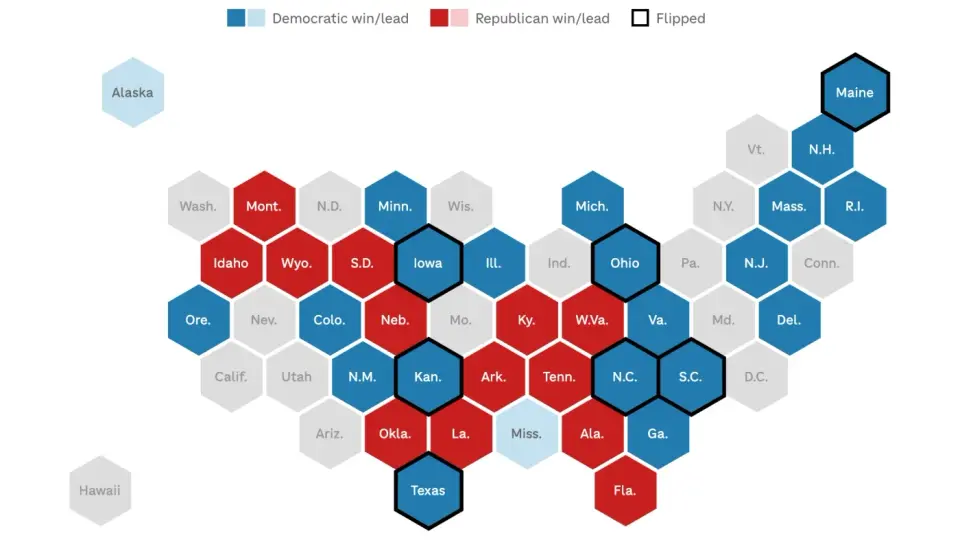
Democrats achieved a historic sweep in the 2026 midterms, flipping Senate seats in Texas, South Carolina, and North Carolina. Keisha Lance Bottoms became the first Black woman governor, while GOP redistricting efforts failed. Analysts attribute the shift to high Black voter turnout and poor candidate choices by Republicans.
Key points
- Democrats flipped Senate seats in Texas, South Carolina, North Carolina, and Maine, securing control of the chamber.
- Keisha Lance Bottoms won the Georgia governorship, becoming the first Black woman to hold the office.
- Black voter turnout surged in the South, particularly in Louisiana and Georgia, driving Democratic victories.
- Republican-led redistricting in Alabama, North Carolina, and Texas failed to secure expected seats.
- Mississippi’s Senate race remains too close to call, with Democrat Scott Colom leading by fewer than 1,200 votes.
Background
Prior to the election, Republicans anticipated expanding their majority, relying on redistricting and incumbent strength. However, a Supreme Court ruling earlier in 2026 weakened the Voting Rights Act, prompting states to redraw maps. Pre-election polling indicated rising Black voter engagement due to economic concerns and opposition to the Trump administration. Our archive noted that defections from former Trump supporters in Georgia were a critical factor in the state's shift.
How outlets are covering it
NPR emphasizes the role of Black voter turnout and the failure of Republican redistricting, framing the results as a 'blue tsunami' driven by demographic shifts. Axios highlights the collapse of the GOP 'red wall,' noting that Republicans lost or trailed in every toss-up, including in the home states of party leaders. The Washington Stand focuses on candidate quality, arguing that poor choices by the party, such as Ken Paxton in Texas and Darline Graham in South Carolina, led to 'negative coattails' that dragged down other Republican candidates. While NPR and Axios focus on structural and demographic factors, The Washington Stand attributes the losses to specific candidate failures and ticket-splitting.
Why it matters
The 2026 midterms fundamentally altered the political landscape, ensuring that future power struggles for both parties will center on the South. The Democratic gains in Texas, Florida, Georgia, and North Carolina represent over a third of the electoral votes needed to win the presidency, making these states pivotal for the 2028 cycle. The results also signal a potential shift in voter priorities, with economic concerns and candidate quality outweighing partisan loyalty in many districts.
What to watch
Republicans will likely face internal debates over party strategy and candidate selection, while Democrats will consolidate their new majorities. The outcome of the Mississippi Senate race and other close contests will determine the final balance of power. Both parties are already investing in the South for the 2028 presidential election, with key figures like Ted Cruz and Pete Buttigieg focusing on these states.
- The South flexes political power in midterms, sets regional influence in 2028 election NPR
- GOP's red wall comes crashing down Axios
- Of Candidates and Coattails The Washington Stand
- The return of the Democratic South? Seth Masket | Substack
- Opinion | The red walls have fallen, even in Texas The Boston Globe
Want the full story? Read the original reporting
Read on NPR