
Democrats Poised for Historic House Majority as Final Polls Shift 12 Races Left
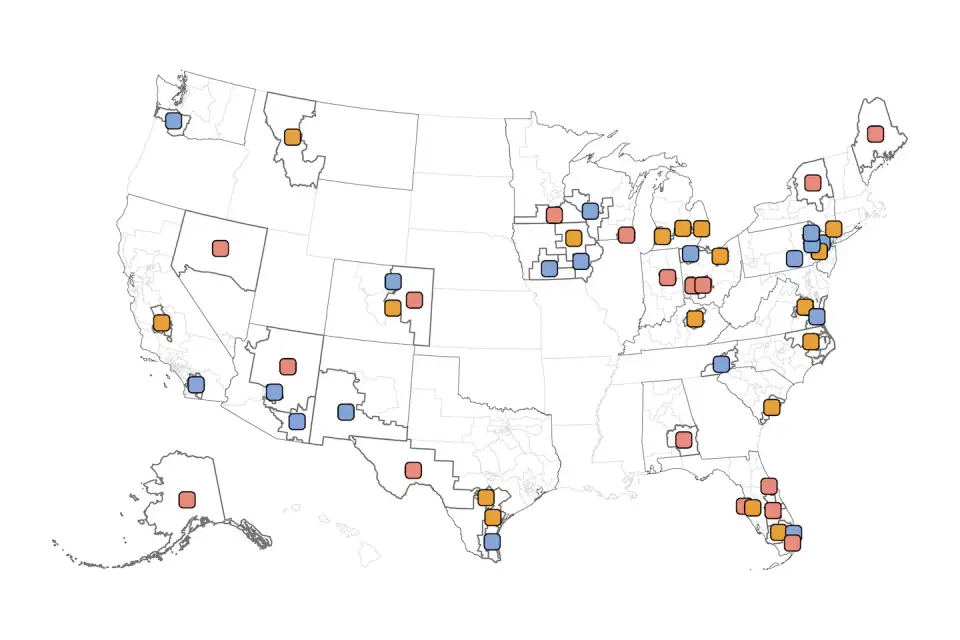
The 2026 midterm election is approaching a decisive Democratic victory in the US House, with the Cook Political Report shifting 12 additional races to the left in the final days. Polling data indicates Democrats could flip between 12 and 25 seats, potentially securing their largest majority since 2009. While prediction markets assign Democrats an 89-93% chance of taking the House, party leaders remain cautious due to historical polling errors and concerns over election integrity. Republican efforts to counter this trend, including heavy spending and presidential rallies in deep-red states, appear ineffective against a national environment driven by low approval ratings for President Trump.
Key points
- The Cook Political Report updated its ratings four days before the election, moving 12 House races toward Democrats, projecting a potential flip of 12 to 25 seats.
- Democrats are projected to win up to 240 seats, surpassing majorities from the 2006 and 2018 cycles but falling short of the 257 seats held after 2009.
- Prediction markets and forecasting sites like VoteHub and Decision Desk assign Democrats an 89% to 93% probability of controlling the House.
- President Trump's approval rating has dropped below 40%, with only 29% approving of his economic handling, driving anti-incumbency sentiment even in deep-red districts.
- Republican concerns include turnout in North Carolina and Pennsylvania, where Democrats are winning statewide races, and the impact of mid-decade redistricting in Southern states.
- Democratic leaders describe their mood as 'nauseously optimistic' due to fears of polling errors and election tampering, despite strong generic ballot leads.
Background
This development follows a period of intense redistricting battles in 2026, where nine states adopted new congressional boundaries affecting 34 million voters. Earlier analyses noted that competitive House districts had shrunk to 37 due to polarization, but economic dissatisfaction has expanded the battlefield. The current shift represents a significant reversal from the 2024 election results, where Republicans won comfortably in many of these same districts.
How outlets are covering it
The Washington Post and Cook Political Report emphasize the structural shift in competitive races, highlighting that heavy Republican spending has failed to move the needle. Axios focuses on the psychological state of Democratic leaders, describing 'guarded optimism' and anxiety over potential election tampering or polling errors. Fox News acknowledges the Democratic advantage in polls but highlights Republican panic, noting Trump's decision to campaign in deep-red states like Kansas and Iowa as a sign of concern. While all sources agree on the Democratic momentum, they differ on the certainty of the outcome, with Axios stressing historical caution and Fox News pointing to specific Republican vulnerabilities in the Senate.
Why it matters
The potential Democratic takeover of the House would mark a significant shift in legislative power, potentially impacting policy agendas and oversight of the executive branch. The scale of the predicted victory, if realized, would be the largest Democratic majority since 2009, signaling a major realignment in voter sentiment. The outcome will also test the resilience of Republican strongholds in the South and Midwest, where redistricting and national trends are colliding. This election result will define the political landscape for the next two years and influence the balance of power in the Senate, where control remains uncertain.
What to watch
Election Day is scheduled for November 3, 2026. Early results from Florida, Virginia, and South Carolina will be critical in determining the final outcome. The Justice Department has filed a lawsuit to delay certification of the Alaska Senate election if the Republican candidate narrowly loses. Analysts will monitor turnout in North Carolina and Pennsylvania, as well as the impact of late-stage spending by Republican super PACs, including a $366 million infusion from Elon Musk. The final seat counts will determine whether Democrats achieve their projected 240-seat majority or if the race remains closer than polls suggest.
- The House races that should raise alarms among Republicans The Washington Post
- Four Days Out, a Dozen More House Races Move Toward Democrats Cook Political Report
- "Nauseously optimistic": Anxious House Democrats brace for midterm Election Day Axios
- SCHOEN, COOPERMAN: Democrats close in as Republicans scramble to hold Congress Fox News
- Blue Wave Likely: 12 Seats Shift Left As Democrats Could Have Largest Majority Since 2009 Forbes
Want the full story? Read the original reporting
Read on The Washington Post