
Massive Voter Fraud Claims Collapse Under Scrutiny, Leaving Few Prosecutions
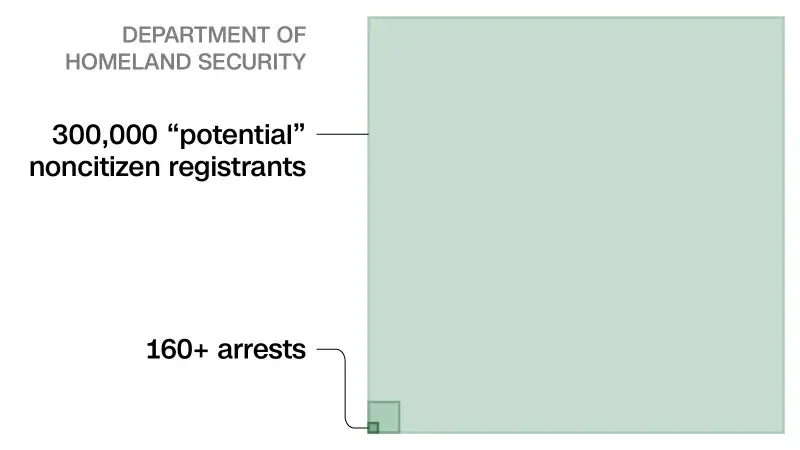
The Trump administration’s aggressive campaign to identify noncitizen voters has resulted in far fewer prosecutions than its initial claims suggested. While officials initially cited hundreds of thousands of potential illegal voters, subsequent investigations and local verification have drastically reduced these numbers. As of mid-September, the Department of Homeland Security (DHS) had opened 1,620 investigations leading to approximately 160 arrests, a fraction of the alleged scale. Critics argue that the administration relies on flawed data-matching systems, such as the expanded SAVE program, which often produce false positives. Legal experts and election officials note that many cases involve accidental registrations or administrative errors rather than intentional fraud, highlighting a significant gap between political rhetoric and judicial outcomes.
Key points
- DHS claims to have found 300,000 potential noncitizens on voter rolls after reviewing over 100 million records, but this number has shrunk significantly upon closer inspection.
- As of mid-September, the effort has resulted in only about 160 arrests, including both criminal and administrative immigration proceedings, despite over 800 DHS employees being involved.
- The Justice Department has brought just 23 criminal cases in California and nine in Texas, with many defendants being legal permanent residents charged with false statements during naturalization rather than voting.
- The expanded SAVE system, which allows states to upload entire voter lists, has produced high initial match numbers that decrease substantially after local verification using state records and passports.
- Critics, including the Bipartisan Policy Center, state that there is no evidence of noncitizen voting at scale, and that initial claims often fall apart when individual cases are investigated.
Background
This development follows a series of escalating tensions between federal authorities and state election officials in the lead-up to the 2026 midterms. Recent reports indicate that the DOJ has threatened California counties with criminal charges for counting ballots from individuals flagged as noncitizens, while also attempting to block certification of the Alaska Senate race due to a 'decoy' candidate strategy. Earlier in the year, the DOJ admitted that DHS used Social Security data in voter probes, a move that raised privacy concerns and led to whistleblower allegations. These actions have prompted Democrats and election chiefs to form task forces and pre-write legal filings to counter potential federal interference, setting the stage for the current debate over the validity of mass voter fraud claims.
How outlets are covering it
The Trump administration and its allies, including DHS Secretary Markwayne Mullin, maintain that noncitizen voting is a widespread issue that is tipping elections, arguing that every illegal ballot cancels a citizen's vote. They emphasize the growing number of arrests and the need for strict enforcement. In contrast, election officials, legal experts, and the Bipartisan Policy Center argue that the administration’s claims are based on flawed data-matching programs and that the actual number of noncitizen voters is negligible. They point out that many cases involve accidental registrations or administrative errors, and that the initial high numbers from systems like SAVE shrink significantly after verification. The Washington Post analysis of 180 cases found that many charges cite honest mistakes rather than organized efforts, further supporting the view that the scale of the problem is overstated. Brookings Institution commentary highlights that while dirty tricks and confusion can occur, institutional safeguards and audits have consistently shown no evidence of widespread fraud, emphasizing the importance of procedural integrity over unsubstantiated claims.
Why it matters
The discrepancy between the administration’s claims and the actual number of prosecutions raises serious questions about the integrity of the electoral process and the use of federal resources. If the data-matching programs are flawed, it could lead to the disenfranchisement of eligible voters and undermine public trust in elections. The legal challenges and threats of prosecution against state election officials could set a precedent for federal interference in state-run elections, potentially impacting the outcome of the 2026 midterms. This situation also highlights the ongoing debate over voter ID, citizenship verification, and the balance between election security and accessibility, with potential long-term implications for democratic participation and the rule of law.
What to watch
The Justice Department and DHS are expected to continue their investigations and prosecutions, with the number of cases likely to grow as the administration claims. State election officials, particularly in Democratic-led states, will likely face increased legal pressure and scrutiny, with potential court battles over the validity of the data-matching programs. The 2026 midterms will be a critical test, with both parties mobilizing volunteers and lawyers to monitor the polls and the count. Legal experts anticipate that courts will play a key role in determining the admissibility of evidence and the legality of federal actions, potentially setting precedents for future elections. Public opinion may shift depending on the outcomes of these legal challenges and the perceived fairness of the electoral process.
- Why Trump’s big claims of voter fraud have yielded so few prosecutions CNN
- Trump officials charged 180 noncitizens with voter fraud. We looked at each case. The Washington Post
- Election fraud is hard. Persuading voters it exists is easy The Seattle Times
- How dirty tricks harm, and institutional safeguards protect, the integrity of US elections Brookings
- Election Fraud Claims Should Meet The Standard We’d Demand In Court Religion Unplugged
Want the full story? Read the original reporting
Read on CNN