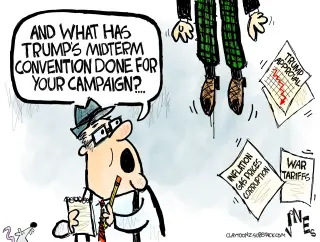
Trump has steered the Republican Party to align with his agenda, highlighted by Ken Paxton's Senate runoff win, but it remains uncertain whether this realignment will translate into Republican victories in the upcoming midterm elections.
A federal three-judge panel blocked Alabama from reusing its 2023 congressional map for the 2026 midterms, ruling it tainted by intentional race-based discrimination and mandating a map with two majority-Black districts; Republicans are likely to appeal to the Supreme Court.
Republicans are racing a shrinking legislative window before the midterms, with key fights over an immigration-enforcement bill and funding for the Trump administration’s anti-weaponization fund, plus the need to extend expiring surveillance authorities by June 12, avoid a October government shutdown, and address Iran war powers. Lawmakers must also reconcile crypto and housing bills, push insulin-price relief, resolve college sports NIL rules, and renew surface transportation and farm bills before deadlines in August and September, all while the House sits for about ten weeks and the Senate only eight before the election.
Trump-era tariffs reduced Canadian visitors to Las Vegas by about 17% last year, helping drive a 7.5% drop in overall tourism in 2025; Democrats are highlighting the Canada-to-Vegas drop in Nevada battleground races, while Republicans point to some early 2026 improvements and other positives like Governor Lombardo. Las Vegas is responding with promotions and marketing to lure back Canadian travelers amid broader inflation and cost‑of‑living concerns.
Newsweek reports Ken Paxton’s chances against incumbent Sen. John Cornyn have surged in the days before the election, while Cornyn’s allies say he would fare better against Democrat James Talarico in November.
A retiring Republican senator warns that if Trump keeps acting as he has, it could jeopardize the GOP’s November prospects, urging party leaders to avoid divisive moves and focus on winning over swing voters.
Trump’s ongoing purge of GOP dissent intensifies after Thomas Massie’s primary defeat, signaling a power move to consolidate loyalty while risking cross-party support and complicating his agenda in a razor-thin Congress; with several high-profile critics still in office, polls showing weak broad support and independents turning away, the strategy could backfire in the upcoming midterms even as Trump’s core base remains ardently behind him.
Trump’s grip on the GOP is uneven: endorsements like Ken Paxton’s upset and pressure on Republicans to fund a White House ballroom are stirring GOP unease, while Democrats gain openings as intra-party feuding surfaces over their own post-2024 autopsy and Colorado backlash; in parallel the administration arranged a $1.776 billion “weaponization” fund to compensate those investigated in Trump-era matters, prompting questions about who will actually benefit, all against a backdrop of ongoing foreign-policy bravado and other distractions as the 2026 midterms loom.
The White House’s push for an $1.8 billion “anti-weaponization” fund and a personal-project agenda has exposed fresh rifts with Senate Republicans, who fear the fight could derail immigration talks and hurt GOP prospects ahead of the November elections. Trump remains defiant, citing recent primary wins and insisting unity, while lawmakers push back, warning the internal battles risk the party’s control of the Senate unless there’s a reset.
Massie’s concession line about having to “find Ed Gallrein in Tel Aviv” underscored how Israel policy and the flood of pro‑Israel money have become a defining, polarized midterm issue, with donors and advocacy groups weighing in across states and races. The piece details broader tensions over Israel in both parties, debates about antisemitism, and surveys showing younger voters questioning broad Israel aid, as AIPAC‑aligned groups pour money into campaigns and candidates navigate a battlefield where opposition to Israel and concerns about Jewish influence shape messaging.
With the 2026 midterms looming, Trump’s aggressive control of the GOP risks widening rifts as lawmakers who cross him are targeted; while party leaders push loyalty, some Republicans warn the focus on revenge campaigns could jeopardize majorities, giving Democrats a more optimistic outlook for November.
President Trump's last‑minute endorsement of Ken Paxton in the Texas Senate primary roiled Republicans, risking higher costs and a tougher path to hold the seat as Paxton heads toward a runoff against Cornyn‑backer James Talarico. Democrats see a potential opening to flip Texas and are ready to spend big, while GOP insiders warn the endorsement could backfire by weakening down‑ballot candidates and accelerating a costly statewide battle. Paxton's long history of controversy and fundraising gaps add to the uncertainty, even as Trump’s loyalty helps Paxton mobilize his base.
With the Memorial Day recess looming, lawmakers from both parties are racing to advance a package of bipartisan bills—ranging from affordable housing and college athletics to cryptocurrency taxation, energy-permitting reform, AI governance, manufacturing, and a reauthorized public lands package—before the midterms. Trump’s push to attach the SAVE Act to these measures threatens their passage, and GOP hard-liners or ballroom-security funding disputes add further obstacles. Yet several lawmakers say they want to make real progress, signaling a concerted push to demonstrate productivity on Capitol Hill.
With a Memorial Day recess and midterm campaigning looming, lawmakers from both parties are trying to push a package of bipartisan bills before the clock runs out—immigration enforcement, housing affordability, college athletics reforms (the SCORE Act), and energy-permitting changes—while also pursuing talks on cryptocurrency regulation, Great American Outdoors Act reauthorization, and other must-pass items like funding, the farm bill, and transportation. Despite a professed desire to work together, deep distrust persists, and President Trump’s recent push for a partisan election-security measure adds a complication to negotiations as Speaker Johnson faces conservative opposition.
The Wall Street Journal reports that President Trump, 79, has told aides he isn’t optimistic about the GOP’s chances in the November midterms and may not care about the outcome, while privately railing at Republicans for not doing more to advance his agenda, a stance that observers say could imperil the party’s razor-thin House majority.