
Midterm House Race: Democrats Target 70 Districts in Bid for Majority
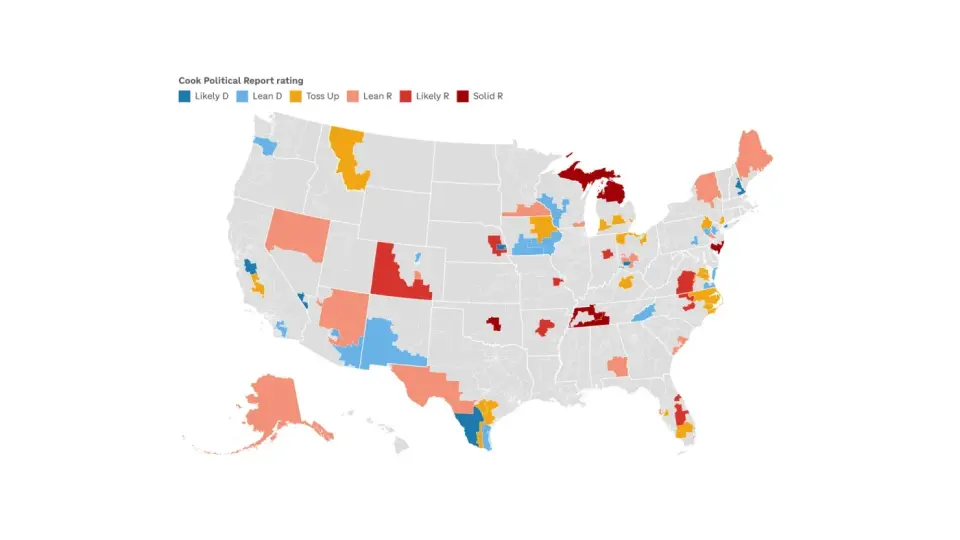
Democrats are positioned to win House control in the 2026 midterms, with 70 districts showing significant ad spending from both parties. The Cook Political Report rates 220 seats as Democratic favorites, 17 as toss-ups, and 30 as competitive but leaning Republican. High ad costs, including over $10 million in key states like Michigan and North Carolina, reflect the intense competition. The Democratic lead on the generic ballot is 10 points among registered voters, driven by economic concerns and anti-incumbency sentiment.
Key points
- 70 House districts have at least six figures in ad spending from both parties, with some exceeding $10 million.
- The Cook Political Report rates 220 seats as Democratic favorites, 17 as toss-ups, and 30 as competitive but leaning Republican.
- Democrats lead the generic congressional ballot by 10 points among registered voters and 8 points among likely voters.
- Cost of living, gas prices, tariffs, and the Iran war are top voter concerns influencing the election.
- Redistricting by Republicans in states like Alabama and Tennessee has created competitive races in previously safe districts.
Background
The 2026 midterms are marked by a significant anti-incumbency sentiment, with a record number of congressional retirements. The Supreme Court's decision to roll back parts of the Voting Rights Act led to mid-decade redistricting, where Republicans redrew boundaries to add conservative voters to Democratic-held districts. This has created competitive races in states like Alabama and Tennessee. The economic climate, driven by rising gas prices, tariffs, and the ongoing war in Iran, has also influenced voter sentiment, with cost of living being the top concern for many Americans.
How outlets are covering it
NPR emphasizes the expansive competitive landscape, highlighting 70 districts with significant ad spending and the Democratic lead on the generic ballot. CNN focuses on specific races that could indicate a wave or tsunami for Democrats, such as California's 1st District, Nebraska's 2nd District, and Pennsylvania's 1st District. Both outlets agree on the Democratic advantage but differ in their emphasis: NPR on the broad competitive map, CNN on key races that could signal a larger shift. CNN also notes the impact of redistricting and the unpopularity of the Trump administration, while NPR highlights the role of ad spending and economic concerns.
Why it matters
The outcome of the 2026 midterms will determine control of the House, with Democrats widely expected to win the majority. The competitive landscape, driven by ad spending, redistricting, and economic concerns, could lead to a significant shift in power. The results will also reflect the impact of the Trump administration's unpopularity and the anti-incumbency sentiment, potentially reshaping the political landscape for the next two years.
What to watch
The final week of the 2026 midterms will see intense ad spending in 70 competitive districts, with key races in Michigan, North Carolina, New York, and Florida. The outcome of these races will determine whether Democrats achieve a majority or a wave. The results will also reflect the impact of redistricting, economic concerns, and anti-incumbency sentiment, potentially reshaping the political landscape for the next two years.
- These are the House races to watch in the 2026 midterm election on Nov. 3 NPR
- Four Scenarios for How the Midterms Could Go The New York Times
- How to tell if Democrats are heading for a landslide in the House CNN
- US midterms: Five days to go – What the polls say as Trump, Harris campaign Al Jazeera
- What our final poll before Election Day says about midterms and Trump PBS
Want the full story? Read the original reporting
Read on NPR