
Midterm Results Delayed by Mail Ballots and Close Races
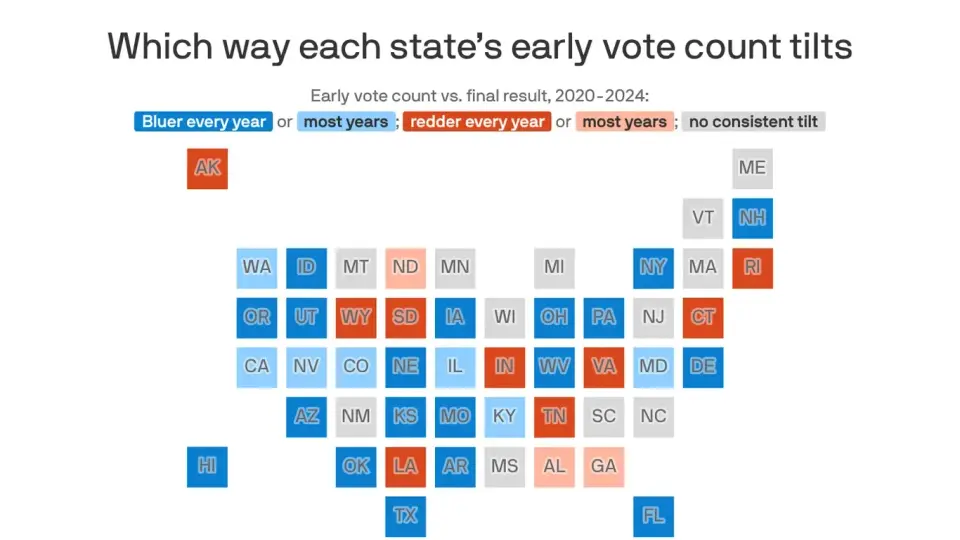
The 2026 US midterm election results will likely take days to finalize, with early returns skewing Republican due to fast-counting states. Experts warn that delayed counts are standard procedure, not evidence of fraud, while President Trump has conditioned his acceptance of results on 'honest' elections.
Key points
- Early returns often skew 4-9 points more Republican than final results due to fast-counting states like Florida.
- The Associated Press typically takes 7-8 days to call House control, while Senate results may take days or weeks.
- Mail ballot processing and signature verification delays contribute to the 'red mirage' effect, where early leads shift as later votes are counted.
- President Trump has stated he will accept results only if they are 'honest,' raising concerns about post-election disputes despite legal safeguards.
Background
In previous midterms, House control was not called until 7-8 days after Election Day, while Senate results varied from hours to months. The 2024 Senate race took until 12:06 AM the next day, and the 2020 Senate race required Georgia runoffs in January. The 2026 midterms feature 435 House seats, 33 Senate seats, and 36 governorships up for election, with close races in key states like Ohio, Michigan, and Texas.
How outlets are covering it
Axios emphasizes the geographic skew of early results, noting that fast-counting states like Florida and right-leaning areas create a 'red head start' that fades as West Coast states report. The Guardian highlights the local nature of vote counting and the potential for misinformation during the information vacuum between voting and results. CBS News focuses on the 'red mirage' effect and warns that candidates who complain about the process are likely losing, while CBC provides live updates and notes that Alaska and Hawaii will be last to report. All sources agree that delayed counts are standard and not indicative of fraud, but they differ in emphasis: Axios on data patterns, The Guardian on legal safeguards, CBS on misinformation, and CBC on real-time tracking.
Why it matters
Delayed results can create false impressions of who is winning and fuel suspicion when early leads vanish. The information vacuum between voting and results can be exploited by partisan actors to spread lies about stolen elections, as seen in previous cycles. Understanding the mechanics of vote counting helps voters and the public interpret early results accurately and avoid misinformation.
What to watch
Voters should expect a gradual shift in results as West Coast states report and mail ballots are processed. The Associated Press will likely call House control within 7-8 days, while Senate results may take longer in close races. Candidates who complain about the process are likely losing, and the winners will let the process play out. Final results in Alaska could be delayed until mid-November due to ranked-choice voting and slow mail ballot processing.
- Charted: Why early midterm results can be misleading Axios
- Midterm elections 2026: how are votes counted and when will we know the results? The Guardian
- Why some 2026 races won't be decided on election night, and why that doesn't mean foul play CBS News
- U.S. midterms live results CBC
- Why We May Not Know Who Won the Midterms on Election Night U.S. News & World Report
Want the full story? Read the original reporting
Read on Axios