
NC Students March to Polls After Campus Voting Sites Are Denied
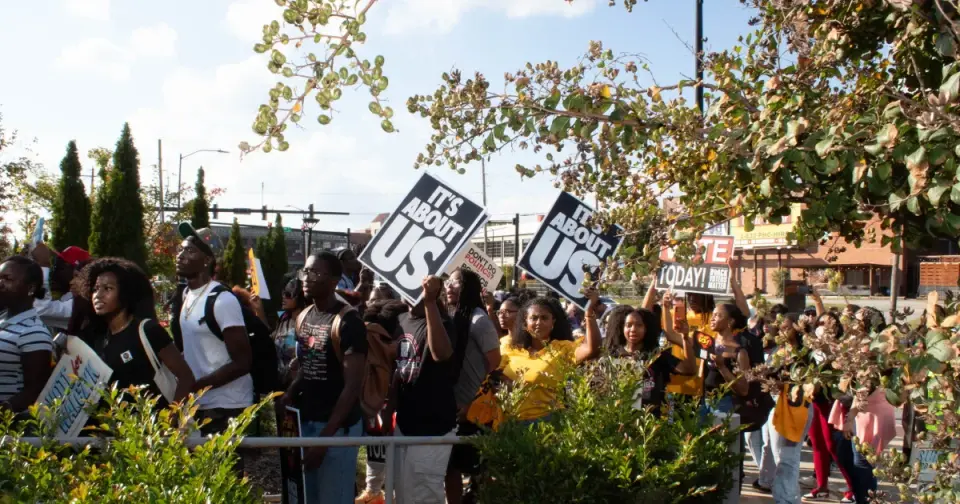
More than 100 students from North Carolina A&T and UNC Greensboro marched to the nearest polling place on the first day of early voting after local election officials denied their requests for on-campus sites. The protest highlights tensions over voter access in the 2026 midterm cycle, as early voting opens across the state with strict ID requirements and limited registration windows.
Key points
- Over 100 students from NC A&T and UNC Greensboro marched to Union Square in Greensboro to vote after the Guilford County Board of Elections denied on-campus early voting sites for the 2026 midterms, a site they had used in 2024.
- The march occurred on October 15, the first day of early voting, which runs through October 31. Some students faced a 45-minute walk with obstructed sidewalks to reach the nearest polling location.
- Statewide, early voting opened with 370 sites. Wake County offered a record 18 locations, while Mecklenburg County recorded over 20,000 votes on the first day.
- Voters must present photo ID, and same-day registration is only available during the early voting period, not on Election Day (Nov. 3).
- Ballots include races for U.S. Senate, House, state legislature, and three constitutional amendments regarding voter ID, income tax, and property tax.
Background
This story follows a broader pattern of student activism regarding voting access and election integrity, as seen in recent HBCU protests and disputes over ballot certification in other states. It also builds on earlier coverage of North Carolina’s early voting logistics, including record site numbers in Wake County and strict ID enforcement.
How outlets are covering it
88.5 WFDD focuses on the student protest and the specific denial of campus sites in Guilford County, framing it as a direct response to election officials. WRAL and Wake County Government emphasize the logistical expansion of early voting, highlighting record site numbers in Wake County and the availability of same-day registration. The Charlotte Observer provides a comprehensive voter guide for Mecklenburg County, detailing ballot contents, ID requirements, and high first-day turnout, without directly addressing the Greensboro protest but contextualizing the statewide voting environment.
Why it matters
The denial of on-campus voting sites for Black students at historically Black universities raises concerns about voter access and the potential chilling effect on youth turnout. The protest signals growing resistance to perceived barriers in the 2026 midterm cycle, while the strict ID and registration rules may impact participation among students and first-time voters statewide.
What to watch
Early voting continues through October 31, with Election Day on November 3. Voter turnout will be monitored, particularly in areas where access was contested. The outcome of the three constitutional amendments, including the one expanding photo ID requirements to all voters, will have long-term implications for voting laws in North Carolina.
- After losing on-campus voting sites, NC A&T and UNCG students march to polls WFDD
- Early voting begins in North Carolina. Here's where to vote and what to know WRAL
- Early voting now underway for the 2026 General Election Wake County Government (.gov)
- Voting has begun in NC’s 2026 midterm election. What voters need to know Charlotte Observer
- Early voting surges in Buncombe County, 7,000+ ballots cast on first day WLOS
Want the full story? Read the original reporting
Read on WFDD