
Redistricting Backfires: Republicans Lose Seven North Carolina House Seats
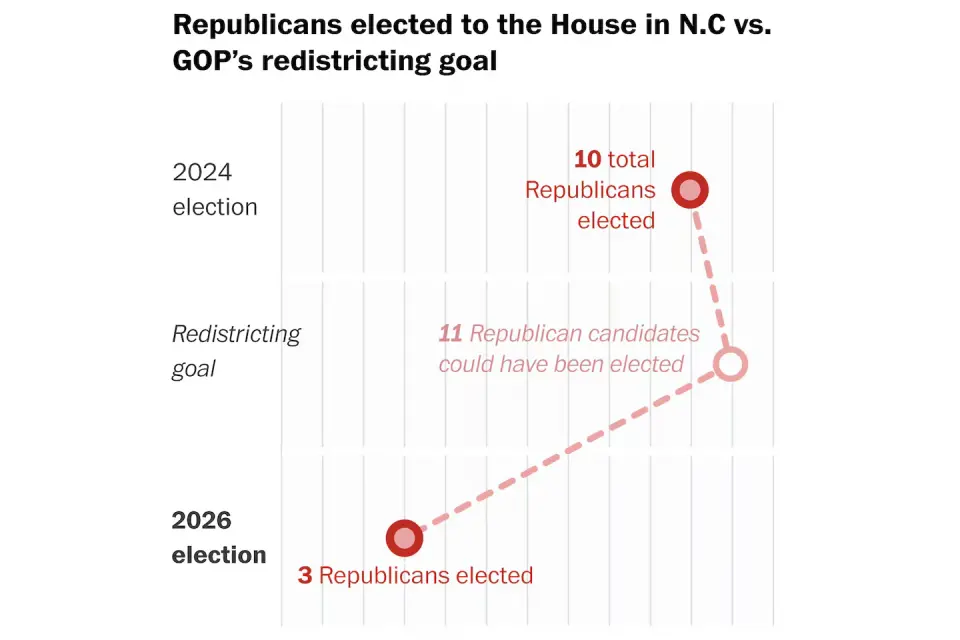
Final results in North Carolina reveal that Republican efforts to redraw House districts failed, resulting in a net loss of seven seats. Democrats flipped five seats and held four, while Republicans retained only three. The collapse of the redistricting strategy, which aimed to gain at least one seat, marks a significant setback for the party in a state that had not elected a Democratic senator in nearly two decades.
Key points
- Republicans lost seven House seats in North Carolina, failing to gain any despite redrawing maps to favor their party.
- Democrats flipped five seats, including those held by Richard Hudson, the National Republican Congressional Committee chair, and Virginia Foxx.
- The 5th District race required a recount, with Democrat Chuck Hubbard leading Republican incumbent Virginia Foxx by 330 votes.
- North Carolina’s state Senate remained under Republican control with a 26-24 majority, though the margin is narrow and subject to recounts.
- The 1st District, targeted for redistricting to flip to Republican, remained Democratic, with Don Davis winning by over 10,000 votes.
Background
This election follows a period of intense partisan redistricting efforts urged by President Trump, which aimed to secure legislative advantages for Republicans. Earlier in 2026, Republican state leaders began urging Trump to step back from the 2028 race due to historic midterm losses, and California Republicans faced a historic Democratic supermajority after losing nine state seats. The current results in North Carolina highlight the broader national trend of Republican underperformance in the 2026 midterms.
How outlets are covering it
The Washington Post emphasizes the failure of the redistricting strategy, noting that Republicans lost seven seats in North Carolina and failed to gain any in Texas. Axios provides a detailed breakdown of the 13 House races, highlighting narrow margins in districts 3 and 5, and noting that the 1st District was the most expensive congressional race in history. The Guardian focuses on the reasons for the losses, citing voter frustration with perceived elitism and unfulfilled promises, with NC Democratic chair Anderson Clayton arguing that Republicans took voters for granted. Ballotpedia details the state Senate results, noting that Republicans maintained a 26-24 majority but failed to secure a veto-proof 30-seat majority, a shift from their previous 30-20 control.
Why it matters
The failure of redistricting in North Carolina signals a potential shift in voter sentiment and the limits of gerrymandering as a political tool. The loss of key seats, including those held by party leaders like Richard Hudson, may impact Republican strategy and influence in the upcoming Congress. The narrow margins in several districts suggest that future elections in the state will remain highly competitive, with voter turnout and grassroots efforts playing a critical role.
What to watch
The Associated Press has not called all races, but the current results suggest Democrats will take control of Congress in January. The state Senate majority for Republicans is narrow and may be subject to recounts. The party is currently divided on how to balance loyalty to President Trump with the need to recover from significant electoral losses, as noted in earlier coverage of GOP state leaders urging Trump to step back from the 2028 race.
- A look at how much Republicans fell short in the states where they redrew maps The Washington Post
- ‘Dummymander’ helps propel Army veteran to Congress in NC’s 3rd District NC Newsline
- Who won North Carolina's congressional races Axios
- How did Republicans lose so badly in North Carolina? The Guardian
- Republicans maintained their majority in the general election for North Carolina Senate on Nov. 3 Ballotpedia News
Want the full story? Read the original reporting
Read on The Washington Post