
Supreme Court oral arguments reveal deep uncertainty over climate liability for oil giants
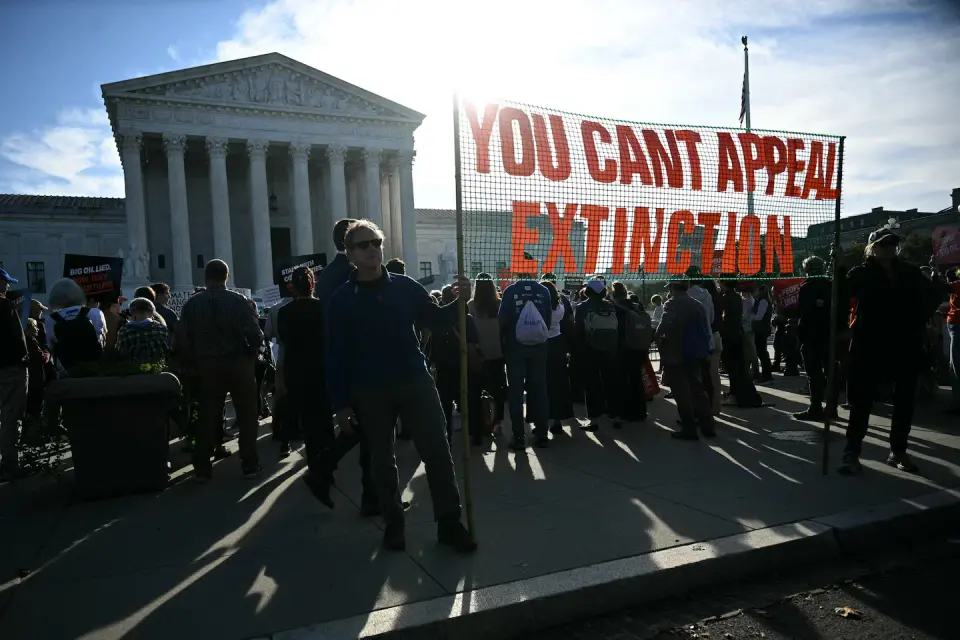
The Supreme Court heard oral arguments in Suncor v. Boulder, a case determining if state laws can hold oil companies liable for climate damages. Justices signaled concern over a potential flood of lawsuits but struggled to find a clear legal basis to dismiss the case, with some seeking a procedural exit.
Key points
- Boulder, Colorado, sued Suncor and ExxonMobil for climate-related damages, seeking to hold them accountable for global emissions.
- The energy companies argue that federal law, specifically the Clean Air Act, preempts these state-level tort claims.
- Justice Samuel Alito recused himself, creating a risk of a 4-4 tie that would uphold the lower court's decision without setting a national precedent.
- Justices Roberts, Kavanaugh, and Barrett expressed concern that allowing the suit could trigger a wave of similar lawsuits across the country.
- Justices Jackson and Sotomayor questioned the Court's jurisdiction, suggesting the case might be premature and could be sent back to the Colorado Supreme Court.
Background
This case is part of a broader trend of local governments suing fossil fuel companies for climate damages. The Supreme Court has previously ruled in American Electric Power Co. v. Connecticut that the Clean Air Act gives the EPA authority over greenhouse gas emissions. The current dispute tests whether state tort laws can bypass federal regulatory frameworks to impose liability on energy companies for indirect harms.
How outlets are covering it
The Washington Post editorial board argues that allowing the suit would unleash an economic tsunami, effectively imposing a backdoor carbon tax. The New York Times opinion piece suggests the case could give fossil fuel companies a 'get-out-of-jail-free card' for climate harms. Fox News highlights that liberal justices are seeking an 'off-ramp' due to a lack of votes, while conservative attorneys general warn of a nationwide 'carbon tax.' SCOTUSblog notes that the Court sent mixed signals, with some justices skeptical of the energy companies' preemption arguments and others concerned about the breadth of Boulder's theory.
Why it matters
The outcome of Suncor v. Boulder will determine whether state and local governments can use tort law to hold energy companies liable for climate change damages. A ruling in favor of the energy companies could dismiss dozens of similar pending cases, while a ruling in favor of Boulder could open the door to billions in potential liabilities for the energy sector and set a precedent for climate litigation nationwide.
What to watch
The Supreme Court is expected to issue a ruling in the coming months, likely next summer. If the Court declines to reach the merits, the case may be sent back to the Colorado Supreme Court, leaving the broader legal question unresolved. The outcome will have significant implications for the energy industry and climate policy in the United States.
- Opinion | The Supreme Court foresees a shakedown of the energy industry The Washington Post
- Opinion | The Science That Has Oil Companies Running Scared The New York Times
- Liberal justices look for 'escape hatch' as high-stakes climate case lands at Supreme Court, experts say Fox News
- Court sends mixed signals on whether it will allow state-tort suits seeking to hold energy companies liable for climate change to go forward SCOTUSblog
- Kavanaugh breaks with conservatives as Alito sits out Supreme Court case Yahoo
Want the full story? Read the original reporting
Read on The Washington Post