
Trump Declares Oval Office and Cabinet Room National Monuments to Block Future Redesigns
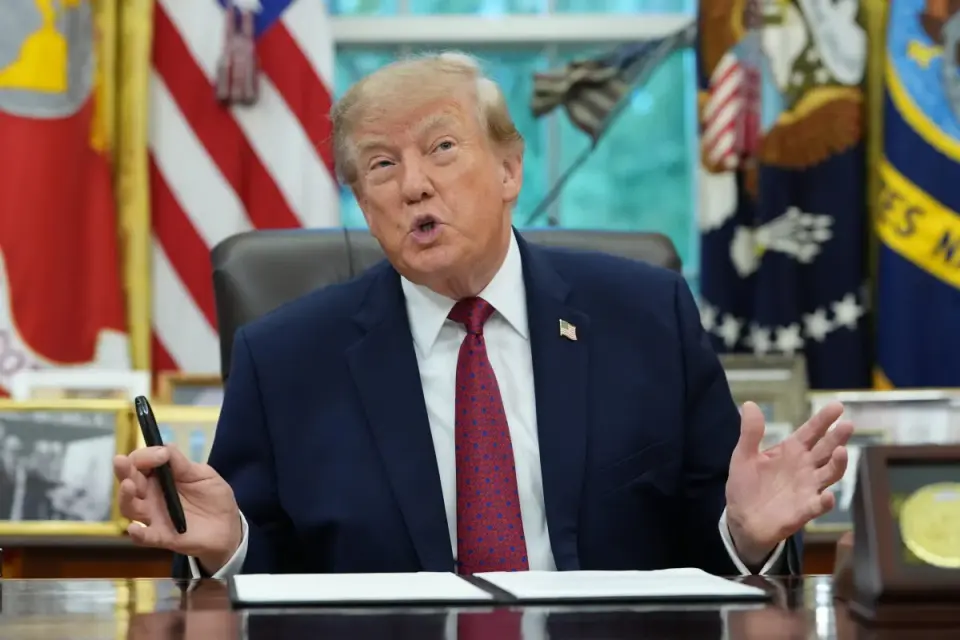
President Donald Trump signed a proclamation on November 5, 2026, declaring the Oval Office and Cabinet Room national monuments to prevent future alterations. The move follows his extensive redesign of these spaces, including adding golden accents and portraits, and occurs two days after Democrats regained control of Congress following midterm losses for Republicans.
Key points
- Trump signed a proclamation on November 5, 2026, stating the Oval Office and Cabinet Room are now national monuments that cannot be modified by future administrations.
- The president told reporters, 'We’re making it a national monument and it will not be allowed to be touched by anybody,' emphasizing the permanence of his design changes.
- The signing occurred two days after midterm elections where voters rejected Republican economic policies, resulting in Democrats regaining control of Congress.
- Trump has overseen numerous design changes since returning to office, including filling the Oval Office wall with portraits, a copy of the Declaration of Independence, and golden accents.
- The proclamation was the third major statement this week focused on Trump’s Washington, D.C. projects, including an opulent ballroom and the Lincoln Memorial Reflecting Pool.
Background
This action follows a period of heightened scrutiny regarding the use of the Oval Office for political purposes. In late October 2026, twelve Catholic bishops issued public apologies after the White House released video of them praying with Trump in the Oval Office just 12 days before the midterm elections. Church leaders accused the administration of exploiting a private policy discussion for partisan gain, causing a rift with the Vatican. Additionally, in late October, Trump hosted Stephen Hubbard, a recently released American teacher, in the Oval Office, linking the release to sanctions waivers. The current proclamation appears to be a response to the political shift following the midterms, where Republicans lost significant ground due to dissatisfaction with economic policies.
Why it matters
The proclamation sets a precedent for the permanence of presidential design choices in key White House spaces, potentially limiting future administrations' ability to modify these iconic rooms. It also highlights the tension between the executive branch and the newly Democratic-controlled Congress, as Trump seeks to lock in his legacy just after suffering electoral losses. The move may influence future debates over the use of White House spaces for political or ceremonial purposes, given recent controversies involving the release of Oval Office footage.
What to watch
The proclamation's legal standing and enforceability may be tested by the new Democratic-controlled Congress, which could challenge the designation of the Oval Office and Cabinet Room as national monuments. Future administrations may face legal or political hurdles if they attempt to alter these spaces, given Trump's explicit statement that they will not be 'touched by anybody.' Additionally, the administration may continue to emphasize its Washington, D.C. projects, including the opulent ballroom and Lincoln Memorial Reflecting Pool, as part of its legacy.
Want the full story? Read the original reporting
Read on AP News