
Appeals Court Halts Trump's White House Ballroom, Prompting Immediate Supreme Court Appeal
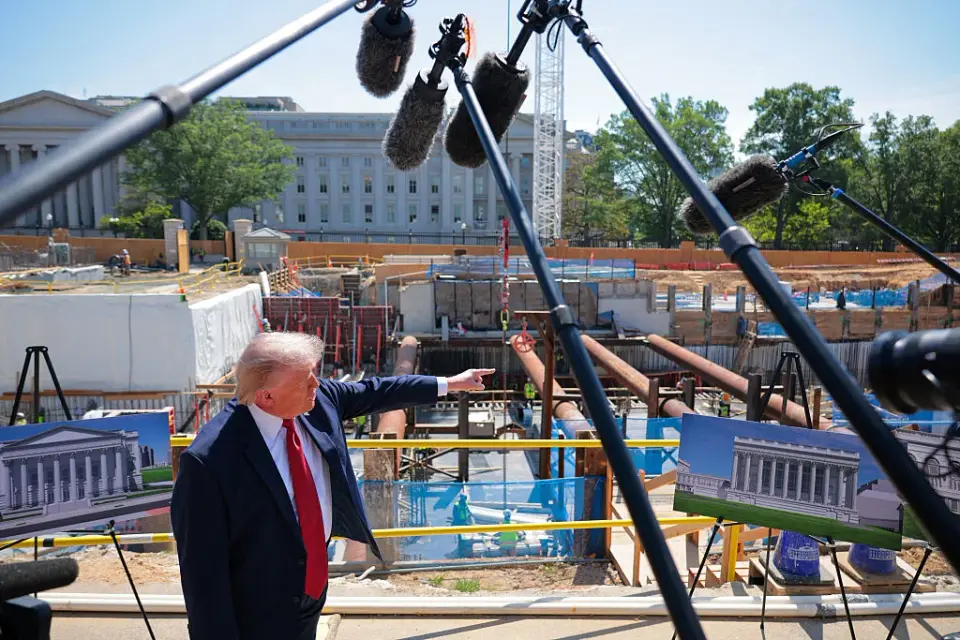
A divided federal appeals court has blocked above-ground construction of President Trump's $400 million White House ballroom, ruling that the project requires congressional authorization. Trump has vowed to appeal to the Supreme Court, arguing that presidents are not 'tenants' and that the structure is a military complex. The court paused its ruling for 14 days to allow for the appeal, while underground bunker construction may continue.
Key points
- The DC Circuit Court ruled 2-1 that Trump cannot proceed with above-ground construction of the 90,000-square-foot ballroom without congressional approval.
- Judges Patricia Millett and Brad Garcia stated that the White House belongs to the American people and that no prior president has privately funded the demolition of congressionally authorized structures.
- Trump rejected the 'tenant' terminology, labeling the ruling a 'National Security Threat' and describing the project as a 'Military Complex' with a rooftop 'DronePort.'
- The court paused its decision for two weeks to allow the administration to seek Supreme Court review, while permitting underground bunker and security-related work to continue.
- The project's cost has escalated from $200 million to $400 million, with a June estimate suggesting $600 million total, including taxpayer funds, despite initial claims of private funding.
Background
The ballroom project was announced in July 2025, with the East Wing demolished in late 2025. The National Trust for Historic Preservation filed a legal challenge in December 2025. This follows a pattern of Trump's construction projects in Washington, DC, which have faced public opposition and legal hurdles, including a separate lawsuit over the Eisenhower Executive Office Building.
How outlets are covering it
Salon emphasizes Trump's rhetorical pushback, highlighting his 'DronePort' claims and AI-generated images. MS NOW focuses on the legal standing of the plaintiff, Alison Hoagland, and the potential for a Supreme Court reversal due to Trump-appointed judges. CNN provides a detailed timeline of construction delays and cost overruns, noting that 58% of Americans are dissatisfied with Trump's DC projects. All sources agree that the underground bunker construction is not blocked, but they differ on the likelihood of a Supreme Court victory, with MS NOW suggesting a potential win and CNN citing internal White House confidence in the legal position.
Why it matters
The case tests the limits of executive power over federal property and the role of congressional approval in major construction projects. It also highlights the tension between presidential legacy projects and public opinion, with the ballroom becoming a symbol of Trump's broader construction agenda in Washington, DC.
What to watch
The Supreme Court will decide whether to hear the case and whether to uphold the lower court's injunction. If the court declines to intervene, the administration may need to seek congressional approval, which could become politically difficult if Democrats gain power in the November midterms. Construction of the underground bunker may continue regardless of the ballroom's status.
- Trump to judges: "We are not tenants … we are PRESIDENTS" Salon.com
- Why Trump’s ballroom loss may be short-lived with Supreme Court looming MS NOW
- A concrete frame and four towering walls: How Trump’s ballroom, blocked by appeals court, has taken shape CNN
- News Wrap: Court rules Trump needs Congress to approve White House ballroom PBS
- US appeals court blocks Trump’s $400 million White House ballroom project Reuters
Want the full story? Read the original reporting
Read on Salon.com