
Trump floats renaming Atlantic or Pacific as 'Trump Ocean' or 'Ocean of the Americas'
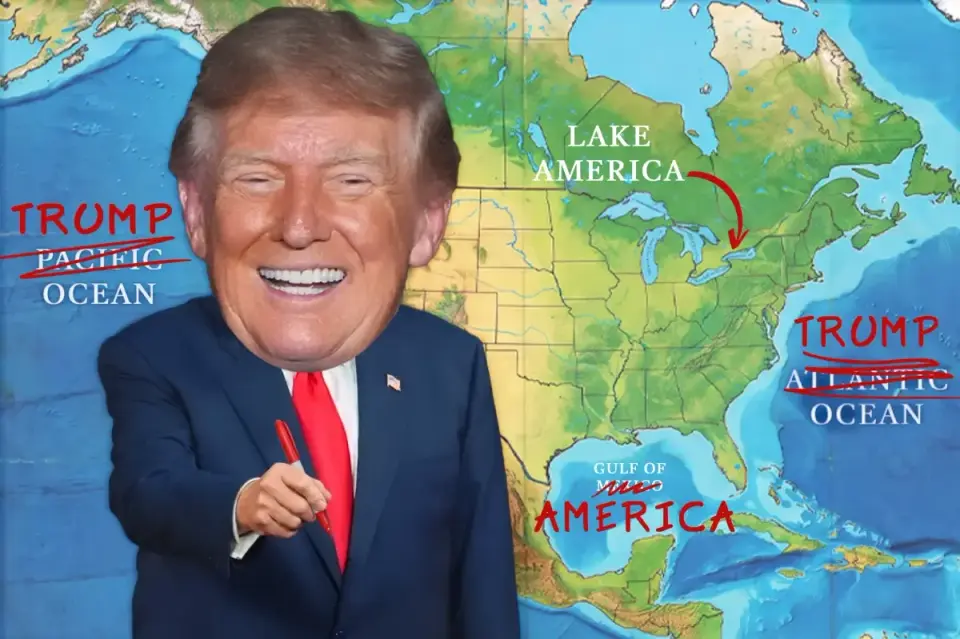
President Donald Trump suggested renaming the Atlantic or Pacific Ocean to 'Trump Ocean' or 'Ocean of the Americas' during a rally in Clarksville, Tennessee, on October 10, 2026. This proposal extends his recent pattern of rebranding US waterways, including the Gulf of Mexico and Lake Ontario, though he explicitly ruled out changing the names of the Hudson and Mississippi Rivers.
Key points
- Trump proposed renaming the Atlantic or Pacific Ocean to 'Trump Ocean' or 'Ocean of the Americas' during a rally in Clarksville, Tennessee, on October 10, 2026.
- The proposal follows previous executive orders renaming the Gulf of Mexico to the 'Gulf of America' and Lake Ontario to 'Lake America' in response to trade tensions with Canada.
- Trump explicitly stated he would not rename the Hudson River, citing Henry Hudson's historical contributions, or the Mississippi River, noting the state's strong support for his administration.
- The New York Post notes that Trump has previously floated renaming New Mexico to 'New America' and the Strait of Hormuz to the 'Trump Strait,' but has not followed through on those changes.
- The Washington Post frames the comments as part of a broader push to rebrand US geography, noting that some initial jokes have been formalized into executive orders.
Background
This proposal arrives amid a period of heightened geopolitical tension and domestic political maneuvering. In late September 2026, the Atlantic and Pacific Oceans experienced a stark divergence in hurricane activity, with the Atlantic seeing record calm and the Pacific experiencing hyperactive storms, a phenomenon linked to El Niño and Ethiopian drought. Additionally, scientists have warned of a potential collapse of the Atlantic Meridional Overturning Circulation (AMOC), which could disrupt European climate and economies. Trump's renaming efforts follow a pattern of using geographic nomenclature as a tool for political leverage, similar to his previous attempts to rename the Kennedy Center and the Institute of Peace, the latter of which was rebranded to the 'Donald J. Trump Institute of Peace' in an apparent bid for the Nobel Peace Prize.
How outlets are covering it
The New York Post emphasizes the personal branding aspect of the proposal, highlighting Trump's history of slapping his name on real estate and government structures, and noting his frustration with the Nobel Committee. The Washington Post frames the event as a continuation of a broader policy trend, focusing on the transition from rhetorical jokes to formal executive orders, such as the renaming of the Gulf of Mexico. Both outlets agree on the factual details of the rally but differ in emphasis: the Post focuses on the 'ego' and 'branding' angle, while the WaPo focuses on the 'policy' and 'diplomatic' implications of the renaming push.
Why it matters
The proposal signals a potential shift in US diplomatic posture and domestic political strategy, using geographic nomenclature as a tool for leverage and branding. It may exacerbate tensions with international partners, particularly Canada and Mexico, and could impact global navigation and cartographic standards. The move also reflects a broader trend of using executive power to reshape national identity and historical narratives.
What to watch
It is unclear if Trump will issue an executive order to rename the Atlantic or Pacific Ocean, as he has not followed through on previous proposals to rename New Mexico or the Strait of Hormuz. The White House may issue a formal statement or executive order in the coming weeks, potentially triggering diplomatic responses from affected nations. Public and media reaction will likely focus on the feasibility and legality of such a move, as well as its impact on international relations.
- President Trump toys with renaming Atlantic and Pacific ‘Trump Ocean’ New York Post
- Trump suggests ‘Ocean of Americas’ as new name for Atlantic or Pacific The Washington Post
- Donald Trump Suggests Renaming the Atlantic or Pacific Ocean to the ‘Trump Ocean’ or ‘Ocean of the Americas’ People.com
- 'Something like that': Trump suggests renaming the Atlantic or Pacific oceans during campaign rally WBAL-TV
- Trump Reveals Two Places He Won’t Rename – List Of What He’s Changed So Far Newsweek
Want the full story? Read the original reporting
Read on New York Post