
Trump's Ireland Visit Sparks Unity Debate and Protests
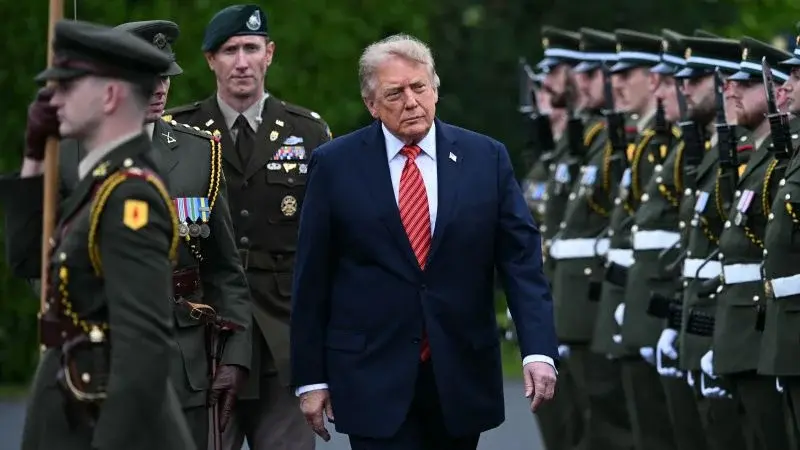
President Donald Trump arrived in Ireland for a two-day visit centered on the Irish Open golf tournament at his Doonbeg resort. During meetings in Dublin, Trump stated he would 'love' to see a unified Ireland, a comment that drew sharp criticism from UK and unionist leaders. The visit was marked by significant protests in Dublin and a diplomatic exchange with Irish President Catherine Connolly, who emphasized opposition to war and genocide. While local communities in Doonbeg highlighted economic benefits from the resort, the trip underscored ongoing tensions between the US and Ireland regarding foreign policy and constitutional issues.
Key points
- Trump arrived in Dublin on September 12, 2026, to attend the Irish Open at his Doonbeg golf resort, meeting with Taoiseach Micheál Martin and President Catherine Connolly.
- Trump stated that a unified Ireland would be 'fantastic' and 'may as well happen now,' a remark that provoked backlash from UK Prime Minister Andy Burnham and unionist parties in Northern Ireland.
- Irish President Catherine Connolly told Trump that the normalization of war and genocide 'can never be accepted,' referencing Ireland's history and current global conflicts.
- Thousands of protesters gathered in Dublin, chanting against Trump's presence and policies, while locals in Doonbeg expressed mixed views, citing economic benefits from the golf resort.
- Trump also commented on the Falkland Islands dispute, suggesting he could help settle the conflict between the UK and Argentina, further straining relations with London.
Background
This visit follows a pattern of US presidents engaging with Ireland to highlight diplomatic and economic ties, as noted in previous coverage. The 2026 trip is distinct for its focus on golf and policy signals, amid a backdrop of protests and a robust US-Ireland relationship driven by diaspora links and investment. The 9/11 anniversary memorials in the US occurred just before this trip, highlighting the global context of US leadership.
How outlets are covering it
CNN focused on the logistical aspects of Trump's arrival and the golf tournament, while The New York Times highlighted the mixed reactions in Doonbeg, noting both economic benefits and local opposition. KCCI and The Guardian emphasized the political fallout from Trump's comments on Irish unity and the Falkland Islands, detailing the responses from UK and Irish leaders. The Guardian also noted the protests in Dublin and the diplomatic exchange with President Connolly, contrasting with the more neutral tone of CNN.
Why it matters
Trump's visit to Ireland highlights the complex interplay between personal interests, diplomatic relations, and political tensions. His comments on Irish unity and the Falkland Islands have significant implications for UK-Ireland relations and US-UK diplomacy. The protests and diplomatic exchanges underscore the ongoing challenges in managing international relationships amidst domestic and global conflicts.
What to watch
Trump is expected to return to Washington after the Irish Open, with the political fallout from his comments on Irish unity and the Falkland Islands likely to continue. The UK and Irish governments will need to navigate the diplomatic tensions, while the economic benefits for Doonbeg may persist. The visit may also influence future US-Ireland relations and the broader context of US foreign policy.
- President Trump arrives in Dublin to meet Ireland’s leaders before attending golf tournament CNN
- In an Irish Village, Trump’s Visit for a Golf Tournament Prompts Protests and Praise The New York Times
- Trump meets Ireland's leaders before heading to his golf club in Doonbeg KCCI
- Donald Trump meets Irish president in Dublin as he begins two-day visit – live The Guardian
- Trump Says He Would 'Love' to See a United Ireland U.S. News & World Report
Want the full story? Read the original reporting
Read on CNN