
Trump Vows Supreme Court Fight After Appeals Court Halts White House Ballroom
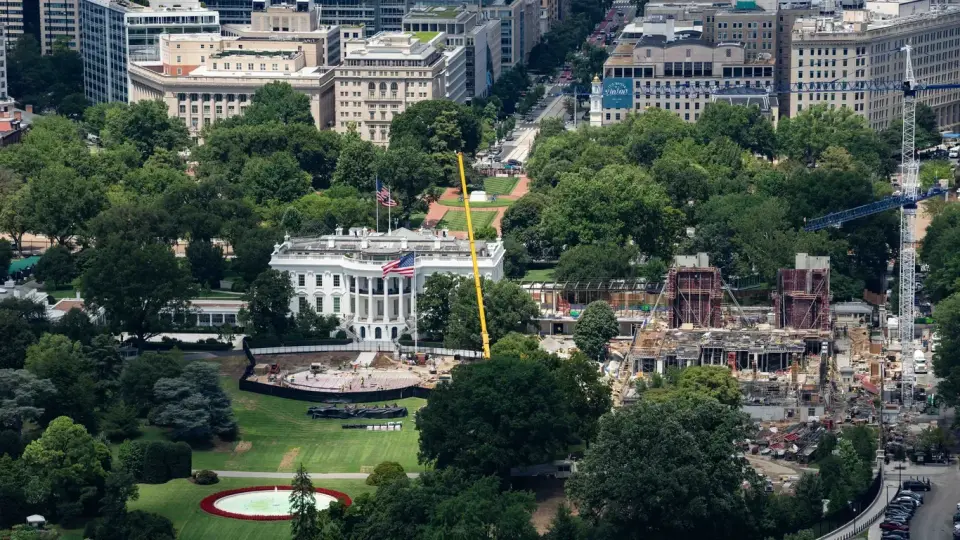
The Trump administration will appeal a federal appeals court ruling that halted above-ground construction of the White House ballroom, arguing the project is a national security necessity. The D.C. Circuit Court ruled that the executive branch lacks authority to build the $400 million expansion without congressional approval, though it permitted underground security work to continue. Trump called the decision a 'national disgrace,' while critics argued the administration bypassed legal processes to demolish the historic East Wing.
Key points
- A divided D.C. Circuit Court panel ruled that the White House ballroom project requires congressional authorization, upholding a lower court injunction against above-ground construction.
- Trump promised to 'immediately' appeal the decision to the Supreme Court, labeling the ruling a 'national security threat' and 'politically motivated.'
- The court allowed below-ground construction of bunkers, medical facilities, and security infrastructure to proceed, citing national security concerns.
- The project, initially announced in July 2025, involved demolishing the East Wing and has faced legal challenges since December 2025.
- The National Trust for Historic Preservation, which sued to block the project, celebrated the ruling as a victory for democratic ideals.
Background
The White House ballroom project, announced in July 2025, faced immediate legal scrutiny after the administration demolished the historic East Wing in October 2025 without congressional approval. A federal judge in April 2026 blocked above-ground construction but allowed underground security work. The project’s cost escalated from $200 million to $400 million, with some estimates reaching $600 million, and Senate Republicans attempted to secure $1 billion in taxpayer funding for security upgrades in spring 2026, which failed. Public opposition to the project and other Trump construction initiatives in Washington, D.C., has been significant, with polls showing 58% of Americans dissatisfied or angry about these projects.
How outlets are covering it
Axios and ABC News emphasized Trump’s framing of the ballroom as a 'national security' imperative, including bomb shelters and military facilities, while the courts rejected this as an 'automatic get-out-of-the-law-free card.' CNN highlighted the uncertainty of the project’s future, noting that even if the Supreme Court sides with Trump, the project may not be completed before the end of his term. BBC focused on the legal principle that the White House belongs to the American people, not the president, and that Congress must authorize such major changes. All outlets agreed that the ruling does not decide the policy merits of the ballroom but rather the executive’s authority to proceed without congressional approval.
Why it matters
The case tests the limits of presidential authority over federal property and the role of Congress in authorizing major construction projects. It also raises questions about the balance between national security concerns and democratic oversight, with implications for future executive actions. The outcome could influence how presidents approach large-scale renovations or expansions of federal buildings, particularly those with historical significance.
What to watch
The Supreme Court will decide whether to take up the case, with the administration seeking to reverse the appeals court ruling. If the court declines to intervene, the lower court’s injunction may take effect, halting above-ground construction. Congress may also be called upon to authorize the project, though this is unlikely if Democrats gain power in the November midterms. Construction on underground security features will continue regardless of the legal outcome.
- Trump says he'll ask SCOTUS to reverse ballroom project ban Axios
- Appeals Court Upholds Block on Trump Ballroom Construction The New York Times
- What makes Trump's ballroom a matter of national security? ABC News - Breaking News, Latest News and Videos
- A concrete frame and four towering walls: How Trump’s ballroom, blocked by appeals court, has taken shape CNN
- US appeals court halts Trump ballroom project paving way for Supreme Court showdown BBC
Want the full story? Read the original reporting
Read on Axios