
Trump-Xi APEC Summit Ends With Viral Escalator Moment But No Trade Breakthrough
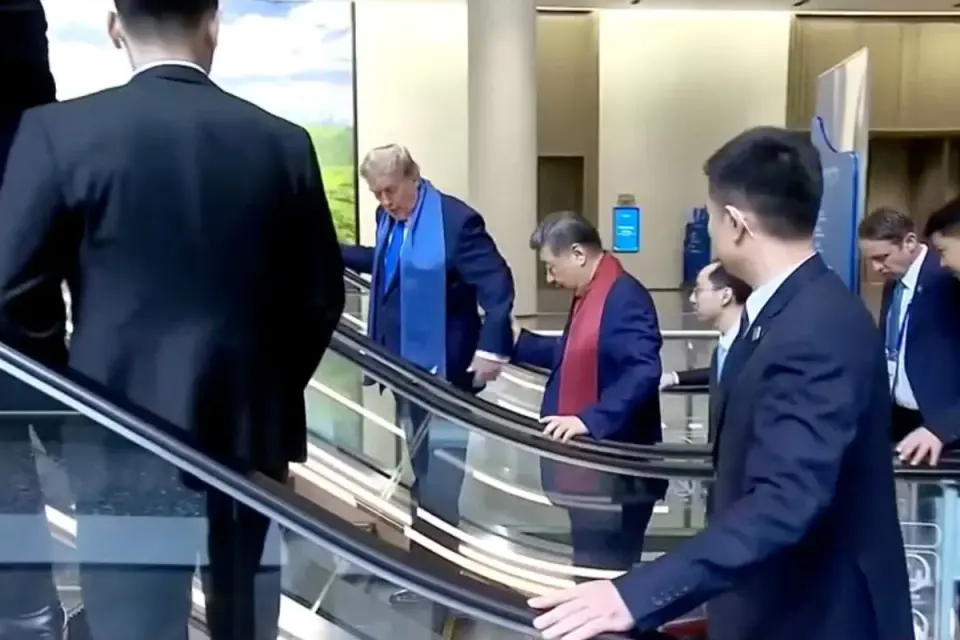
President Donald Trump and Chinese President Xi Jinping concluded their Asia-Pacific Economic Cooperation (APEC) summit in Shenzhen, China, with a viral escalator interaction but no significant progress on trade or technology disputes. The leaders held closed-door talks alongside Russian President Vladimir Putin, focusing on nuclear risks and conflicts in Ukraine and Iran. While the White House highlighted the friendly physical gestures, analysts note that the US-China trade truce expires in January without extension, and new restrictions on AI chip access remain contentious. The meeting featured a rare trilateral format, but substantive outcomes were limited, with both sides emphasizing the need for continued communication despite ongoing tensions over semiconductors and rare earth minerals.
Key points
- Trump and Xi engaged in a viral escalator moment during the APEC summit, which the White House highlighted on social media as a sign of personal rapport.
- The trilateral talks with Putin concluded with a joint statement committing to reform the United Nations, but yielded no concrete agreements on nuclear arms control or the war in Ukraine.
- Economic standoffs over semiconductors, rare earth minerals, and tariffs remained unresolved, with the US-China trade truce set to expire on January 10 without an apparent extension.
- Rep. Gregory Meeks criticized the summit for lacking a clear strategy, warning that the meetings could undermine US alliances and potentially divide the world into spheres of influence.
- Trump emphasized the 'Board of Trade' and a 30-for-30 tariff framework, claiming progress in balancing economic ties, while Xi called for abandoning 'Cold War thinking' and avoiding supply chain disruptions.
Background
This summit follows a series of high-profile diplomatic events, including a Quad leaders' meeting in Manila where Trump and Indian PM Narendra Modi had a viral photo-op snafu. The US has recently faced critical infrastructure outages, which experts attribute to technical failures rather than cyberattacks. Additionally, Democrats secured a 56-seat Senate majority after flipping Alaska, and Nvidia confirmed its ousted CEO Jensen Huang will not return, a topic that arose during the Shenzhen talks.
How outlets are covering it
The Independent focused on the viral escalator moment and Trump's history with escalators, framing the event as a lighthearted but notable diplomatic gesture. NPR, through Rep. Gregory Meeks, criticized the summit for lacking a clear strategy and warned of potential negative impacts on US alliances and national security. Yahoo Finance highlighted the lack of progress on economic standoffs, noting that the leaders sidestepped difficult topics like the Nvidia scandal and semiconductor restrictions. Roll Call provided a transcript of Trump's remarks, emphasizing his focus on the 'Board of Trade' and personal relationship with Xi, while downplaying the lack of substantive outcomes. The outlets differ in their emphasis: The Independent and Yahoo Finance focus on the personal and economic aspects, while NPR highlights the strategic and security concerns.
Why it matters
The summit's lack of concrete outcomes on trade and security issues underscores the ongoing tensions between the US and China, particularly regarding semiconductors and rare earth minerals. The viral escalator moment, while lighthearted, highlights the personal dynamics between the leaders, which may influence future diplomatic relations. The criticism from Rep. Meeks and the lack of progress on nuclear arms control and the war in Ukraine suggest that the US may face challenges in maintaining its alliances and addressing global security issues. The expiration of the trade truce in January without an extension could lead to increased tariffs and economic disruptions, affecting global supply chains and trade relationships.
What to watch
Trump and Xi are expected to meet again in a few weeks when Xi travels to Florida for a G20 Summit in December. The US and China will need to address the expiration of the trade truce on January 10, potentially leading to new tariff negotiations or escalations. The US may also need to address the concerns raised by Rep. Meeks regarding Chinese espionage and intellectual property theft, as well as the lack of progress on nuclear arms control and the war in Ukraine. The outcome of these future meetings will be crucial in determining the direction of US-China relations and global security dynamics.
- Trump has a moment with an escalator: This time due to an embrace with China’s leader The Independent
- Top House Democrat questions what Trump accomplished in Xi-Putin summit NPR
- Stalemates over semiconductors and rare earth minerals appear little changed as Trump heads home from China Yahoo Finance
- Remarks: Donald Trump Holds a Bilateral Meeting with Xi Jinping of China - Factba.se Roll Call
- Trump and Xi’s Show of Friendship Is Good for Markets but Deeper Tensions Are Still Unresolved Barron's
Want the full story? Read the original reporting
Read on The Independent