
Court Documents Reveal ICE Undercover Infiltration of Minneapolis Protest Groups
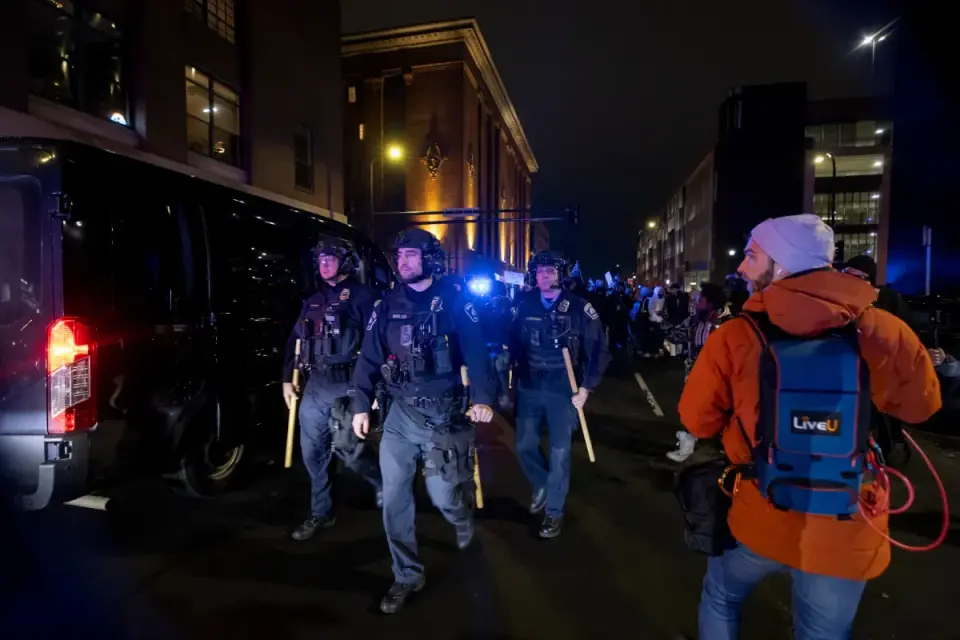
Court filings reveal that Homeland Security Investigations conducted a months-long undercover operation in Minneapolis, infiltrating meetings of the Sunrise Movement, labor unions, and churches to monitor anti-ICE protesters. Agents secretly recorded nonviolent trainings, accessed financial records via subpoenas, and attempted to entice organizers into confrontational tactics. The operation, dubbed 'Operation Puppet Master,' targeted 18 groups despite evidence that many advocated for peaceful protest. Critics argue the surveillance violates First Amendment rights and mirrors historical FBI abuses, while the government maintains it was a legal investigation into 'violent agitators.'
Key points
- Homeland Security Investigations launched 'Operation Puppet Master' and 'Project Whipple Shield' to monitor anti-ICE protesters in Minneapolis during the winter of 2025-2026.
- Undercover agents infiltrated Sunrise Movement trainings, church gatherings, and union meetings, secretly recording discussions on de-escalation and peaceful protest tactics.
- The government subpoenaed financial records from groups like the Sunrise Movement and Service Employees International Union, dating back to 2023, without notifying the organizations.
- One undercover agent attempted to entice a Sunrise organizer into supporting 'direct-action' protests by offering to build items for more confrontational demonstrations.
- Defense attorney Kevin Riach argued the investigation was a 'broad and irrational' political vendetta, noting that agents often reported back that groups focused on peaceful, constitutional activities.
- The surveillance included monitoring a Minneapolis church that had a federal court injunction barring immigration enforcement on its property, raising questions about potential legal violations.
Background
This development follows the federal government's 'Operation Metro Surge' in Minnesota, which deployed approximately 3,000 agents to enforce immigration laws, leading to widespread protests and the fatal shootings of Renee Good and Alex Pretti. The current revelations come after a June 2026 indictment of 15 activists, known as the 'Minnesota 15,' for impeding federal operations. The broader context includes a series of legal challenges to ICE tactics and a growing concern among civil rights groups about the erosion of First Amendment protections for protest and association.
How outlets are covering it
The Intercept and CBS News emphasize the scope of the surveillance, highlighting how agents infiltrated nonviolent groups like the Sunrise Movement and major labor unions, and attempted to provoke confrontational behavior. The Guardian, through columnist Kenneth Roth, draws parallels to the FBI's Cointelpro program, arguing that the administration's use of Homeland Security rather than the Justice Department signals a disregard for legal norms and a political vendetta. MPR News focuses on the potential violation of a federal court injunction regarding surveillance at a Minneapolis church, raising questions about the legality of the agents' presence in protected spaces. The Foundation for Individual Rights and Expression criticizes the chilling effect on free speech, while the government maintains that its actions were within legal authority to investigate 'violent opportunists.'
Why it matters
The revelations expose a significant expansion of federal surveillance powers into the realm of protected political speech and association, potentially setting a precedent for monitoring dissent. The use of undercover agents to infiltrate nonviolent groups and attempt to entice them into illegal activity raises serious concerns about the integrity of the justice system and the protection of First Amendment rights. This case highlights the tension between national security enforcement and civil liberties, with implications for future protest movements and the role of federal agencies in domestic policing.
What to watch
Defense attorneys are seeking the release of additional investigative reports, including those related to 'Project Whipple Shield,' and correspondence between administration officials and prosecutors to determine if political motives influenced the investigation. The outcome of the Minnesota 15 case and any potential legal challenges to the surveillance tactics will be closely watched as indicators of the administration's approach to dissent. Civil rights groups are expected to continue advocating for transparency and accountability in federal investigations.
- Secret ICE Agent Tried to “Entice” Minneapolis Activists Into Confrontational Tactics The Intercept
- U.S. Investigated Left-Leaning Groups During Minnesota Immigration Crackdown The New York Times
- Donald Trump’s spying on leftwing groups recalls J Edgar Hoover’s Cointelpro The Guardian
- Feds spying in Minneapolis church may have violated court order MPR News
- Federal surveillance operation in Minnesota targeted progressive groups and unions, documents show CBS News
Want the full story? Read the original reporting
Read on The Intercept