
Vance and Rubio Face 2028 Succession Struggle Amid Iran and Nvidia Divisions
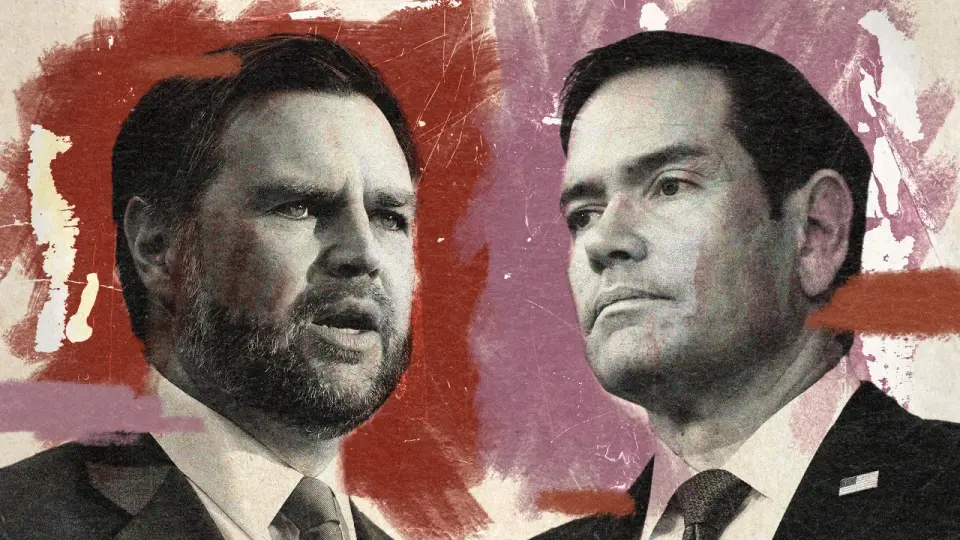
JD Vance and Marco Rubio are locked in a low-level political rivalry for the 2028 Republican presidential nomination, driven largely by external hawks rather than a formal campaign. Their public disagreements over the unpopular Iran war and the Nvidia CEO Jensen Huang scandal have highlighted deep ideological splits within the MAGA movement. While Vance opposes the war and supports Huang, Rubio defends the conflict and warned against Huang, creating a dilemma for both as they navigate loyalty to President Trump and voter sentiment.
Key points
- The 2028 GOP succession race is characterized as a 'phony war' driven by neoconservative hawks and media figures seeking to discredit Vance, rather than a formal campaign by Rubio, who has not announced a run.
- Vance and Rubio are on opposite sides of the Iran war: Vance publicly blamed the conflict for the GOP’s midterm losses, while Rubio defended the intervention, despite the war’s low approval ratings.
- The Jensen Huang scandal further divided the pair; Rubio warned Trump about Huang’s alleged ties to a Chinese spy, while Vance lobbied for Huang’s reinstatement, dismissing the allegations as lacking evidence.
- Multiple House Republicans, including Nicole Malliotakis and Marlin Stutzman, are pushing Rubio to run, citing his ability to unify the party and reach Hispanic voters, though administration officials remain split on the preferred successor.
- Vance faces a strategic dilemma: intensifying his anti-war stance risks alienating Trump and the MAGA base, while remaining silent risks losing younger and working-class voters who opposed the war.
Background
The rivalry emerges after the Republican Party lost its congressional majorities in the 2026 midterms, a defeat widely attributed to the unpopularity of the Iran war and high inflation. This follows a period of shifting US foreign policy, including Trump’s alignment with Russian narratives on Ukraine and the unilateral alteration of NATO statements, which has strained transatlantic relations. The current tension mirrors earlier internal GOP debates over foreign policy orthodoxy, where figures like Rubio and Vance previously aligned on populist economic views before diverging on international intervention.
How outlets are covering it
UnHerd characterizes the conflict as a 'phony war' orchestrated by outside hawks to discredit Vance, noting that Rubio has not signaled a desire to run. Axios emphasizes the personal and political costs of loyalty to Trump, highlighting how both men are saddled by decisions made against their advice. The Guardian frames the divide as a choice between isolationism (Vance) and imperialism (Rubio), warning that either candidate could destabilize global relations. Fox News focuses on the grassroots support for Rubio among House Republicans, portraying him as a unifier and potential bridge to Hispanic voters, while noting administration officials are split 50/50 on the preferred successor.
Why it matters
The outcome of this internal struggle will define the direction of the Republican Party and US foreign policy in 2028. A Vance victory could signal a shift toward isolationism and anti-interventionism, while a Rubio win would likely continue the current hawkish posture. The division also reflects broader fractures in the MAGA coalition, particularly among young and working-class voters who opposed the Iran war, potentially affecting the party’s long-term electoral viability.
What to watch
Vance is expected to decide on a 2028 run after the new year, possibly as late as spring 2027. Rubio has indicated he will not run if Vance does, but may reconsider if Vance withdraws. The political fallout from the Nvidia scandal and Iran war will continue to shape public opinion and primary dynamics in the coming months.
- The phony war for Trump’s crown A Rubio-Vance race isn’t guaranteed UnHerd
- Vance and Rubio learn the price of loyalty to Trump Axios
- The Vance v Rubio battle to lead Maga 2.0 is hotting up. One will be bad for the world: the other may be worse The Guardian
- Marco Rubio's 2028 stock surges among House Republicans as Trump insiders split on Vance Fox News
- Rubio and the NeverVance coalition The Spectator
Want the full story? Read the original reporting
Read on UnHerd