
Veterans Group Leader Claims Misleading Endorsement as Court Weighs Arch's Military Role
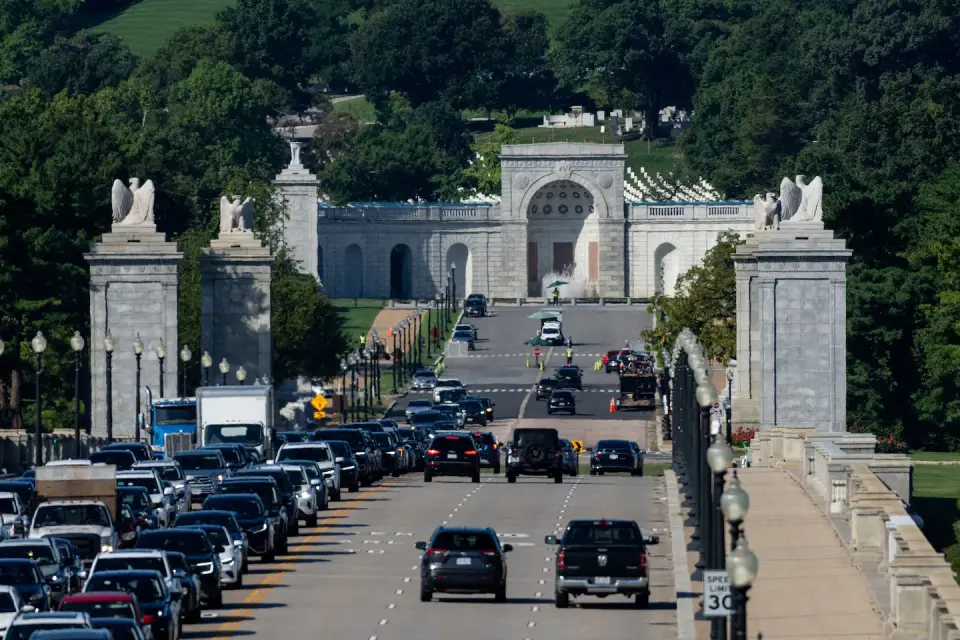
The head of a Vietnam veterans group that endorsed President Trump’s proposed 250-foot arch stated he was misled regarding its military functions. Meanwhile, Defense Secretary Pete Hegseth and Homeland Security Secretary Markwayne Mullin submitted court declarations arguing the structure is a 'generational national defense opportunity' capable of countering drone threats and hosting snipers. These claims contradict earlier architectural plans submitted to the National Capital Planning Commission, which described the project solely as a ceremonial gateway without military features. A federal court hearing is scheduled for Friday, followed by a final planning commission vote on November 5.
Key points
- The leader of a Vietnam veterans group that previously endorsed the arch project told The Washington Post he was misled about the structure's intended military use.
- Defense Secretary Pete Hegseth and Homeland Security Secretary Markwayne Mullin filed sworn statements with a federal court, asserting the arch serves a dual purpose as a monument and a military asset.
- Hegseth claimed the 250-foot height provides an elevation advantage for counter-sniper operations and drone detection, while Mullin noted it would enhance Secret Service monitoring capabilities.
- The administration’s new national security justification contrasts with recent plans submitted to the National Capital Planning Commission, which omitted military features and described the arch as a ceremonial gateway.
- Hegseth stated that security features would be integrated into the existing design without requiring structural modifications, despite the absence of such details in the latest architectural submissions.
Background
The arch project, located in Memorial Circle opposite Arlington National Cemetery, has faced legal challenges since September 2026. Three Vietnam veterans and an architectural historian sued to halt construction, arguing the project lacks congressional authorization and harms historic sightlines. Public opinion opposes the project by more than 2-to-1. The administration has cited a 1925 law to justify proceeding, aiming to begin construction as early as November 5, coinciding with a final vote by the National Capital Planning Commission.
How outlets are covering it
The Washington Post highlighted the credibility crisis within the veterans' community, noting that a key endorser felt misled. In contrast, Politico and The New York Times focused on the administration's strategic pivot, emphasizing how Hegseth and Mullin are rebranding the project as a critical defense necessity to counter legal challenges. CNN provided a detailed analysis of the discrepancy between the cabinet secretaries' sworn statements and the actual architectural plans submitted to regulators, pointing out that the latest designs excluded the military components described by Trump and his aides. While the administration frames the arch as a security imperative, critics and the plaintiffs view the sudden inclusion of military functions as a post-hoc justification to bypass legal and preservation hurdles.
Why it matters
The outcome of the upcoming court hearing and the National Capital Planning Commission vote will determine whether the arch proceeds. The administration's attempt to reframe a ceremonial monument as a military asset raises questions about the integrity of the review process and the potential impact on historic preservation and national security protocols in Washington, D.C.
What to watch
A federal court hearing is scheduled for Friday, October 30, where the legal challenges to the arch will be reviewed. The National Capital Planning Commission is set to vote on the project on November 5. If approved, the administration has indicated construction could begin immediately. The administration must reconcile its court declarations regarding military use with the architectural plans that omit such features.
- Head of Vietnam veterans group says he was misled before it endorsed Trump’s arch The Washington Post
- Hegseth, Mullin rebrand triumphal arch as ‘generational national defense opportunity’ Politico
- Officials Back Trump’s Claim That Triumphal Arch Is Needed for National Security The New York Times
- Trump’s arch would cast shadow on Arlington graves, including Kennedy’s The Washington Post
- A ‘generational defense opportunity’: Hegseth offers full-throated endorsement of Trump’s arch amid legal battle CNN
Want the full story? Read the original reporting
Read on The Washington Post