
Canadian hiker survives seven-hour standoff on icy Adirondack ledge
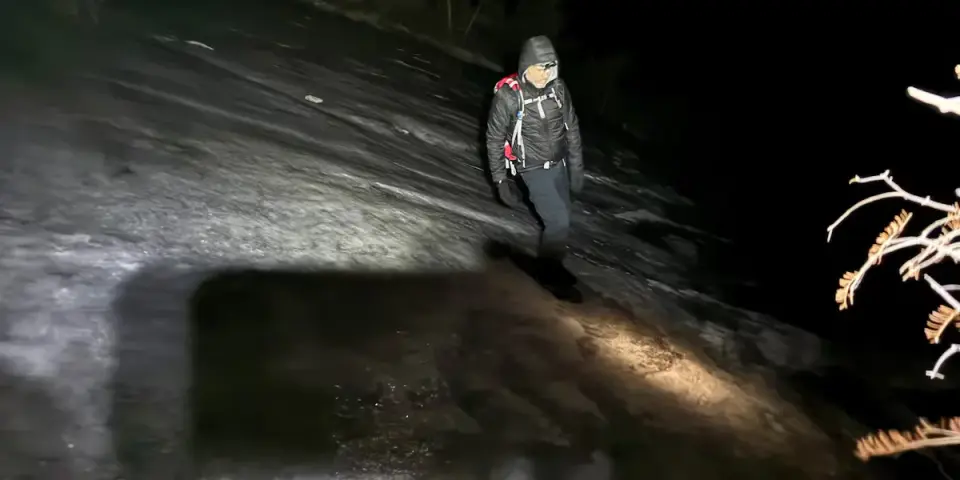
A 60-year-old Canadian man was rescued from the Mount Colden Trap Dike in New York after standing on an icy ledge for seven hours. He lost his crampons on October 21 and activated a satellite beacon. Forest rangers reached him at 1 a.m. and completed a high-angle rope rescue, clearing the incident by 8 a.m. The hiker, identified as Eric Le Bourhis, survived the ordeal without fatal injury.
Key points
- The incident occurred on October 21 at the upper north edge of the Mount Colden Trap Dike in Keene, New York.
- The hiker, a 60-year-old from Canada, lost his crampons while attempting to put them on an icy ledge, leaving him stranded.
- He activated a satellite beacon around 6:30 p.m. and waited for seven hours, uncertain if the signal had been received.
- Forest rangers arrived at 1:16 a.m. and executed a complex high-angle rope rescue to move him to the vegetated edge.
- The rescue team then bushwhacked to the summit and descended to Marcy Dam Outpost, using ATVs to reach the trailhead by 8 a.m.
Background
The Adirondack Park has seen a surge in search and rescue operations in late October 2026. According to the New York State Department of Environmental Conservation, rangers responded to multiple incidents in the same region within days of the Trap Dike rescue, including a hypothermia case on Mount Marcy and a lost group of hikers from the Northeast. The Trap Dike route is classified as a fourth-class climb and has a history of fatalities, prompting officials to urge hikers to prepare adequately for backcountry conditions.
How outlets are covering it
WCAX reported the rescue as a dramatic survival story, highlighting the danger of the route and the ranger's fear of a fatal slip during the initial contact. The Adirondack Explorer provided a detailed technical account of the rescue, naming the hiker as Eric Le Bourhis and describing the specific rope techniques used by Rangers Jeffery, Engel, and Jansen. The Daily Gazette covered the broader context of multiple simultaneous rescues and fires in the region but did not provide specific details on the Trap Dike incident. Commenters on the Adirondack Explorer noted that the route requires significant skill and that some believe fees should be charged to deter unprepared hikers.
Why it matters
The incident underscores the life-threatening risks associated with the Mount Colden Trap Dike, a popular but dangerous climbing route. It highlights the critical role of satellite beacons in backcountry emergencies and the complex logistical challenges faced by forest rangers during high-angle rescues in remote terrain. The event also reflects a broader trend of increased search and rescue activity in the Adirondacks during the fall season.
What to watch
The hiker is expected to recover from the ordeal. Forest rangers continue to monitor the region for additional incidents as weather conditions remain challenging. The New York State Department of Environmental Conservation is likely to continue publicizing safety guidelines for backcountry hikers, emphasizing the importance of proper equipment and route preparation.
- Canadian man rescued from Adirondacks after standing in same spot for 7 hours WCAX
- ‘Heart in the throat moment’: Rangers rescue man trapped on icy ledge in Adirondacks Times Union
- Forest rangers conduct multiple Trap Dike rescues Adirondack Explorer
- Stranded Adirondacks hiker stood on icy ledge for seven hours NewYorkUpstate.com
- Rangers make two Trap Dike rescues, battle wildfires and help lost, injured hikers The Daily Gazette
Want the full story? Read the original reporting
Read on WCAX