
EU and Canada Forge 'Alliance for the Future' Amid Critical Minerals and AI Deals
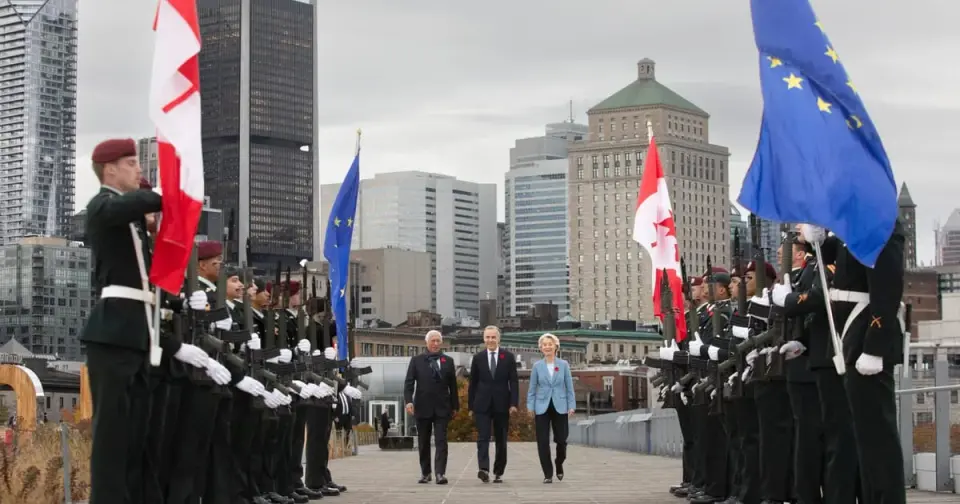
The 21st EU-Canada summit in Montreal concluded with a new partnership framework, including a critical minerals deal and AI cooperation, as leaders navigated internal disputes over the 'associate member' label and Quebec's exclusion.
Key points
- Leaders agreed to a framework agreement between the European Investment Bank and Canada to support critical minerals supply chains, reducing reliance on China.
- Canada committed to an additional €500 million in funding for Ukraine, part of a broader €90 billion support loan.
- The summit announced a merger between Canadian AI firm Cohere and German company Aleph Alpha, with a Canadian government stake of up to C$1.6 billion.
- Disputes persisted over the 'associate member' label, with Germany and others preferring 'Alliance for the Future,' though von der Leyen and Carney retained the former term.
- Quebec Premier Paul St-Pierre Plamondon boycotted the summit after Ottawa refused to grant him a speaking role, criticizing the federal government's handling of provincial interests.
Background
This summit follows Canada's suspension of trade talks with the United States over tariff disputes and a broader pivot toward European partnerships. Previous coverage highlighted internal EU disagreements over the legal status of Canada's relationship with the bloc, with some member states resisting the 'associate member' designation due to concerns about legal ambiguity and precedent for other non-European nations.
How outlets are covering it
POLITICO emphasizes the 'associate member' label as a breakthrough, noting Carney's eventual acceptance and a six-month deadline to define its scope. The Guardian highlights the 'Alliance for the Future' as a hedge against geopolitical instability, focusing on AI and defense independence from the US. Le Monde frames the outcome as a two-stage process, prioritizing immediate ties before expanding to other nations. All sources agree on the critical minerals and AI deals but differ on the significance of the 'associate member' terminology, with POLITICO and The Guardian noting its contentious nature among EU capitals.
Why it matters
The summit marks a significant shift in EU-Canada relations, creating a new model for non-European partnerships that could reduce dependence on the US and China. The critical minerals and AI agreements address supply chain vulnerabilities, while the 'associate member' debate signals potential changes in EU external relations. The Quebec boycott highlights internal Canadian tensions that may complicate future cooperation.
What to watch
A six-month deadline has been set to define the 'associate member' framework, with a follow-up summit planned for 2027. The Cohere-Aleph Alpha merger and supercomputing network integration will proceed, while the LNG feasibility study and critical minerals investments will be evaluated. U.S. midterm elections in November may influence the trajectory of transatlantic relations.
- 8 things we learned at the EU-Canada summit POLITICO.eu
- Carney Commits Canada to Becoming European Union’s First ‘Associate Member’ The New York Times
- Canada and EU announce new alliance open to like-minded countries The Guardian
- Europe and Canada detail first measures after unprecedented rapprochement Le Monde.fr
- As Trump Unravels the Old World Order, Canada and EU Join Forces Bloomberg.com
Want the full story? Read the original reporting
Read on POLITICO.eu