
US Confirms On-Orbit Weapons Deployment Amidst Blurring Civil-Military Space Lines
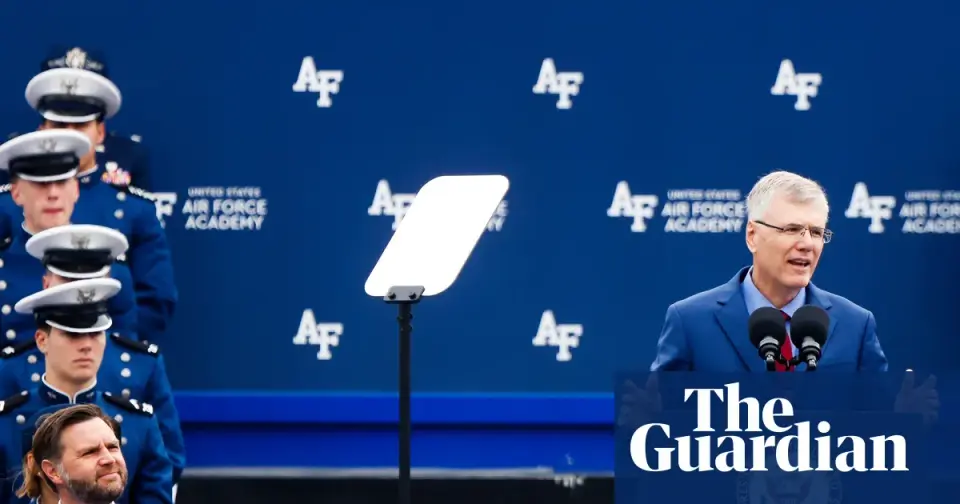
Air Force Secretary Troy Meink confirmed the US has deployed 'on-orbit space control weapons' to deter adversaries, though no technical details were provided. This disclosure coincides with a broader Trump administration strategy to merge civilian and military space operations, including the creation of a joint Space Academy and expanded launch targets, despite international concerns over the militarization of orbit.
Key points
- Air Force Secretary Troy Meink announced at the Air, Space and Cyber Conference that the US possesses on-orbit weapons capable of defending against hostile actions, refusing to disclose specifics to maintain deterrence.
- The Trump administration is actively merging civilian and military space roles, evidenced by the signing of an executive order for a joint civilian-military Space Academy and a national policy targeting over 1,000 launch operations by 2030.
- Defense analysts suggest the move is a response to perceived Russian and Chinese advancements in counterspace capabilities, including potential anti-satellite weapons and electromagnetic pulse technologies.
- International reactions were mixed; China and Russia condemned the move as a violation of peaceful space norms, while US officials framed it as necessary readiness against evolving threats.
- Critics, including former NASA officials, argue that blurring the line between civilian exploration and military defense violates the 1967 Outer Space Treaty and risks escalating an arms race.
Background
This development follows earlier reports in September 2026 confirming the existence of autonomous space-based weapons. It aligns with previous administration moves, such as the creation of the Space Force in 2019 and recent executive orders regarding missile defense and lunar ambitions, marking a significant shift from the traditional separation of civilian and military space agencies established in the 1950s.
How outlets are covering it
The Guardian emphasizes the lack of transparency in the White House's disclosure, noting that the vague nature of the announcement undermines its effectiveness as a deterrent. In contrast, Stars and Stripes highlights the strategic logic behind the move, framing it as a necessary response to Chinese and Russian escalation and a potential catalyst for new diplomatic dialogue on space norms. CNN focuses on the operational readiness aspect, noting that the weapons are designed for defensive purposes and that the 1967 Outer Space Treaty does not explicitly ban conventional weapons in orbit, leaving room for interpretation. While all outlets agree on the fact of deployment, they differ on whether this represents a dangerous escalation or a calculated defensive measure.
Why it matters
The explicit confirmation of US space weapons signals a potential end to the era of strictly peaceful space exploration, risking an arms race that could threaten global infrastructure reliant on satellites. The blurring of civilian and military space roles under the current administration may undermine international treaties and complicate future diplomatic efforts to regulate outer space activities.
What to watch
The US is expected to recruit and train 10,000 new Space Force members within five years. The administration aims to complete its 'Golden Dome' missile defense system by 2028 and has set a target for over 1,000 launch operations by 2030. International discussions regarding the expansion of the Outer Space Treaty may intensify as the US and its rivals continue to deploy capabilities in orbit.
- The US air force admitted to deploying weapons in space. Don’t expect the White House to explain why The Guardian
- US space weapon announcement comes amid deepening space race, experts say stripes.com
- The Pentagon must prepare for battles around the moon: Joint Chiefs chair Defense One
- The US military said it has deployed weapons in space. Here’s what that could mean CNN
- U.S. acknowledges for the first time that it has deployed weapons in space NPR
Want the full story? Read the original reporting
Read on The Guardian