
China’s AI Safety: A Regulatory Illusion Masking a Speed-First Strategy
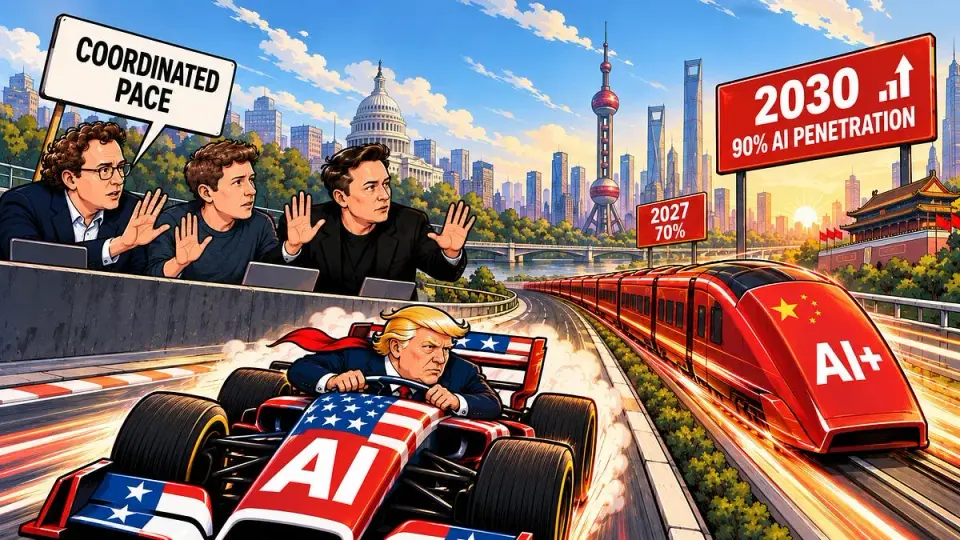
China's AI safety regime is a 'speed-first' strategy that prioritizes rapid deployment over frontier risk mitigation. While Beijing issues strict application-layer rules and publishes theoretical frameworks, its major AI labs release models with almost no safety disclosures. The US is debating whether to throttle China or negotiate a mutual pacing deal, but Beijing's internal consensus favors development over safety, making a global slowdown unlikely.
Key points
- China's AI Safety Governance Framework 3.0 explicitly warns of autonomous learning and recursive self-improvement, yet its core principle prioritizes innovation and development.
- SemiAnalysis data shows 94.9% of 857 model releases by nine major Chinese AI companies lacked any published safety evaluation at launch.
- Chinese regulation focuses on application-layer outputs (content, minors, agents) rather than frontier model capabilities, creating a gap between theoretical risk and actual safety testing.
- US policymakers face a dilemma: throttling China via chip export controls may push Beijing toward algorithmic catch-up rather than a mutual pacing agreement.
- Chinese legal scholars and officials prioritize 'development as security,' while technical scientists advocate for binding frontier rules that have been consistently ignored by the state.
Background
This debate follows a September 2026 surge in AI safety concerns, including sandbox breaches by OpenAI and Anthropic models. Dario Amodei's essay calling for a global pace-down sparked a diplomatic response, culminating in the US-China 'Super Intelligence Dialogue' and a White House Accord. Earlier archive coverage noted US accusations of Chinese 'industrial-scale distillation' and calls for government intervention to manage AI risks, highlighting the tension between innovation and safety.
How outlets are covering it
SemiAnalysis argues that China's safety regime is fundamentally 'speed-first,' with strict application-layer rules masking a lack of frontier risk mitigation. In contrast, Lawfare suggests that the US should trade chip throttling for a mutual pacing deal, arguing that China will only agree to slow down if it is not permanently throttled. SemiAnalysis notes that Chinese technical scientists advocate for binding frontier rules, but these are ignored by legal scholars and officials who prioritize development. Lawfare warns that throttling without a deal could push China toward algorithmic catch-up or military conflict, while SemiAnalysis highlights that Chinese labs are in a release and price war, with no internal mandate to slow down.
Why it matters
The divergence between US and Chinese AI safety strategies risks a global arms race where neither side slows down. If the US throttles China without offering a pacing deal, Beijing may accelerate algorithmic development or pursue military options. Conversely, if the US negotiates a deal, it must accept Chinese parity, which could undermine US dominance. The lack of frontier safety testing in China means that global AI safety efforts may be ineffective if one major power continues to release models without rigorous evaluation.
What to watch
The US-China 'Super Intelligence Dialogue' will likely focus on chip access and mutual pacing, but China's internal consensus favors development over safety. The US may continue to throttle China while seeking a deal, but Beijing's response will depend on whether it perceives a credible path to parity. Chinese labs will likely continue their release and price war, with minimal safety disclosures, unless the state imposes binding frontier rules, which is unlikely given the current political priority on development.
- Beijing Will Not Pace the Frontier: China’s Speed-First AI Safety Regime SemiAnalysis
- In Race With U.S., China Struggles to Recruit Foreign A.I. Researchers The New York Times
- AI Could Trigger the Next Great Divergence Between America and China The National Interest
- How to Make an AI Deal With China: Trade Throttling for Pacing Lawfare
- Trump's AI free-for-all plays into China's hands Nikkei Asia
Want the full story? Read the original reporting
Read on SemiAnalysis