
White House AI Summit Excludes Apple Amid Midterm Political Pressure
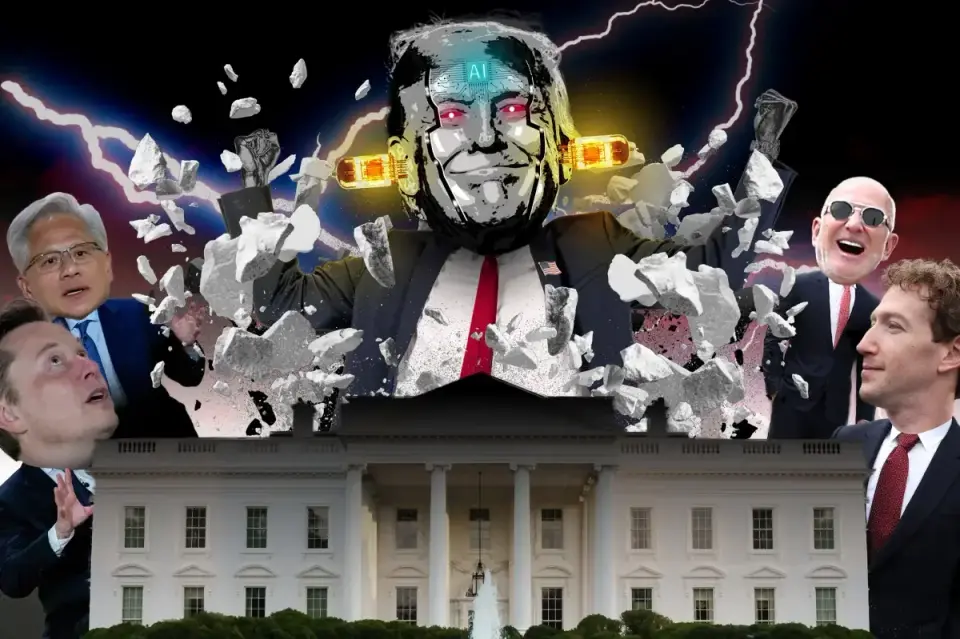
President Trump hosted a high-level AI summit at the White House to address midterm political concerns, resulting in a new industry safety accord. While major tech leaders signed the agreement, Apple was notably absent, sparking debate over its role in frontier AI development.
Key points
- The White House hosted a lunch meeting with major AI executives, including Elon Musk, Jensen Huang, and Mark Zuckerberg, to discuss AI policy and safety.
- The meeting was driven by political concerns, specifically House Speaker Mike Johnson’s fears that AI-related issues are hurting GOP midterm prospects.
- Participants signed an accord committing to safety measures, reflecting a push for self-regulation with government oversight, similar to the financial sector model.
- Apple was excluded from the meeting, with CNBC noting its absence due to its focus on efficient, on-device models rather than frontier AI development.
- The event follows recent White House initiatives, including the appointment of an AI Czar and rejection of global oversight, aimed at maintaining U.S. dominance over China.
Background
This summit follows a series of White House actions in September 2026, including the formation of an 'AI Force' and the appointment of David Sacks as AI Czar. Trump had previously rejected global AI oversight at the United Nations, emphasizing U.S. leadership and criticizing international regulations as potential obstacles to growth. The current meeting aligns with these efforts to balance innovation with political stability ahead of the 2026 midterms.
How outlets are covering it
The New York Post frames the summit as a political maneuver to address GOP midterm vulnerabilities, highlighting concerns about AI's uneven economic benefits and public backlash against data centers. CNBC focuses on Apple's exclusion, arguing that the meeting targeted companies at the frontier of model development, while Apple's smaller, efficient models and lack of public stance on AI safety made it a less relevant participant. Both sources agree on the political motivation but differ in emphasis: the Post stresses the regulatory framework's political necessity, while CNBC highlights the technical and strategic reasons for Apple's absence.
Why it matters
The summit signals a shift toward self-regulation in AI, potentially influencing future policy and industry practices. The exclusion of Apple raises questions about the definition of 'frontier' AI and its implications for companies not at the forefront of model development. The political dimension underscores the growing intersection of technology and electoral strategy, with AI becoming a key issue in the 2026 midterms.
What to watch
The signed accord may lead to new regulatory frameworks, potentially modeled on self-regulation with government oversight. The political impact on the 2026 midterms will be closely monitored, particularly regarding public sentiment on AI infrastructure and economic benefits. Apple's absence may prompt further debate on its role in AI policy and its future engagement with the White House.
- Here’s the real reason President Trump invited all those AI moguls to lunch this week New York Post
- Trump, Big AI go all-in together Yahoo
- Slovenia’s .si domain sees a surge in registrations after Trump’s ‘super intelligence’ order TechCrunch
- Here’s The White House’s 308-Word AI ‘Accord’ In Full—Including Misspelling Forbes
- Trump’s AI lunch included every major tech company. Except Apple CNBC
Want the full story? Read the original reporting
Read on New York Post