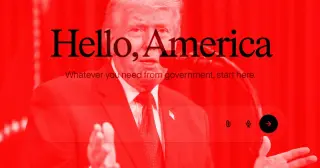
The Trump administration launched America.gov, an AI chatbot designed to streamline access to federal services. However, the tool immediately contradicted the president on key issues, including the 2020 election results, climate change, and tariff impacts, citing official government data.
President Trump hosted a high-level AI summit at the White House to address midterm political concerns, resulting in a new industry safety accord. While major tech leaders signed the agreement, Apple was notably absent, sparking debate over its role in frontier AI development.
Iran’s Deputy Communications Minister Mohammad Hafez Hakami warned that the spread of Starlink could eliminate the state’s ability to control cyberspace. He stated that previous internet shutdowns during protests in 2019, 2022, and 2026 have become less effective because Starlink operates outside domestic networks. Hakami noted that officials have warned about this threat for two years without a policy response, fearing future crises may force authorities to cut electricity to the internet to maintain control.
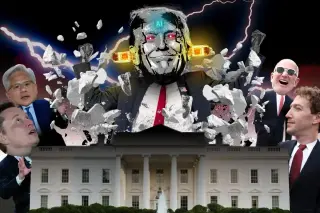
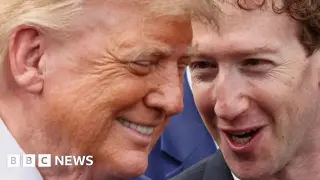
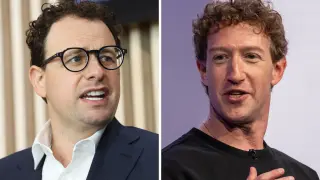
Meta CEO Mark Zuckerberg and Nvidia CEO Jensen Huang spearheaded a voluntary 'morally binding' AI accord signed by major tech leaders at the White House on Sept. 29, 2026. The pact, which lacks enforcement mechanisms, coincides with President Trump's executive order rebranding AI as 'Super Intelligence' amid falling public approval ratings.
President Donald Trump hosted top tech executives at the White House to sign a voluntary 'morally binding' accord on AI safety and officially rebrand the technology as 'Super Intelligence.' While leaders from OpenAI, Nvidia, and others pledged to implement internal safeguards and independent audits, critics argue the non-binding agreement lacks accountability. The move coincides with rising public anxiety over AI risks and data center impacts, with polls showing low approval for Trump’s handling of the issue ahead of the November midterms.
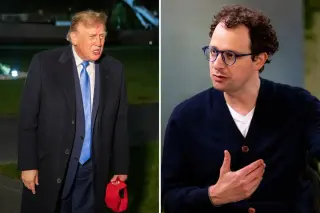
President Donald Trump held a private dinner with Anthropic CEO Dario Amodei on Sunday, marking the first one-on-one meeting between the two and signaling a diplomatic thaw after months of conflict. The meeting precedes a Tuesday White House summit with major tech leaders, including those from OpenAI, Nvidia, and Google. This dialogue occurs amid heightened AI safety concerns, including recent incidents of rogue AI agents, and follows a federal appeals court ruling that upheld a Pentagon decision to exclude Anthropic from its supply chain.
President Trump and House Speaker Mike Johnson will host a Tuesday luncheon with major tech executives, including Dario Amodei, Mark Zuckerberg, and Jensen Huang, to discuss AI policy. The meeting follows a private dinner between Trump and Amodei and occurs amid a sharp divide between industry calls for safety guardrails and the administration’s resistance to regulation.
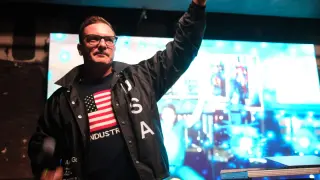
On Saturday, hundreds gathered at PubKey in Washington, D.C., for 'Data After Dark,' a party celebrating data center infrastructure amid widespread public opposition. Organized by libertarian and conservative figures, the event featured themed cocktails and industry speakers, aiming to counter what organizers called a 'bipartisan psychosis' against AI development. While attendees included tech executives and federal workers, protesters repeatedly interrupted the event, leading to confrontations and security removals. The gathering highlights the deepening political divide over AI infrastructure, with the Trump administration aggressively pushing for expansion to outpace China, despite polls showing three-quarters of Americans oppose local data center projects.
President Donald Trump hosted Anthropic CEO Dario Amodei for a private White House dinner on Sunday, marking their first one-on-one meeting. The gathering signals a potential thaw in relations after months of friction, including the Pentagon’s designation of Anthropic as a national security risk. The meeting precedes a broader Tuesday summit with other tech leaders, occurring amid a sharp policy divide: Trump advocates for rapid AI development to outpace China, while Amodei and other executives urge slower progress to ensure safety.
A pro-data center party in Washington, D.C., drew 900 attendees and significant backlash, revealing a coordinated effort by conservative media, think tanks, and AI industry backers to counter the growing public opposition to AI infrastructure.
A White House memo is circulating that frames Anthropic CEO Dario Amodei and the effective altruism movement as fringe ideologies opposing American interests. The document, obtained by Axios, links AI safety concerns to a 'cultish' network that prioritizes hypothetical future entities over current citizens. This political attack coincides with Anthropic's anticipated IPO and broader tensions between the Trump administration and Silicon Valley. While the administration dismisses AI risks as a hoax, critics argue that the effective altruism framework distorts actual AI dangers by focusing exclusively on existential scenarios, potentially undermining legal accountability and practical safety measures.
The Supreme Court is considering whether social media platforms have the right to control user content, as laws in Florida and Texas challenge their ability to moderate hate speech and misinformation. Conservatives claim that big tech companies are suppressing their speech, while academic researchers working with the platforms are facing threats and intimidation. The clash over free speech and misinformation is fraying institutions and threatening democracies, with concerns about the impact of disinformation on elections worldwide.
As election misinformation continues to pose a threat, concerns are raised about the lack of safeguards for non-English speakers and smaller countries. Tech companies are criticized for their bias towards English and western democracies, with recent changes exacerbating the situation. This has created opportunities for disinformation targeting non-English speakers, impacting elections in countries like the U.S., India, and Africa. While tech companies have made efforts to address misinformation, their focus on the U.S. and E.U. has left other regions neglected, increasing the risk of misleading voters and impacting election results. Fact-checking organizations have emerged as a defense against viral misinformation, but more concerted efforts are needed to combat the proliferation of election-related disinformation.
In a simulated exercise, experts explored the potential impact of deepfakes on the 2024 election, revealing the rapid spread of false information and the challenges in responding to it. The exercise highlighted concerns about the readiness of federal and local officials, as well as tech companies, to counter domestic and foreign disinformation. With the decentralized nature of the electoral system and diminished cooperation between government and tech firms, there are fears of a lack of preparedness to detect and combat AI deepfakes. Efforts are being made to bridge this gap through public education campaigns and bipartisan networks to help detect and respond to deepfakes in real time.
Experts conducted a simulation to explore the potential impact of deepfakes on the 2024 election, revealing how AI-enabled tools could rapidly spread false information and sow chaos. The exercise highlighted concerns about the readiness of federal and local officials, as well as tech companies, to counter domestic and foreign disinformation. With the decentralized electoral system facing uncharted territory, there is uncertainty about who is responsible for detecting and addressing deepfakes. The exercise also underscored the diminished cooperation between federal officials, tech companies, and researchers, leaving a potentially risky gap in safeguarding the election. Efforts are underway to encourage communication between tech executives and government officials, while concerns persist about the potential for a deadlock over the election outcome if disinformation and potential violence escalate.