
NTSB data reveals Amazon cargo pilots attempted aborted landing before Miami crash
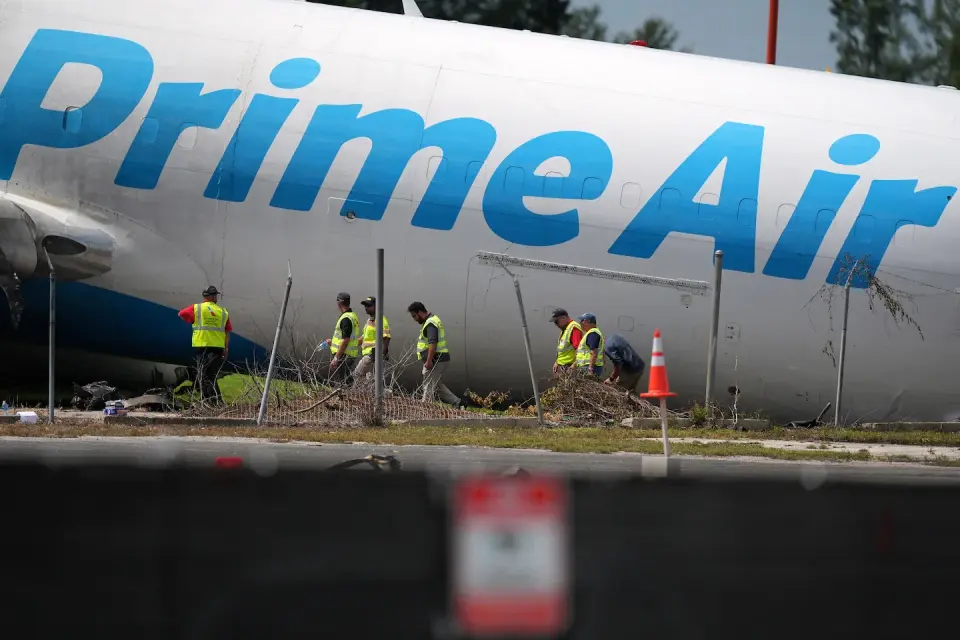
Federal investigators revealed that the pilots of the Amazon cargo plane involved in the deadly Miami crash briefly attempted a 'go-around' maneuver before the aircraft overshot the runway. Flight data shows the crew applied full engine power 15 seconds before impact, though it remains unclear why they aborted the landing attempt. The crash killed five ground workers and injured five others, prompting questions about runway safety systems and pilot decision-making during adverse weather.
Key points
- NTSB data indicates the Boeing 767-300 pilots applied full throttle 15 seconds before crashing, consistent with an aborted landing attempt.
- The aircraft overshot the runway by 1,300 feet, striking a cleaning van and an SUV, killing five people and injuring five.
- Investigators noted that speed brakes and thrust reversers were not deployed, and the plane landed without a standard flare maneuver.
- Weather factors, including a sudden tailwind and thunderstorms, are being examined as potential contributors to the unstable approach.
- Miami International Airport lacks an Engineered Material Arresting System (EMAS), a safety feature present at many other U.S. airports to stop runaway aircraft.
Background
The crash occurred on September 7, 2026, involving a 32-year-old Boeing 767-300 operated by 21 Air for Amazon. The aircraft had completed two prior flights that day before the fatal landing from San Juan, Puerto Rico. Previous reports confirmed the deaths of five employees from Professional Ocean Service Corp., a contract cleaning company, and injuries to the two pilots and three other ground personnel. The NTSB has been leading the investigation since the incident, with initial focus on flight data and scene documentation.
How outlets are covering it
The Washington Post and Sun Sentinel both highlight the 'go-around' maneuver, noting that flight data shows the pilots briefly considered aborting the landing. CNN provides more granular detail, stating that throttles were set to full power 15 seconds before impact, followed by a return to idle four seconds later. While all sources agree on the lack of thrust reverser use, CNN and Sun Sentinel emphasize the role of a sudden tailwind and thunderstorms in creating an unstable approach. Aviation experts cited by CNN and Sun Sentinel suggest a possible disagreement between pilots or a hesitation in executing the go-around, whereas the NTSB cautions against drawing conclusions until pilot interviews are completed. Additionally, CNN and Sun Sentinel note the absence of an EMAS system at Miami International Airport, a safety feature that could have stopped the plane, while the airport maintains it meets FAA buffer space requirements.
Why it matters
This incident underscores critical gaps in aviation safety infrastructure and pilot decision-making under adverse conditions. The lack of an EMAS system at a major hub like Miami International Airport raises questions about whether current FAA requirements are sufficient to prevent catastrophic runway excursions. Furthermore, the detailed flight data revealing a last-second abort attempt highlights the complexity of pilot responses to unstable approaches, potentially influencing future training protocols and regulatory standards for cargo operations. The tragedy also impacts the broader logistics sector, as Amazon relies heavily on such cargo flights, and may lead to increased scrutiny of third-party operators like 21 Air.
What to watch
The NTSB is scheduled to interview the two pilots, Jaime Felipe Silva Molina and Joseph Carol, on Wednesday to clarify the reasons behind the throttle changes and the aborted landing attempt. Investigators will continue analyzing the cockpit voice recorder and flight data recorder, which have been recovered and show no obvious damage. The agency aims to release the runway back to the airport as quickly as possible after documenting the scene, though a final report is not expected for at least a year. Miami International Airport has reopened a third runway, but full operations remain disrupted as investigators continue their work.
- Amazon cargo plane appeared to consider aborting landing before Miami crash, investigators say The Washington Post
- Amazon Cargo Jet Pilots Appeared to Try Aborting Landing, N.T.S.B. Investigation Indicates The New York Times
- Officials Reveal What Pilots Did Before Deadly Miami Runway Crash People.com
- Pilots applied full power seconds before Amazon cargo plane overran Miami runway, killing 5 in cleaning van, officials say cnn.com
- Cargo jet tried to abort unsteady landing before Miami crash that killed 5, flight data indicates Sun Sentinel
Want the full story? Read the original reporting
Read on The Washington Post