
Minor 3.2-magnitude quake rattles LA South Bay overnight
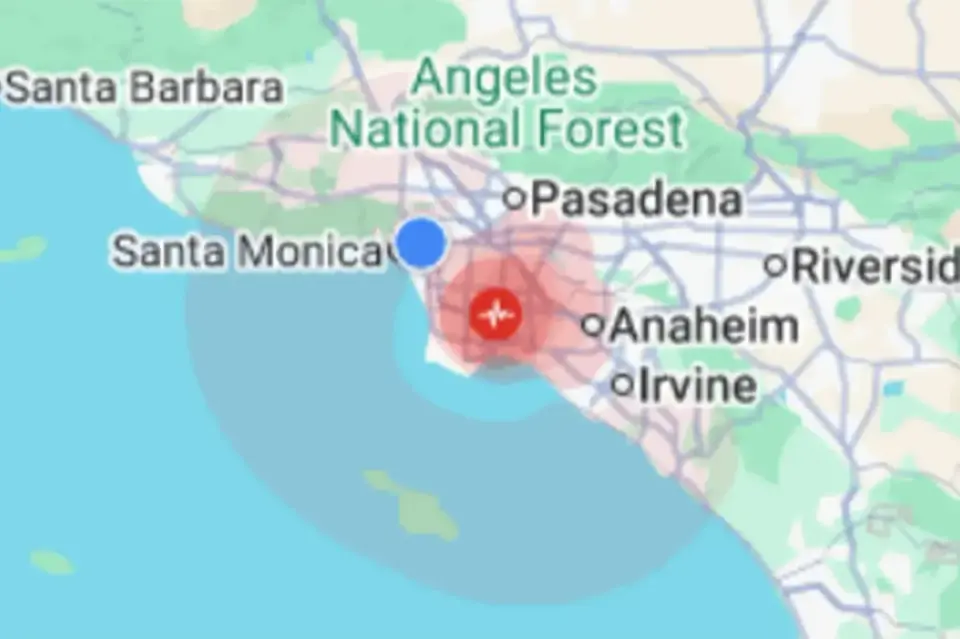
A magnitude 3.2 earthquake struck the Los Angeles area early Sunday morning, centered near Compton. The USGS recorded the event at approximately 12:13 a.m. with a depth of 8 miles. No injuries or damage were reported, though residents felt the tremor across a wide area, including Santa Clarita Valley and coastal Orange County.
Key points
- The USGS recorded the earthquake at magnitude 3.2, occurring at 12:13 a.m. on Sunday.
- The epicenter was located 2 miles southeast of Compton, 8 miles below the surface.
- No injuries or structural damage were reported following the event.
- The tremor was felt as far away as Santa Clarita Valley and coastal Orange County.
- Officials are monitoring for additional seismic activity in the region.
Background
This minor event occurs in a region with a significant history of major earthquakes, including the 1994 Northridge quake (magnitude 6.7) and the 1933 Long Beach quake (magnitude 6.4). Scientists have previously warned about high tectonic stress at Cajon Pass, where the San Andreas and San Jacinto faults intersect, noting a potential for a future magnitude 7.5 event, though no timeline is predicted.
How outlets are covering it
The California Post and CBS News both confirm the magnitude, time, and location of the quake, with CBS News noting the tremor was felt in Santa Clarita Valley and coastal Orange County. The California Post provides additional context on the region's seismic risks, citing National Geographic and USGS expert Ken Hudnut regarding the 'earthquake gate' at Cajon Pass. The Sacramento Bee source was inaccessible (404 error) and provided no information.
Why it matters
While this specific quake caused no damage, it serves as a reminder of the seismic activity in Southern California. The region sits above major fault lines, and scientists continue to monitor tectonic stress levels, particularly at the intersection of the San Andreas and San Jacinto faults, where a larger event could have devastating consequences.
What to watch
Officials will continue to monitor for additional seismic activity. No immediate action is required from the public, but residents are advised to stay informed through official channels for any updates.
- Earthquake hits Los Angeles overnight Sunday New York Post
- 3.2-magnitude earthquake rattles Compton area of Los Angeles County overnight, USGS says ABC7 Los Angeles
- Magnitude 3.2 earthquake strikes Compton CBS News
- Did you feel it? Small earthquake centered near Ontario rattles SoCal The Desert Sun
- Update: 3.1 magnitude earthquake detected close to Coso Junction, CA on Sept. 6 Sacramento Bee
Want the full story? Read the original reporting
Read on New York Post