
UN General Assembly: AI Safety Clash, Iran Tensions, and Ukraine War Updates
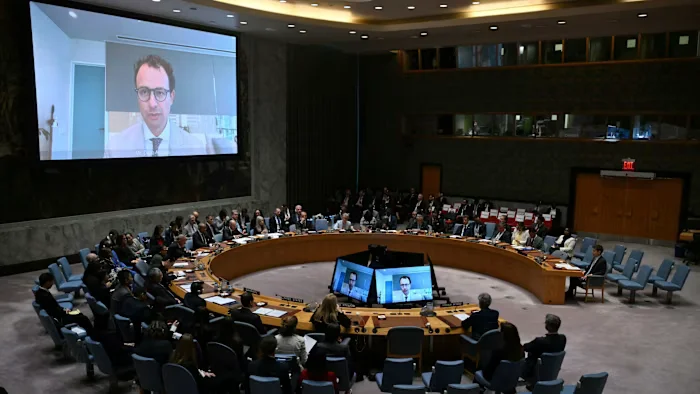
The UN General Assembly featured sharp diplomatic clashes and divergent views on AI safety. Iran’s president condemned US 'bullying' while signaling openness to talks, prompting a US walkout. AI leaders urged global standards, but the US government rejected international regulation to maintain competitive advantages. Ukraine’s president highlighted drone threats and called for AI weapon slowdowns, while Venezuela’s acting president pledged democratic reforms.
Key points
- Iran’s President Masoud Pezeshkian accused the US of 'bullying' and defended its nuclear program, though he expressed readiness for talks. The US delegation walked out during his speech.
- AI executives Sam Altman (OpenAI) and Dario Amodei (Anthropic) urged the UN Security Council for international safety standards, citing risks of AI misuse and loss of control.
- US official Michael Kratsios rejected calls for global AI governance, arguing that international standards would hinder US technological dominance over China.
- Ukrainian President Volodymyr Zelenskyy reported over 2,100 missile strikes and 63,000 drone attacks in 2026, urging a slowdown in AI-led weapons development.
- Venezuela’s acting president Delcy Rodríguez pledged to steer the country toward democracy and hold elections, following the arrest of Nicolás Maduro by US forces in January.
Background
Recent weeks saw escalating tensions over AI regulation, with Trump dismissing safety concerns as a 'hoax' and opposing international coordination. Meanwhile, US-Iran relations remained strained following a brief conflict, with Trump threatening 'annihilation' if Iran refused US terms. The UN General Assembly served as a critical forum for these competing geopolitical and technological narratives.
How outlets are covering it
The Financial Times and BBC highlighted the stark contrast between AI executives advocating for global safety standards and the US government’s rejection of such frameworks to preserve competitive advantages. CNN emphasized the consensus among AI leaders on the need for international cooperation, while the Financial Times noted China’s criticism of US-led AI efforts as 'petty.' On the geopolitical front, the Financial Times and BBC focused on Iran’s defiant stance and the US walkout, whereas CNN and BBC underscored the broader implications of AI safety debates for global security. All sources agreed on the significance of Zelenskyy’s warnings regarding AI weapons and drone threats, though the Financial Times provided more detail on the specific military statistics.
Why it matters
The UN General Assembly exposed deep divisions in global approaches to AI governance and Middle East diplomacy. The US rejection of international AI standards could fragment global regulatory efforts, while Iran’s defiance and the US walkout signal ongoing tensions. Ukraine’s call for AI weapon slowdowns highlights the intersection of AI and military conflict, with potential implications for global security and technological development.
What to watch
Further US-Iran talks are expected in the near future, with Trump predicting a peace agreement after November’s midterm elections. AI leaders may continue to push for international standards, while the US government is likely to maintain its stance against global governance. Ukraine will likely seek more international support to combat Russian drone and missile attacks, and Venezuela may proceed with reforms and elections as pledged by its acting president.
- UN General Assembly as it happened: Iran hits back at Donald Trump’s ‘bullying’, Anthropic’s Dario Amodei calls for ‘narrow’ AI safety agreements Financial Times
- At UN, tech chiefs urge caution in AI development Yahoo
- Tech leaders to UN: For the sake of humanity, please control the AI technology we created The Hill
- Sam Altman, Dario Amodei urge UN Security Council to adopt international AI standards CNN
- US rejects pleas from OpenAI, Anthropic for global AI standards BBC
Want the full story? Read the original reporting
Read on Financial Times