
Xi's VIP Welcome for Trump Masks Stalemate on Chips and Tariffs
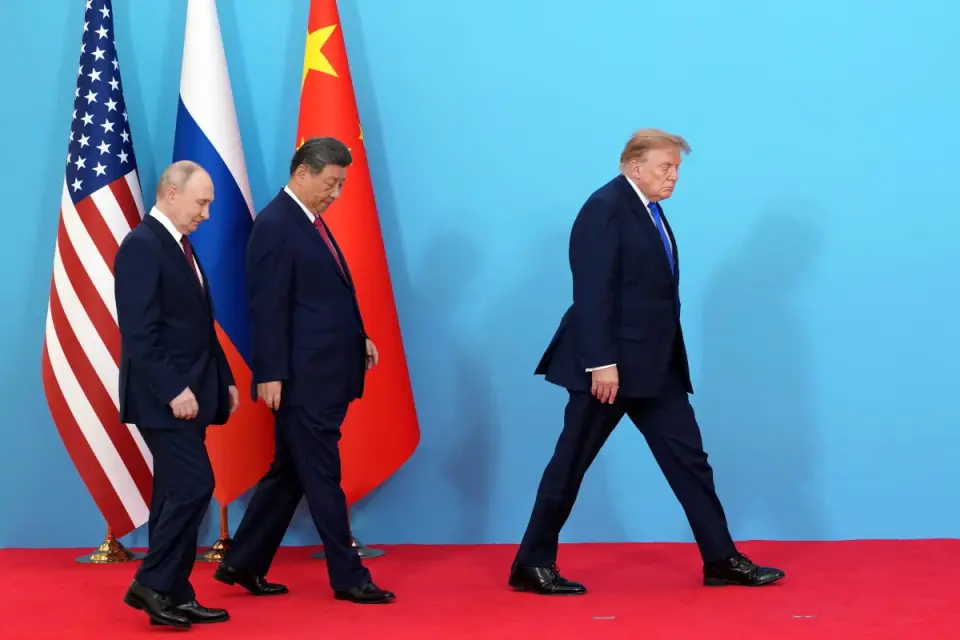
President Xi Jinping personally greeted Donald Trump at the APEC summit in Shenzhen, offering a warmer reception than for Vladimir Putin, but the leaders failed to resolve key disputes over semiconductors and tariffs. While the optics suggested a warming of US-China ties, substantive progress remained elusive, with no agreement to extend the current trade truce.
Key points
- Xi Jinping broke protocol by personally greeting Trump at the airport, including a hug and red-carpet welcome, while Putin was received by Xi's chief of staff, Cai Qi.
- The leaders held a trilateral meeting in Shenzhen, agreeing to support UN reforms and reduce nuclear risks, but produced no new substantive agreements.
- Negotiations on a 'Board of Trade' to lower tariffs on $30 billion in annual imports stalled, with no agreement to extend the current US-China trade truce, which expires on January 10, 2026.
- US officials expressed frustration over China's slow follow-through on rare earth mineral exports, a commitment made a year prior, while China criticized US limits on semiconductor exports.
- The US and China agreed to increase communication on AI and maintain dialogue on Taiwan, with Chinese state media describing the meeting as a step toward 'strategic stability'.
Background
This summit follows a year of escalating tensions between the US and China, particularly over semiconductor export controls and rare earth mineral restrictions. Previous coverage noted that Beijing's diplomatic protocol at the APEC summit signaled a clear hierarchy, favoring engagement with Washington over Moscow, while also highlighting friction with Japan. The current meeting is the third high-level encounter between Trump and Xi in 2026, occurring amid ongoing disputes over technology and trade.
How outlets are covering it
AP and Bloomberg emphasized the symbolic significance of Xi's personal welcome for Trump, interpreting it as a diplomatic calculation to manage Washington's relationship, while noting that analysts caution against reading too much into the optics. Yahoo Finance highlighted the lack of substantive progress, noting that the leaders sidestepped difficult topics like the Nvidia CEO controversy and failed to extend the trade truce. NPR focused on the political backlash in the US, with Rep. Gregory Meeks criticizing the summit for lacking a clear strategy and potentially undermining US alliances, while warning against Chinese espionage and intellectual property theft. The outlets diverged on the interpretation of the 'friendship' rhetoric: AP and Bloomberg saw it as a tool for stability, while Yahoo and NPR viewed it as masking unresolved economic and security conflicts.
Why it matters
The summit's outcome signals that despite high-level diplomatic gestures, the US and China remain locked in a structural economic standoff. The failure to extend the trade truce and resolve semiconductor disputes suggests that the 'special relationship' rhetoric does not yet translate into policy changes, with potential implications for global supply chains and geopolitical alliances.
What to watch
Trump and Xi are expected to meet again in December at the G20 Summit in Florida. The trade truce expires on January 10, 2026, with no current agreement to extend it. US officials may press China further on rare earth exports and semiconductor restrictions, while China may continue to criticize US 'Cold War thinking' in trade policy.
- The diplomatic choreography was delicate as China's Xi welcomed Putin and Trump to APEC AP News
- Stalemates over semiconductors and rare earth minerals appear little changed as Trump heads home from China Yahoo Finance
- Top House Democrat questions what Trump accomplished in Xi-Putin summit NPR
- Xi Seeks to Cement Stable Ties in Trump Talks Despite Chip Curbs Bloomberg.com
- Trump and Xi are set to meet in China amid tensions over AI. Here's what to know. CBS News
Want the full story? Read the original reporting
Read on AP News