
Copper Catalysts Enable Controlled Cycloadditions for Benzene Bioisosteres
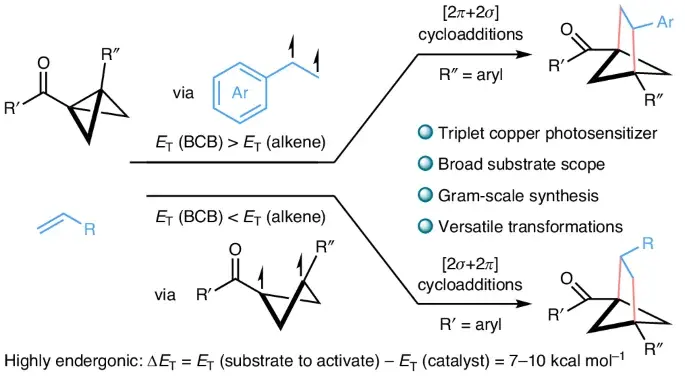
Researchers at Nature Chemistry report a new method for synthesizing bicyclo[2.1.1]hexanes, which serve as saturated bioisosteres for benzene rings. By using heteroleptic copper(I)-BINAP complexes with pyrazolylpyridine ligands, the team achieved controlled triplet photosensitization. This approach moderates radical generation, preventing polymerization side reactions and expanding the range of compatible substrates to include electron-deficient alkenes, enynes, and dienes. The method allows for the synthesis of complex polycyclic alkanes with aryl substituents at specific positions, offering a more versatile alternative to traditional noble-metal catalysts.
Key points
- Heteroleptic copper(I)-BINAP complexes with bidentate pyrazolylpyridine ligands act as effective triplet photosensitizers for cycloadditions between bicyclo[1.1.0]butanes and alkenes.
- The catalysts feature extended excited-state lifetimes that enable endergonic photosensitization, moderating radical generation and suppressing alkene polymerization.
- The method broadens substrate scope to include electron-deficient alkenes, enynes, dienes, and aliphatic alkenes, which were previously difficult to handle.
- Bicyclo[2.1.1]hexanes with aryl substituents at either the 3- or 2-position can be synthesized by activating either styrenes or bicyclo[1.1.0]butanes.
- The findings suggest copper photocatalysis can enhance the synthetic versatility of visible-light-driven energy transfer processes in organic synthesis.
Background
Recent advancements in energy transfer photocatalysis have focused on synthesizing multisubstituted polycyclic alkanes as benzene bioisosteres. However, traditional noble-metal and organo-photocatalysts often generate diradical intermediates too rapidly, leading to polymerization side reactions and limited functional-group tolerance. This study addresses these limitations by introducing copper-based catalysts with controlled excited-state dynamics.
Why it matters
This research provides a more controlled and versatile method for synthesizing benzene bioisosteres, which are crucial in drug design and lead optimization. By preventing unwanted polymerization and expanding substrate compatibility, copper photocatalysis offers a cost-effective and efficient alternative to noble-metal catalysts, potentially accelerating the development of new pharmaceutical compounds and materials.
What to watch
Further research will likely focus on optimizing the copper catalysts for broader applications in synthetic chemistry, exploring enantioselective variants, and integrating these methods into multi-step synthesis pathways for complex molecular architectures.
Want the full story? Read the original reporting
Read on Nature