
Dark-Matter-Free Galaxies DF2, DF4, and DF9 Challenge Modified Gravity Theories
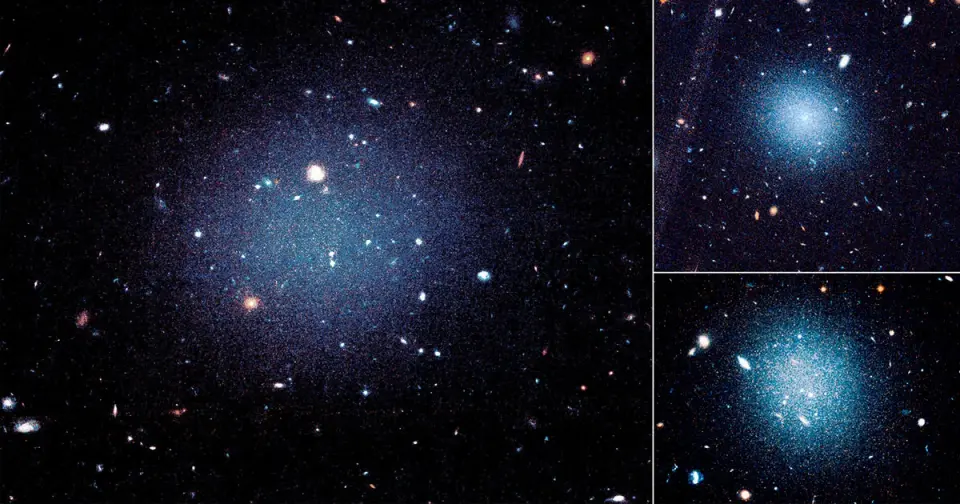
Three faint galaxies located 65 million light-years from Earth, designated DF2, DF4, and DF9, appear to lack dark matter, a finding that supports the existence of dark matter as a physical substance and undermines alternative gravity theories. A June 2026 study suggests these galaxies formed after an ancient collision stripped their dark matter, leaving only ordinary matter behind. While experts debate the exact mechanism of this separation, the absence of dark matter in these systems is difficult to explain without treating dark matter as a distinct, physical entity.
Key points
- Astronomers have identified three 'ghostly' galaxies, DF2, DF4, and DF9, which contain significantly less dark matter than expected, with DF2 having 400 times less than normal.
- A June 2026 paper in The Astrophysical Journal proposes that these galaxies formed after a collision between two regular galaxies, where ordinary matter clumped together while dark matter passed through unaffected.
- The existence of these dark-matter-deficient galaxies poses a significant challenge to Modified Newtonian Dynamics (MOND), which attempts to explain galactic behavior without invoking dark matter.
- While some experts question the collision mechanism due to a lack of expected fluid features, most agree that the absence of dark matter in these galaxies strongly implies it is a physical substance rather than a modification of gravity.
- The findings align with observations of the Bullet Cluster, where dark matter and ordinary matter also separated during a collision, further supporting the physical reality of dark matter.
Background
This development follows recent underground detector experiments, including the LUX-ZEPLIN (LZ) facility in South Dakota, which reported a single unexplained event in 2026 that could resemble a dark matter interaction, though it remains statistically inconclusive. Additionally, a September 2026 survey identified 50 faint dwarf galaxies around distant hosts, helping to refine models of dark matter distribution. These events highlight the ongoing effort to detect and understand dark matter, which constitutes 85% of all matter in the universe but has yet to be directly detected.
Why it matters
The discovery of galaxies devoid of dark matter provides strong indirect evidence that dark matter is a physical substance, not merely a mathematical adjustment to gravity. This finding narrows the search for dark matter's nature, potentially ruling out alternative theories like MOND and focusing efforts on identifying its particle composition, such as WIMPs or other candidates.
What to watch
Researchers will continue to study the formation mechanisms of DF2, DF4, and DF9 to confirm the collision hypothesis. Further observations may help distinguish between competing theories of dark matter's nature, while underground detectors like LZ will seek more definitive signals of dark matter particles. The debate over modified gravity theories may persist, but the physical evidence from these galaxies strengthens the case for dark matter as a tangible component of the universe.
Want the full story? Read the original reporting
Read on Quanta Magazine