
Jupiter’s foreshock transients reveal MeV electron acceleration and a universal shock-energy limit
TL;DR
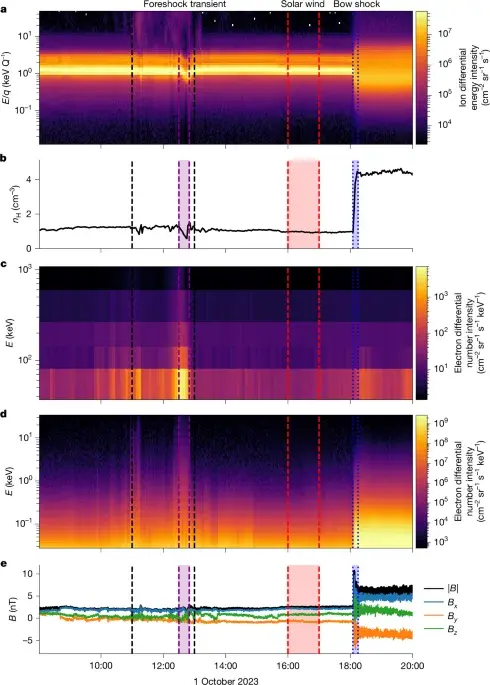
NASA's Juno observed relativistic electrons (>1 MeV) upstream of Jupiter's bow shock within a large-scale foreshock transient, showing efficient acceleration in the foreshock region. The authors propose an empirical scaling linking the acceleration region size to the global shock size (S), enabling a Hillas-limit–based maximum energy (Emax) prediction that matches Solar System data (Earth, Saturn, Jupiter) and is extrapolated to protostellar jets and supernova remnants, yielding energies from MeV up to tens of TeV. This work suggests foreshock-driven acceleration as a universal mechanism governing cosmic-ray energies across planetary to astrophysical shocks.
Topics:sciencespace-physics#astrophysical-shocks#electron-acceleration#foreshock-transient#hillas-criterion#jupiter#space-physics
Want the full story? Read the original reporting
Read on Nature