
Developer Simulates 166,000-Neuron Fruit Fly Brain in Minecraft Using New Connectome Data
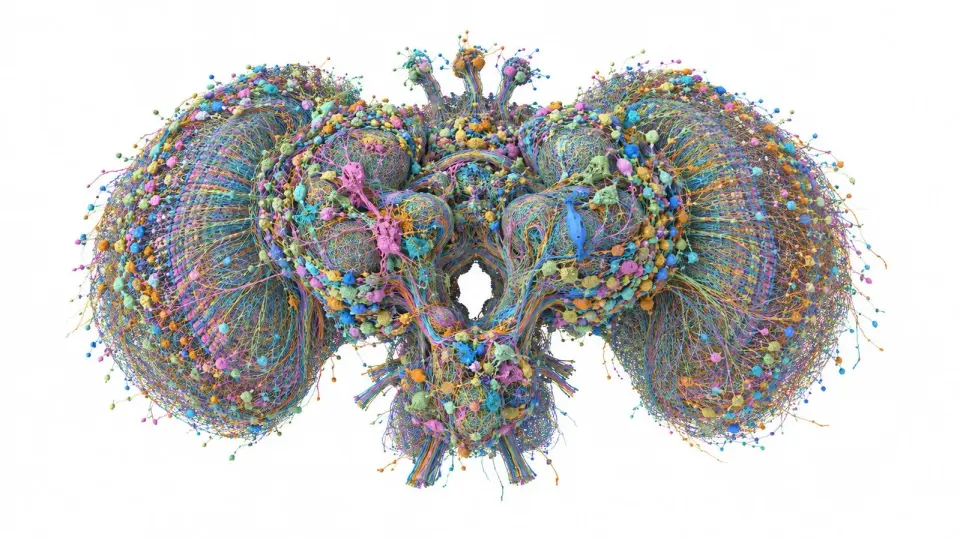
A developer named Evan Smith has successfully run a real-time simulation of the complete adult male fruit fly brain inside the video game Minecraft. This demonstration utilizes the newly released connectome, a comprehensive map of 166,000 neurons and their synaptic connections, produced by a collaboration between HHMI Janelia Research Campus and Google Research. The simulation translates in-game sensory inputs into neural activity, which drives the virtual fly’s movements, such as flying or grooming. While the project highlights the potential of AI to process complex biological data, the creator emphasizes that it is a simplified model rather than a living brain or evidence of consciousness. The release of this connectome follows the completion of a female fruit fly map earlier in 2026, enabling direct comparisons of sex-specific neural differences.
Key points
- Evan Smith used the MaleCNS v1.0 connectome to simulate 166,700 neurons in real-time within Minecraft.
- The simulation uses simplified rules for neural activity, with game events triggering actions like flight and grooming.
- The underlying connectome was mapped by HHMI Janelia and Google Research over a four-year period using electron microscopy and AI.
- The map includes 125 million synaptic connections and covers the brain, optic lobes, and ventral nerve cord.
- Smith clarified that the demo does not simulate consciousness or upload a living brain, but rather reconstructs neural connections.
Background
This development follows the completion of the first complete female fruit fly connectome earlier in 2026. The male connectome, published in Cell, represents the largest brain map by neuron count to date. Previous archive coverage noted that the female map contained approximately 140,000 neurons, while the male map includes 166,000. The new data allows researchers to compare 289 male-specific neurons, 71 female-specific neurons, and 138 shared neurons with different wiring. This project builds on earlier efforts to map the C. elegans worm and advances the field of connectomics, which aims to understand brain function through complete wiring diagrams.
How outlets are covering it
Ars Technica emphasizes the scientific rigor of the connectome, detailing the four-year process of slicing, imaging, and AI-assisted reconstruction that involved human proofreaders to verify the 125 million synapses. They highlight the discovery of sex-specific neural differences, noting that 90% of male-specific neurons express specific genes, while 10% do not. Google Research focuses on the technological breakthrough, describing the use of AI to stitch 2D electron microscope images into 3D reconstructions and the potential application of these methods to vertebrate brains like zebrafish and mice. X (formerly Twitter) users, including the developer Evan Smith, focus on the interactive nature of the Minecraft simulation, with reactions ranging from awe to unease regarding the implications of simulating biological processes. Some users joked about simulation theory, while others noted the limitations of the model as a simplified exploration rather than a living entity.
Why it matters
The release of the complete male fruit fly connectome provides a foundational resource for neuroscience, allowing researchers to trace sensory inputs to motor outputs with unprecedented detail. The Minecraft simulation demonstrates the practical application of this data, showing how AI can process complex neural networks in real-time. This work accelerates the field of connectomics, potentially leading to faster mapping of more complex brains, including those of vertebrates. Understanding the differences between male and female neural circuits may provide insights into behaviors such as mating and aggression, while the techniques developed could eventually aid in understanding human brain disorders and developing treatments for conditions like Alzheimer's and schizophrenia.
What to watch
Researchers will continue to use the male and female connectomes to study neural variability and sex-specific behaviors. The techniques developed for this project, including AI-powered reconstruction and human verification, are expected to be applied to larger brains, such as those of mice and fish. Google Research is working on mapping the larval zebrafish brain, which is one of the few vertebrate brains small enough to be mapped completely. Future studies will likely explore how the connectome can be combined with other data to understand neural plasticity and learning, potentially leading to new insights into brain function and disease.
- Fruit Fly Brain Simulated Inside Minecraft x.com
- Second complete map of a fruit fly brain completed Ars Technica
- Completing the connectome: How pursuing a map of the fly brain rewired neuroscience phys.org
- A connectomics milestone: Mapping the complete male fruit fly brain Google Research
- 5 amazing visuals show how the male fruit fly’s brain map is advancing neuroscience blog.google
Want the full story? Read the original reporting
Read on x.com