
Chinese Robots Shatter Human Sprint Records at Beijing Games
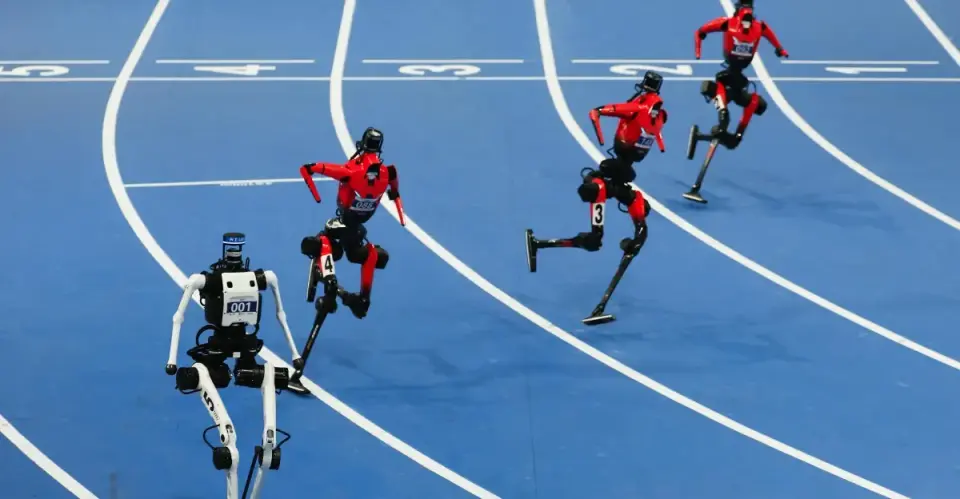
Chinese humanoid robots have officially surpassed Usain Bolt’s 100-meter world record at the World Humanoid Robot Games in Beijing. The Tiangong Ultra robot clocked 9.39 seconds, while the Honor-developed Lightning robot ran 9.47 seconds. The event, described as a robot Olympics, featured 2,056 participants from 16 countries and included record-breaking performances in the 400-meter dash and high jump.
Key points
- Tiangong Ultra, developed by the Beijing Humanoid Robot Innovation Center, completed the 100-meter dash in 9.39 seconds, beating Bolt’s 2009 record of 9.58 seconds.
- The Honor-developed Lightning robot followed with a time of 9.47 seconds in the same preliminary heat.
- Tiangong Ultra also broke the 400-meter world record, finishing in 38.16 seconds compared to Wayde van Niekerk’s 2016 human record of 43.03 seconds.
- The World Humanoid Robot Games, launched in 2025, attracted 2,056 robots from 16 countries for events including sprinting, jumping, football, and boxing.
- Videos show robots colliding with crash pads after finishing, as they lack the ability to decelerate smoothly, often requiring recovery on stretchers.
Background
This development follows earlier reports from August 2026 indicating that Chinese robotics firms like Honor and Unitree have been aggressively pushing speed limits in humanoid machines. Previous coverage noted that Honor’s Lightning robot had already achieved a 9.32-second 100-meter time and won a half-marathon, while Unitree unveiled a 'Superman' model claiming speeds exceeding Bolt’s pace. These milestones highlight China’s rapid advancement in bipedal robotics, though experts caution that mass deployment remains years away.
How outlets are covering it
The Verge emphasizes the spectacle and physical fragility of the robots, noting that they often crash into walls after finishing and are carried away on stretchers. AP News focuses on the breadth of the event, highlighting diverse activities like soccer and record-setting performances across multiple disciplines. Both sources agree on the record-breaking times but differ in tone: The Verge frames the event as a mix of amusement and unease due to the robots' bizarre movement, while AP News presents it as a significant showcase of technological progress.
Why it matters
These achievements mark a pivotal moment in robotics, demonstrating that humanoid machines can now outperform human athletes in sprinting. This signals a shift in the capabilities of bipedal robots, moving from basic locomotion to high-performance athletics. It also underscores China’s strategic push to lead in AI and robotics applications, potentially influencing future industrial and service sector deployments.
What to watch
Expect further advancements in humanoid robot speed and agility as companies like Honor and Beijing Humanoid Robot Innovation Center continue to refine their designs. The success at the World Humanoid Robot Games may accelerate investment in robotics, though real-world deployment challenges remain. Future events may see even more record-breaking performances and expanded categories.
- Humanoid robots smash Usain Bolt’s 100-meter record The Verge
- China will struggle to make money from humanoid robots The Economist
- A Chinese Robot Beat Usain Bolt’s 100-Meter Record. Should We Be Impressed? The New York Times
- Robots can outrun humans, but can they plug in a cable? Reuters
- Humanoid robots sprint, play soccer and set records at Beijing games, in photos AP News
Want the full story? Read the original reporting
Read on The Verge