
Sony Unveils $80,000 RIALTO 65: A Modular 9.6K 65mm Sensor for VENICE 2
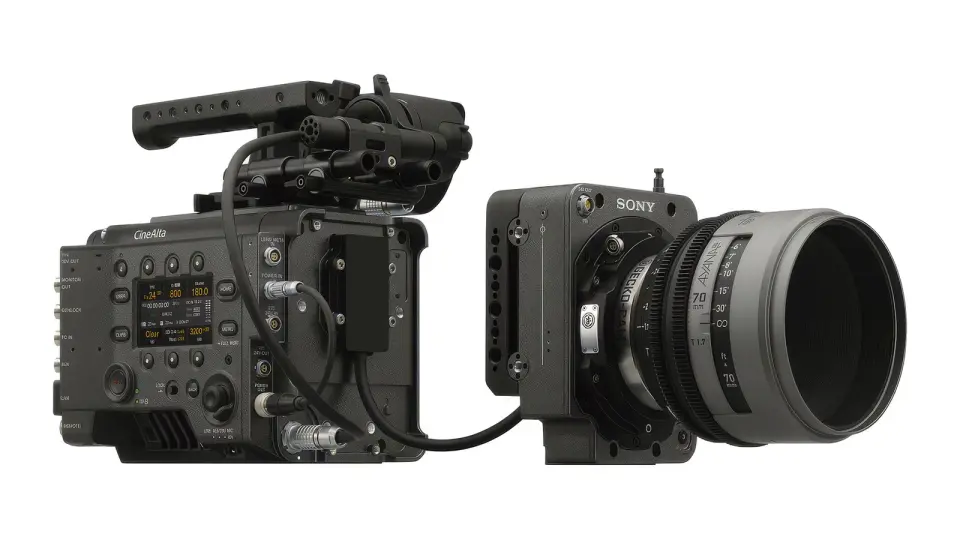
Sony has officially announced the RIALTO 65, a modular 65mm camera extension for the VENICE 2 system. Priced at $80,000, the 1.5kg head features a 9.6K sensor with a 1.5:1 aspect ratio and records 16-bit X-OCN internally. It is available in the first half of 2027.
Key points
- The RIALTO 65 (CBK-6510XS) costs $80,000 and requires a VENICE 2 body with firmware 6.00 or later.
- It features a 53.75 x 35.83mm sensor, approximately 2.2 times larger than full-frame, with a 1.5:1 aspect ratio.
- The system supports 9.6K Open Gate and 9.6K 2.20:1 readout modes, with future firmware adding 17:9 and Super 35 modes.
- It offers dual base ISOs of 2500 and 10000, providing over 15 stops of latitude at ISO 2500.
- The 1.5kg head can be used in 'Extension Mode' via a 4.5m or optional 12m cable, or 'Studio Mode' attached directly to the body.
- It records 16-bit X-OCN internally using the VENICE 2's existing AXS cards and CineAlta color science.
Background
Sony first revealed the RIALTO 65 as a development project in June 2026 at CineGear, leaving key specifications like price and resolution unconfirmed. The new system builds on Sony's modular approach to the VENICE 2, which previously offered interchangeable sensor blocks. This launch positions Sony to compete directly with ARRI's ALEXA 65 and 265 in the large-format digital cinema market, which has been dominated by ARRI for several years. The announcement follows recent updates to Sony's cinema lineup, including the FX5 and new sensor technologies, reinforcing their strategy of extending existing platforms rather than launching entirely new bodies.
How outlets are covering it
CineD emphasizes the strategic advantage of the modular design, noting that rental houses can upgrade existing VENICE 2 packages without new bodies. They highlight the 1.5:1 aspect ratio as a key differentiator from ARRI's wider 2.1:1 format, beneficial for anamorphic and reframing. Newsshooter provides detailed technical specs, including frame rate limitations (24p for 9.6K 3:2, 29.97p for 9.6K 2.20:1) and future firmware plans. Digital Camera World focuses on the $80,000 price point and shared sample footage, noting the low-light capabilities demonstrated by cinematographer Łukasz Żal. Y.M.Cinema Magazine confirms the pricing and highlights the dual base ISOs, particularly the ISO 10000 option for low-light flexibility. All sources agree on the first-half 2027 availability and the core specifications, but differ in emphasis: CineD on workflow integration, Newsshooter on technical limitations, and Digital Camera World on market positioning and price.
Why it matters
The RIALTO 65 democratizes 65mm cinematography by making it accessible through existing VENICE 2 investments, reducing the barrier to entry for high-end productions. Its modular design allows for versatile shooting in confined spaces, handheld, or vehicle rigs, expanding the creative possibilities of large-format cinema. The $80,000 price, while high, is significantly lower than purchasing a new dedicated 65mm camera body, making it a cost-effective upgrade for rental houses and studios. This move intensifies competition in the large-format market, challenging ARRI's dominance and pushing the industry toward more flexible, modular camera systems.
What to watch
Sony will release the RIALTO 65 in the first half of 2027. Future firmware updates are expected to add 9.6K 17:9, 6.4K 3:2, and 4.3K 17:9 readout modes. CineD plans to publish a lab test and interview video from the Pinewood Studios event, focusing on rolling shutter performance and sensor quality. The market will likely see increased adoption of 65mm lenses, such as the ZEISS Panoptes 65 and Angénieux EZ 65, as productions adapt to the new sensor's capabilities. Sony may also announce additional third-party lens mount adapters and accessories in the coming months.
- Sony RIALTO 65 Announced – 65mm Camera Extension for VENICE 2, 9.6K Open Gate, 16-bit X-OCN CineD
- Sony RIALTO 65– 9.6K 65mm sensor with a 1.5:1 aspect ratio Newsshooter
- You probably can't afford Sony's 2.2x larger, 9.6K open-gate sensor – but you can watch the first footage Digital Camera World
- Sony Reveals the Price of Its 9.6K 65mm Cinema Camera System: $80,000 Y.M.Cinema Magazine
- Sony’s RIALTO 65 Camera Extension System for the VENICE 2 Gets New Launch Date and Info No Film School
Want the full story? Read the original reporting
Read on CineD