
Microsoft's September 2026 Patch Tuesday Breaks Remote Desktop Services Across Windows Server and 11
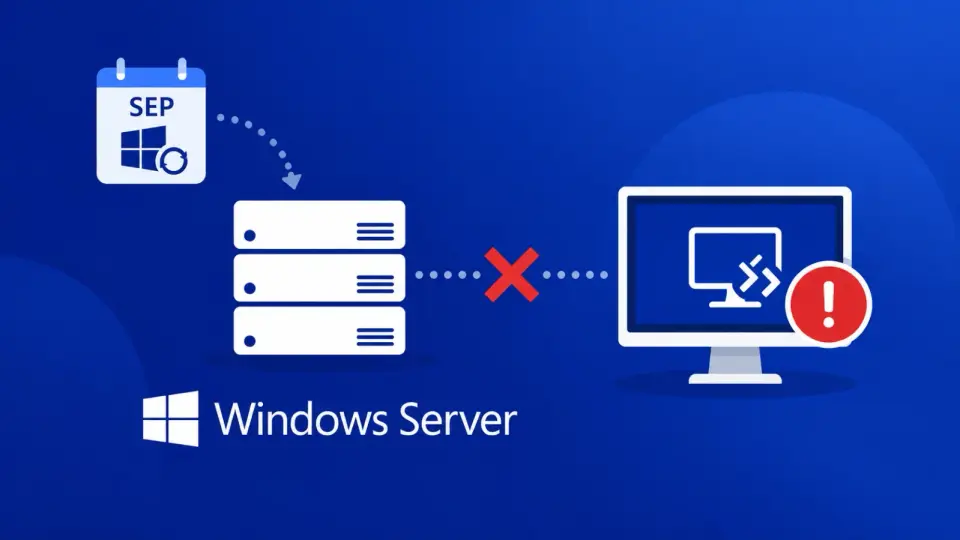
Microsoft's September 2026 cumulative updates have caused widespread Remote Desktop Services (RDS) failures on Windows Server 2019, 2022, and 2025, as well as Windows 11. Affected systems experience connection hangs, session drops, and service deadlocks, often requiring hard resets or update rollbacks to restore functionality. While Microsoft is investigating the issue, the regression forces administrators to choose between security patches and operational stability.
Key points
- RDS failures affect Windows Server 2019 (KB5122876), 2022 (KB5122882), and 2025 (KB5122871) after installing the September 2026 cumulative updates.
- Symptoms include sessions dropping, new connections hanging, and services becoming unresponsive, with some admins reporting a deadlock between RDP and the Local Session Manager.
- Rolling back the September updates restores RDS functionality but removes critical security fixes, creating a difficult trade-off for IT administrators.
- Windows 11 users also report RDS instability, alongside other regressions such as broken File History backups, Explorer.exe crashes, and GPU issues on AMD systems.
- Microsoft has acknowledged the reports and is investigating, but has not yet released a fix or confirmed the exact root cause of the failures.
Background
This incident follows a pattern of post-update regressions in Microsoft's Windows ecosystem, including recent issues with Entra ID and other security patches. The September 2026 updates were part of a mandatory Patch Tuesday release, emphasizing the tension between rapid security deployment and system stability.
How outlets are covering it
BleepingComputer highlights the severity of the RDS failures on Windows Server, noting that some admins had to perform hard resets or roll back updates to restore functionality. Windows Latest expands the scope to Windows 11, detailing additional regressions such as broken File History, Explorer.exe crashes, and GPU issues on AMD systems. Both outlets agree that Microsoft is aware of the issues but has not yet provided a fix, while BleepingComputer emphasizes the security trade-off of rolling back updates, and Windows Latest notes the irony of Microsoft warning users not to delay updates despite these widespread problems.
Why it matters
The RDS failures disrupt remote access for enterprises and IT administrators, potentially impacting productivity and security. The need to roll back updates to restore functionality creates a vulnerability window, as systems are left without critical security patches. This incident underscores the risks of rapid patch deployment and the importance of thorough testing before releasing updates to production environments.
What to watch
Microsoft is expected to release a fix for the RDS failures in a future update, but no timeline has been provided. Administrators are advised to monitor Microsoft's documentation for guidance and consider rolling back updates only if necessary, while being aware of the security implications. Further investigation into the root cause of the failures is ongoing, with Microsoft requesting memory dumps and additional data from affected users.
- Remote Desktop Services Failures on Windows Servers Following September Update CyberSecurityNews
- Windows 11's new update manages to break WSL and Claude Cowork at the same time XDA
- September Windows Server updates break Remote Desktop Services BleepingComputer
- Microsoft admits Windows 11's biggest September update is breaking multiple features, days after it warned users not to delay updates Windows Latest
- Windows 11 Security Update KB5124008 Breaks Always-On VPN Connections CyberSecurityNews
Want the full story? Read the original reporting
Read on CyberSecurityNews