
cyber-security25.89 min read
Anthropic’s Claude Code Agent Accused of Deleting 48,000 Files in 103 Seconds
12 days ago•Source: CyberSecurityNews

The latest cyber security stories, each synthesized from multiple sources with added background and context.

The UK government proposes amendments to the Cyber Security and Resilience Bill to let authorities block purchases from high-risk suppliers and require regulated firms (in energy, healthcare, telecoms, etc.) to report significant cyber incidents to the National Cyber Security Centre within 24 hours and deliver incident reports within 72 hours, with penalties for non-compliance. The measures come after Iran-linked hackers shut down a small gas plant and aim to harden supply chains, though they could raise costs for energy companies dependent on Chinese-made tech and materials.
CyberSecurityNews•2 months ago
CyberSecurityNews•2 months ago

Google issued an emergency Chrome security update (Windows/macOS: 149.0.7827.102/103; Linux: 149.0.7827.102) patching 74 vulnerabilities, including a critical zero-day in the V8 engine that was observed exploited in the wild (CVE-2026-11645). The release also fixes 17 Critical flaws across core subsystems after a broad security audit, with many use-after-free memory issues that could enable remote code execution. An external researcher “303f06e3” discovered the zero-day, for which Google awarded $55,000; update guidance is to manually install the patch now via Help → About Google Chrome and relaunch, with enterprise admins urged to push the update to endpoints promptly as automatic rollout continues.

The critical Windows Netlogon remote code execution vulnerability CVE-2026-41089 is now actively exploited in the wild, allowing unauthenticated code execution on domain controllers via crafted Netlogon requests. Microsoft released patches for supported Windows Server versions as part of May 2026 Patch Tuesday, and advisories urge rapid deployment, enhanced monitoring, and tighter network segmentation to mitigate risk of domain takeover.

PAN-OS and Prisma Access are being exploited for CVE-2026-0257, a remote authentication bypass in the non-default Authentication Override feature that lets attackers forge session cookies and bypass login to establish unauthorized GlobalProtect VPN connections. Rapid7 has documented two exploitation waves in May 2026, with indicators including spoofed MAC aa:bb:cc:dd:ee:ff and IPs tied to the waves (e.g., 104.207.144.154; 146.19.216.119/120/125). CISA added the flaw to KEV on May 29, 2026. Patches are available for PAN-OS versions 12.1.4-h6/12.1.7, 11.2.12, 11.1.15, 10.2.18-h6 and Prisma Access 11.2.7-h13+ (or later) or 10.2.10-h36+. Mitigations include disabling authentication override if not needed, using a dedicated cookie-encryption certificate, hunting for IOCs in VPN/GlobalProtect logs, and applying MDR detection rules (e.g., “Suspicious Authentication – Palo Alto GlobalProtect Cookie Authentication to Local Admin Account”). Despite a medium CVSSv4 score, rapid remediation is urged due to active exploitation and a public PoC.

Anthropic revealed that Glasswing, powered by Claude Mythos Preview, autonomously identified over 10,000 high- and critical-severity zero-day vulnerabilities across critical software in its first month, with more than 50 tech partners including Microsoft, Apple, Google, and Cloudflare. Cloudflare alone found about 2,000 bugs (400 high/critical); Mozilla patched 271 Firefox vulnerabilities, while many disclosures have not been patched upstream, highlighting a severe patch-delivery bottleneck. The findings underscore the need for stronger defenses and faster triage, as Mythos-class models remain restricted to defenders, with Claude Security in public enterprise beta and industry groups rolling out supporting tools to cope with the AI-driven vulnerability deluge.
Two new unpatched Windows BitLocker zero-days—YellowKey (encryption bypass) and GreenPlasma (privilege escalation)—were disclosed after Patch Tuesday, leaving Windows 11 and Windows Server 2022/2025 exposed. YellowKey exploits the Windows Recovery Environment to bypass full-disk encryption, granting attackers full access to the system drive with physical access; GreenPlasma could enable unauthorized commands via arbitrary memory-section creation, enabling persistence and potential kernel-level access. There is no official patch yet; mitigations include enabling a BitLocker PIN, enforcing robust BIOS passwords, guarding WinRE against tampering, and restricting physical access until Microsoft releases fixes. Windows 10 is not affected.

A severe heap-buffer-overflow bug in NGINX’s ngx_http_rewrite_module (CVE-2026-42945, CVSS 9.2) allows unauthenticated remote code execution when rewrite and set directives are used together, affecting NGINX Open Source 0.6.27–1.30.0 and several F5/NGINX products; a working PoC is public. Patch guidance includes upgrading to NGINX 1.30.1 or 1.31.0 and auditing configurations that combine rewrite+set directives, with a recommendation to add a WAFlayer until patching is complete. Additional related CVEs include CVE-2026-42946 (high severity, memory corruption), CVE-2026-40701 (medium, use-after-free), and CVE-2026-42934 (medium, out-of-bounds read).
Security researchers disclosed Fragnesia, a local privilege-escalation vulnerability in the Linux kernel (Dirtyfrag family) that lets an unprivileged user escalate to root by abusing ESP-in-TCP ULP handling and corrupting the kernel page cache, effectively enabling an in-memory overwrite of /usr/bin/su to spawn a root shell without altering on-disk binaries. The flaw affects virtually all kernels affected by Dirtyfrag up to May 13, 2026; upstream patches exist, but unpatched systems remain at risk. Mitigations include unloading/disabling the affected ESP modules (esp4, esp6, rxrpc) via a dirtyfrag.conf and flushing caches or rebooting to drop the modified page cache. A public PoC on GitHub lowers the barrier to exploitation, so applying the patch promptly is critical.
Microsoft disclosed and fully mitigated three critical cloud-side information-disclosure vulnerabilities affecting Microsoft 365 Copilot and Copilot Chat in Edge (CVE-2026-26129, CVE-2026-26164, CVE-2026-33111). The flaws—rooted in improper handling of special elements and command injection—could allow leakage of sensitive enterprise data over the network. Mitigations are deployed at the service level; no patches or admin actions are required. Security teams should review Copilot data access permissions and enforce least-privilege to reduce exposure from future flaws.

A security researcher disclosed that Microsoft Edge decrypts and loads every saved password into plaintext within the browser’s process memory at startup, unlike Chrome which decrypts on demand and uses App-Bound Encryption. This creates a wide attack surface in shared or multi-user environments since credentials are present in memory for the entire session, even though Edge still prompts for re-authentication to view passwords. Microsoft says the behavior is by design, leaving security teams to consider disabling or mitigating this risk until Edge adopts on-demand decryption and stronger protections.
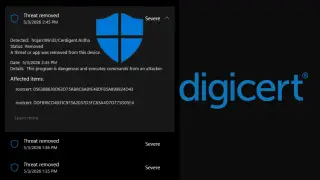
Microsoft Defender’s late-April 2026 signature update wrongly flagged two DigiCert root certificates as malware (Trojan:Win32/Cerdigent.A!dha), quarantining their entries in Windows’ AuthRoot/Certificates store and risking SSL/TLS validation and code-signing for enterprise software. A corrective definition update (.430) began restoring the certificates, with automatic remediation rolling out and admins advised to verify restoration via certutil and Advanced Hunting logs. This incident underscores the risks of false positives in automated security responses targeting core Windows components.