
Microsoft Teams to Launch Context-Aware Phishing Detection and Third-Party Deepfake Scanning in November
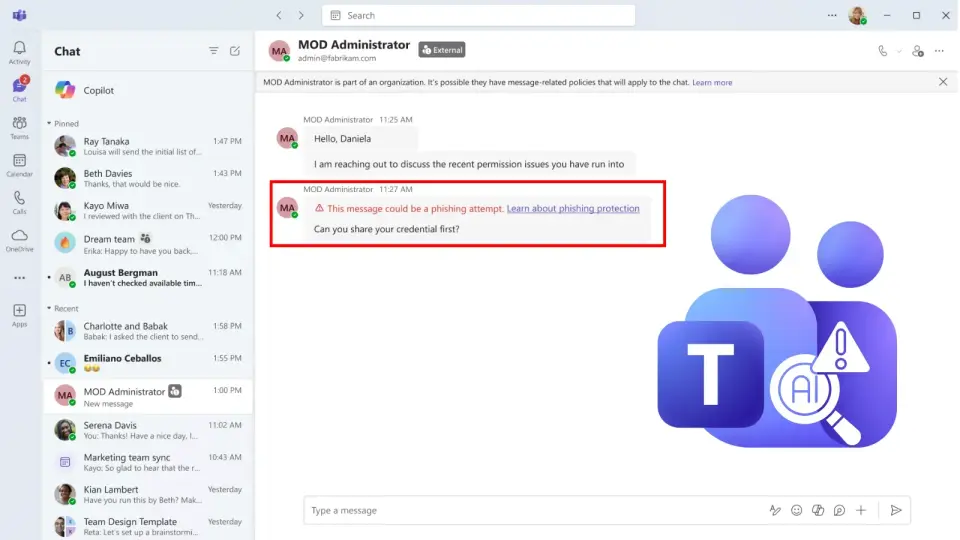
Microsoft is rolling out AI-powered phishing detection in Teams to identify social engineering attacks lacking malicious links, alongside third-party deepfake detection for meetings. The phishing feature targets external first-contact chats, while deepfake scanning relies on certified external providers to analyze audio and video for synthetic media.
Key points
- Microsoft announced AI phishing detection in Message Center notice MC1519866, targeting external first-contact chats to identify deceptive intent without relying on traditional indicators like malicious links.
- The phishing detection rollout begins with a targeted release in early November 2026, with worldwide general availability expected between early and mid-December 2026.
- Microsoft confirmed that the detection system analyzes conversation context but does not retain customer message content for model training or secondary uses, serving only security purposes.
- A separate feature, third-party synthetic media detection, will allow certified external providers to scan Teams meeting audio and video for deepfakes, starting with a targeted release in mid-November 2026.
- IT administrators do not need to configure the phishing detection feature, but they must select and deploy third-party providers for deepfake detection, granting specific permissions for detection bots to join meetings.
Background
This development follows Microsoft's broader security enhancements for Teams, including the August 2026 rollout of meeting protection policies to block external bots and the October 2026 announcement of QR code blurring for external senders. Earlier coverage in October 2026 highlighted the initial roadmap for AI phishing detection, emphasizing the shift toward context-aware security. Recent industry reports, such as Microsoft's Q2 2026 threat research, noted a tenfold increase in malicious Teams voice-call attempts compared to mid-2025, often involving impersonation of IT support personnel.
How outlets are covering it
Cyber Security News emphasizes the importance of context-aware detection for social engineering attacks that lack traditional malicious indicators, highlighting the risk of external contacts posing as support staff. BleepingComputer focuses on the privacy assurances, noting that Microsoft will not retain message content for AI training, and frames the update as part of a broader series of Teams security changes. Spiceworks highlights the growing threat of deepfake impersonation in workplace meetings, citing a September 2026 Gartner survey where 36% of cybersecurity leaders reported at least one deepfake-related social engineering incident. Windows Latest provides technical details on the third-party deepfake detection, noting that Microsoft has not named certified providers or disclosed data handling practices, and questions the accuracy and privacy implications of external bots analyzing meeting media.
Why it matters
The rollout addresses a critical gap in cybersecurity where traditional link-based detection fails against sophisticated social engineering and deepfake attacks. By analyzing conversation context and integrating third-party deepfake detection, Microsoft aims to protect organizations from credential theft and financial fraud. However, the reliance on third-party providers for deepfake detection raises questions about data privacy and accuracy, requiring IT teams to carefully evaluate provider terms and compliance documentation.
What to watch
Microsoft expects the targeted release of AI phishing detection to conclude by mid-November 2026, with worldwide general availability by mid-December 2026. The third-party deepfake detection feature is scheduled for a targeted release between mid-November and late November 2026. Microsoft will communicate further updates via the Message Center as the features progress. IT administrators are advised to review provider terms for deepfake detection and ensure employees verify unexpected support requests through trusted channels.
- Microsoft Teams to Use AI for Detecting Phishing Attacks Using Teams Conversations CyberSecurityNews
- Microsoft Teams to get AI-powered, context-aware phishing detection BleepingComputer
- How Microsoft Teams is tackling the growing threat of deepfakes Spiceworks
- Microsoft confirms Teams will let third-party tools scan your meetings for deepfakes from November Windows Latest
- Microsoft Teams Is Getting Simpler AI Controls and Meeting Templates Windows Report
Want the full story? Read the original reporting
Read on CyberSecurityNews