
Plex2Shell Chain Triggers Wild Attacks Deploying Miners and Proxy Backdoors
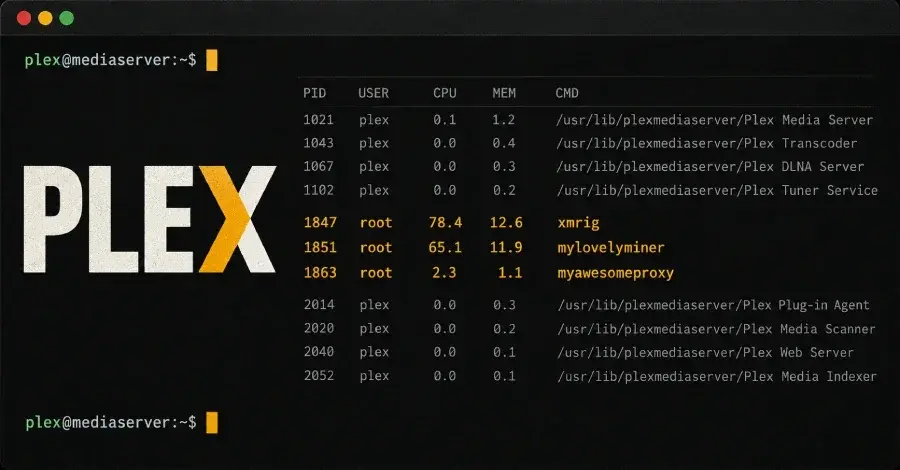
Threat actors are actively exploiting a chain of four vulnerabilities in Plex Media Server, known as Plex2Shell, to install cryptocurrency miners and residential proxy software. The attack chain, which enables unauthenticated remote code execution, was disclosed publicly on October 16, 2026, with exploitation observed within 24 hours. Although Plex patched the flaws in August 2026, unpatched instances remain vulnerable to these payloads, which include an XMRig miner and a stealthy Linux backdoor.
Key points
- Plex2Shell chains four CVEs (96652, 96654, 96655, 96656) to achieve unauthenticated remote code execution on Plex servers.
- Exploitation began one day after public disclosure on October 16, 2026, deploying 'mylovelyminer' and 'myawesomeproxy' payloads.
- The 'myawesomeproxy' artifact functions as a residential proxy, potentially allowing attackers to route traffic through compromised home networks.
- Plex patched the vulnerabilities in version 1.43.3.10861 on August 3, 2026, but exploitation continues against unpatched instances.
- The exploit chain was developed using AI-assisted techniques, highlighting the speed at which complex vulnerabilities can be weaponized.
Background
This incident follows a pattern of rapid exploitation of disclosed vulnerabilities, similar to the CLEANGULP malware campaign involving Chrome and Windows zero-days in September 2026. The use of AI to develop the Plex2Shell exploit chain mirrors recent trends where researchers leverage AI tools to accelerate vulnerability discovery and exploitation, as seen in the OpenAI breach incident earlier this year. Plex had previously urged users to update in September 2026, but the current wave of attacks indicates that a significant number of users have not yet applied the August patch.
How outlets are covering it
The Hacker News and SecurityWeek emphasize the technical details of the exploit chain and the specific payloads deployed, noting the rapid transition from disclosure to in-the-wild exploitation. Ars Technica highlights the role of AI in developing the exploit and the strategic value of residential proxies for accessing corporate networks. CyberSecurityNews focuses on the immediate threat of cryptominer deployment. All sources agree on the urgency of updating to version 1.43.3.10861 or later, though Ars Technica adds that restricting internet exposure is the safest long-term mitigation.
Why it matters
The active exploitation of Plex2Shell demonstrates the persistent risk of unpatched media servers, which are often exposed to the internet for remote access. The deployment of residential proxy software poses a broader threat to network security, as compromised home devices can be used to anonymize malicious traffic or access corporate resources. This incident underscores the need for immediate patching and robust network segmentation for consumer-grade software.
What to watch
Security researchers will continue to monitor for additional payloads and variations of the Plex2Shell exploit. Plex is expected to issue further advisories if new vulnerabilities are discovered. Users are advised to update their Plex Media Server to the latest version and consider restricting internet access to their servers to mitigate future risks.
- Hackers Exploit Plex2Shell Flaws to Install Crypto Miners and Linux Proxy Backdoor The Hacker News
- PSA: Patch your Plex media server before someone hacks it Ars Technica
- Plex2Shell Exploit Chain Weaponized Against Plex Servers Hours After Disclosure SecurityWeek
- Hackers Exploiting Plex Vulnerabilities in the Wild to Deploy Cryptominer Malware CyberSecurityNews
- Your Plex Server Could Be Mining Crypto for Hackers Gizmodo
Want the full story? Read the original reporting
Read on The Hacker News