
LLNL Laser Shocks Reveal Diamond Melts at 12,680°F and Floats on Its Own Melt
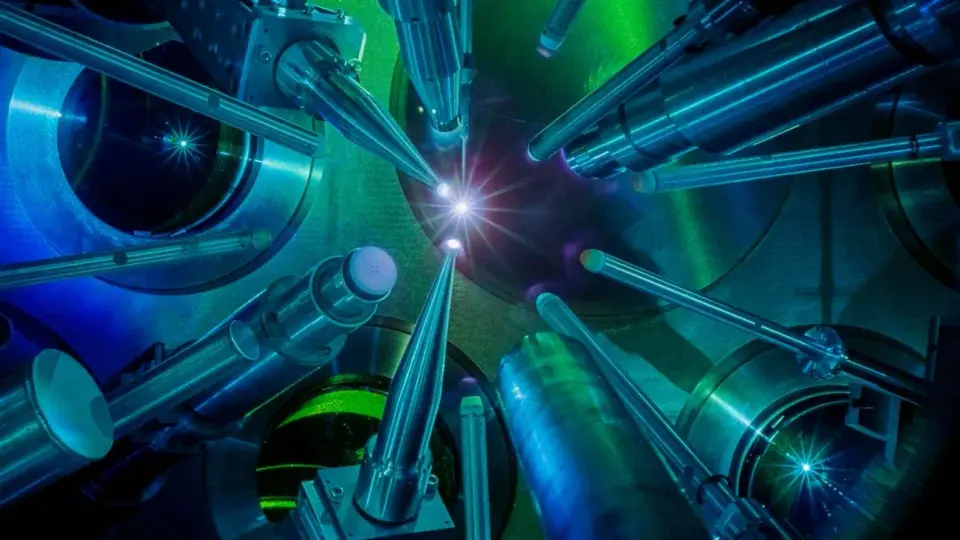
Lawrence Livermore National Laboratory (LLNL) researchers resolved a 20-year dispute over diamond's melting point by using the OMEGA laser to shock-compress tiny diamond samples. The team measured a melting temperature of 12,680°F (7,300 K) at 145 million psi, aligning experimental data with quantum simulations. A key finding is that solid diamond floats on its own liquid, similar to ice on water, indicating the liquid phase is denser. This data improves models for ice-giant interiors and suggests gentler initial shocks could enhance fusion energy gain at the National Ignition Facility (NIF).
Key points
- LLNL published findings in Nature Physics on August 13, confirming diamond melts at 12,680°F under 145 million psi, matching quantum simulations and correcting previous lab errors by over 1,000 degrees.
- Experiments used 60 ultraviolet beams from the OMEGA laser at the University of Rochester to flash-vaporize diamond surfaces, generating shock waves that melted samples within a billionth of a second.
- X-ray diffraction confirmed that diamond retains its crystal structure until melting, with no evidence of the denser BC8 phase predicted by theory, suggesting single shocks do not allow time for atomic rearrangement.
- The discovery that solid diamond floats on molten carbon implies the liquid is denser than the solid, a behavior analogous to ice floating on water, which was directly confirmed by diffraction data.
- These findings suggest that gentler initial shocks in NIF fusion capsules could melt diamond shells more effectively, potentially tripling energy gain by allowing greater fuel compression, provided other implosion factors are controlled.
Background
This study resolves a long-standing discrepancy between experimental measurements and theoretical predictions for diamond's melting point, which had persisted for two decades. Previous data, including earlier LLNL measurements, were off by more than 1,000 degrees. The findings build on earlier work by Jon Eggert, whose initial observations of diamond's floating behavior were now confirmed. The research also connects to broader efforts in high-pressure physics, such as the discovery of ice XXI in 2026, which refined understanding of water behavior under extreme conditions. Additionally, the data supports models of diamond rain in ice giants like Neptune and Uranus, where carbon may crystallize deep within the planets.
Why it matters
Accurate melting data for diamond is critical for inertial confinement fusion, where diamond capsules must melt smoothly to avoid flaws that could cause reactions to fail. The new findings suggest that gentler initial shocks could improve fusion efficiency, potentially tripling energy gain. Furthermore, the data provides concrete measurements for planetary scientists modeling the interiors of ice giants, replacing extrapolations with empirical evidence. This advances both energy technology and our understanding of extreme-condition materials in aerospace and defense applications.
What to watch
LLNL plans to conduct further diamond experiments at the National Ignition Facility (NIF) to observe how capsule materials behave under multiple shocks rather than a single one, though no date has been set. The lab is also monitoring developments in fusion technology, including a US startup that claims to grow hydrogen fuel layers in hours instead of days, and a New Jersey shop testing flat fusion magnets. These advancements may influence the timing and design of future diamond shock experiments.
Want the full story? Read the original reporting
Read on Autonocion.com