Tag

Planetary Science

All articles tagged with #planetary science

Jupiter’s lightning could be up to a million times stronger than Earth’s bolts
space16 days ago

Jupiter’s lightning could be up to a million times stronger than Earth’s bolts

A study using NASA’s Juno data suggests Jupiter’s lightning may be enormously more powerful than Earth’s—potentially up to a million times stronger. By analyzing the planet’s radio emissions rather than optical flashes and focusing on long-lived “stealth” storms in Jupiter’s belts, researchers estimated lightning pulses with power ranging from Earth-like bolts to far more powerful discharges. The findings, which consider Jupiter’s hydrogen-dominated atmosphere and towering storm clouds (up to ~62 miles tall), aim to explain why Jovian lightning is so energetic and were published in AGU Advances.

Hubble Sees Comet ATLAS Split into Four Fragments
science18 days ago

Hubble Sees Comet ATLAS Split into Four Fragments

NASA/ESA’s Hubble Space Telescope captured comet C/2025 K1 (ATLAS) breaking into four fragments just after its perihelion, each surrounded by its own coma. The near-simultaneous breakup provides a rare, nearly pristine sample to study the comet’s composition and the physics of fragmentation and dust-layer formation, offering insights into how icy bodies evolve in the solar system. Observations were made in early November 2025 from about 250 million miles away, and scientists highlighted the serendipitous timing as a reminder that unexpected results can drive breakthrough science.

Earth as Titan's classroom: how terrestrial analogs prep Dragonfly's mission
space-exploration23 days ago

Earth as Titan's classroom: how terrestrial analogs prep Dragonfly's mission

Earth hosts Titan-like processes—methane rain, hydrocarbon rivers, seas and Titan-inspired geomorphology—that scientists are using as terrestrial analogs to test instruments and hypotheses. A new arXiv paper argues that field analog research on Earth can ground-truth Titan studies and refine data interpretation ahead of NASA’s Dragonfly mission to Titan (targeting Selk Crater) in 2036, linking Earth geophysics to the exploration of Saturn’s moon.

Miranda's Hidden Ocean Reframes the Search for Life on Uranus' Moon
space1 month ago

Miranda's Hidden Ocean Reframes the Search for Life on Uranus' Moon

A Planetary Science Journal study reexamining Voyager 2 data suggests Miranda, a moon of Uranus, could have hosted a deep subsurface ocean (potentially ≥100 km) in the last 100–500 million years, with tidal heating possibly keeping liquid water inside. While conclusive evidence of life isn’t found, this makes Miranda a notable candidate in the broader search for extraterrestrial life and informs the Drake Equation’s life-fraction term.

Venus May Hide Kilometer-Wide Lava Tubes Beneath the Surface
space2 months ago

Venus May Hide Kilometer-Wide Lava Tubes Beneath the Surface

New modeling suggests Venus could harbor underground lava tubes up to about 1 kilometer wide, implying a vast subsurface network. Surface radar observations hint at ongoing volcanism, especially at Maat Mons and Idunn Mons, while simulations indicate explosive plumes could reach tens of kilometers into the atmosphere, informing future missions to study Venus's geology and atmospheric chemistry.

NASA Shrinks Planetary Science Advisory Groups Amid Budget Constraints
policy2 months ago

NASA Shrinks Planetary Science Advisory Groups Amid Budget Constraints

NASA will end funding for eight planetary science advisory groups by the end of April as part of a broader squeeze on advisory structures and a tight Planetary Science Division budget. The groups may continue to operate on their own, potentially under new names, with NASA offering limited support (e.g., travel for students). NASA also plans to replace multiple advisory bodies with a single all-discipline science advisory committee, reflecting a wider federal effort to reduce advisory panels.

Mars helps stabilize Earth's climate by taming its tilt, new simulations suggest
science2 months ago

Mars helps stabilize Earth's climate by taming its tilt, new simulations suggest

New simulations quantify Mars' gravitational influence on Earth, showing Mars helps stabilize Earth's axial tilt and orbital eccentricity over Milankovitch cycles, potentially shaping climate over hundreds of thousands to millions of years; removing Mars from the system causes major cycles to vanish, while increasing Mars' mass dampens tilt changes, suggesting Mars plays a stabilizing role in Earth's climate and could influence how we think about habitable worlds elsewhere.

Thin Ice, Hidden Lakes: Mars May Harbor Decades-Long Water Under Seasonal Ice
science2 months ago

Thin Ice, Hidden Lakes: Mars May Harbor Decades-Long Water Under Seasonal Ice

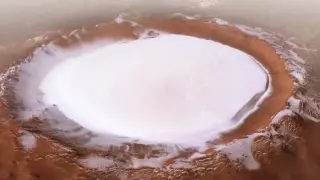
A new LakeM2ARS climate model shows ancient Martian lakes could endure for decades beneath thin, seasonal ice, insulating water enough to stay liquid in a cold, CO2-rich early Mars. By adapting Earth-based Proxy System Modeling, researchers ran 64 simulations across varied conditions, suggesting minimal ice can preserve lakes without leaving obvious glacial traces. If confirmed, this helps explain geological evidence of past water and prompts applying the model to other regions to reassess Mars’ habitability.