
Maker Tom Stanton Achieves Supersonic Speeds with a Modified Trebuchet Design
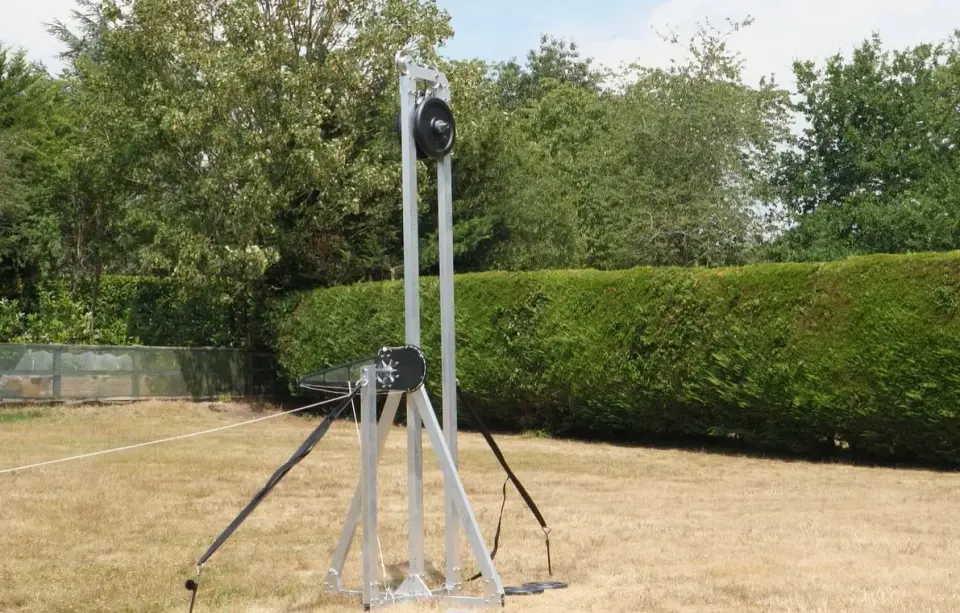
Maker Tom Stanton has successfully engineered a modified trebuchet capable of launching projectiles at supersonic speeds. By incorporating a rope-winding mechanism and a gearing system, the device overcomes the velocity limitations of traditional medieval siege engines. After multiple iterations to improve aerodynamics and efficiency, Stanton achieved a projectile velocity of 1,249 km/h, exceeding the speed of sound. The project demonstrates that while traditional trebuchets are limited by physics, modern mechanical adjustments can unlock extreme velocities for physics demonstrations.
Key points
- Stanton modified a traditional trebuchet by winding the projectile rope around the arm to force an additional pass, increasing velocity.
- A gearing system was added to use the dropping weight's energy more efficiently, though this required precise release timing.
- The release mechanism uses a latch inside a drum that triggers when enough rope is unwound from the counterweight.
- Initial tests with a 10 kg weight reached 528 km/h, improving to 634 km/h after aerodynamic redesigns.
- A 40 kg weight initially failed to reach supersonic speeds, achieving only 1,152 km/h due to component failure and low efficiency.
- The final successful test used a 40 kg weight and a 4 g projectile, reaching 1,249 km/h and breaking the sound barrier.
Background
Trebuchets are medieval siege engines that use a heavy counterweight to launch projectiles. While effective for their time, they were limited by the physics of their design, specifically the acceleration of the falling weight and the length of the arms. Modern makers have explored ways to improve these designs, with previous attempts by others using different mechanisms like rubber bands. Stanton's work builds on these concepts but focuses on a pure counterweight design to achieve supersonic speeds, a feat not previously accomplished with a traditional trebuchet structure.
Why it matters
This project highlights the potential of applying modern engineering principles to historical technologies. It demonstrates that even well-established mechanical systems can be pushed beyond their traditional limits through innovative design changes. For makers and engineers, it serves as a practical example of how understanding physics and aerodynamics can lead to significant performance improvements in mechanical systems. Additionally, it provides a fascinating real-world demonstration of the speed of sound and the challenges of achieving it with mechanical means.
What to watch
Stanton may continue to refine the design or explore other mechanical systems that can achieve high velocities. The success of this project could inspire further experiments in ballistics and mechanical engineering, potentially leading to new applications in fields like aerospace or materials testing. It also opens up discussions about the limits of mechanical energy transfer and the efficiency of different launch mechanisms.
Want the full story? Read the original reporting
Read on Hackaday