
Big Walk: A Co-op Puzzle Game Where Losing Your Friends Is the Main Event
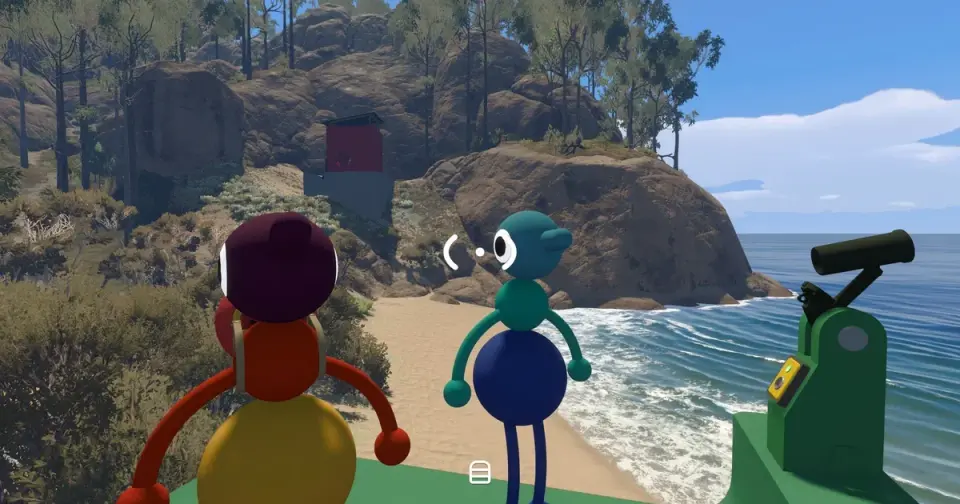
Big Walk, a new co-op puzzle game from House House, emphasizes the joy of reuniting with separated friends through tight proximity chat and environmental puzzles. It is a deliberate, hand-crafted alternative to procedurally generated 'friendslop' titles, requiring players to coordinate schedules and communication to progress through a meticulously designed Australian-inspired landscape.
Key points
- Big Walk is a multiplayer-only game for up to 12 players, developed by House House, the studio behind Untitled Goose Game.
- The game features a tight proximity chat radius, making accidental separation from friends a core mechanic rather than a bug.
- Unlike procedurally generated competitors, Big Walk offers a single, hand-crafted open world with fixed puzzles and a 20-hour playtime.
- Progress is gated by collecting 'doodahs' (red gourd-like objects) to unlock keys, requiring teamwork to solve environmental challenges.
- The game lacks random matchmaking, forcing players to coordinate real-world schedules to play together, as the save file is tied to the host.
Background
Big Walk arrives in the 'friendslop' genre, a term coined in 2025 to describe low-budget, chaotic co-op games like Peak and Lethal Company. While these titles often use procedural generation for replayability, Big Walk takes a different approach by focusing on a curated, slow-burn experience. The game was developed over several years, contrasting with the rapid development cycles of its competitors. It builds on House House's previous success with Untitled Goose Game, shifting from mischief to cooperative exploration and communication.
How outlets are covering it
Rock Paper Shotgun highlights the emotional resonance of being separated and reunited, comparing the experience to losing a SIM card in real life. They praise the game's 'slowburn' design and environmental puzzles but note that boulders can be 'sticky' during traversal. CBC emphasizes the game's elevation of the 'friendslop' genre by mixing emergent chaos with a meticulously crafted world, noting its potential as a game of the year. The Guardian focuses on the aesthetic beauty and the 'artform' of larking around with friends, though it criticizes the backtracking and walking mechanics as the least interesting parts. Aftermath offers a critical perspective on the game's multiplayer-only structure, arguing that the lack of random matchmaking and the requirement for synchronized schedules can be a significant barrier for players with busy lives, contrasting it with the flexibility of live-service games.
Why it matters
Big Walk challenges the current trend in multiplayer gaming by prioritizing deep, real-world social coordination over convenient, asynchronous play. Its success or failure could indicate a shift in how players value communal experiences in digital spaces, moving away from the 'attention-holding logic' of modern gaming toward more organic, childlike interactions. The game's design forces players to confront the logistical realities of friendship, making it a unique entry in a crowded market of co-op titles.
What to watch
Big Walk is available now on PC, Mac, Nintendo Switch 2, and PS5. Players will need to coordinate schedules with friends to progress through the game's 20-hour campaign. The game's reception will likely hinge on how well its demanding multiplayer structure resonates with audiences accustomed to more flexible online gaming experiences.
- Big Walk simulates the strange, childlike sensation of being unexpectedly separated from your friends, and the joy and relief of finding your way back Rock Paper Shotgun
- What is friendslop? Inside gaming's fastest-growing trend, including the newest hit Big Walk CBC
- Big Walk review – larking around with mates elevated to an artform The Guardian
- Big Walk's Hardest Puzzle Is Scheduling Aftermath
- The Best Metacritic-Scored Game Of 2026 Has Arrived forbes.com
Want the full story? Read the original reporting
Read on Rock Paper Shotgun